News, Rare Coin Articles, Reference Library
The $6 Million Coin: A Historic Moment for Rare Coins
Dec
Last week, the rare coin market delivered one of its most dramatic moments in modern history.
On December 11, an elite numismatic auction featuring some of the most important American coins ever offered culminated in a breathtaking result: a long-lost 1804 Silver Dollar sold for an astonishing $6 million.
In the days leading up to the sale, media estimates suggested the coin might reach $5 million. That figure proved conservative.
The 1804 dollar—often called the “King of American Coins”—is among the most coveted rarities ever produced by the U.S. Mint. For decades, professional numismatists believed only 15 examples existed. The discovery of this 16th specimen stunned the collecting world.
The coin was found in the private collection of James A. Stack, a lifelong collector devoted to preserving America’s numismatic heritage. Its precise path into his collection remains unknown, adding further intrigue to an already legendary coin.
Why the 1804 Dollar Is So Extraordinary
Although dated 1804, these dollars were actually struck in 1834–1835 during the presidency of Andrew Jackson. They were produced as diplomatic gifts for Asian rulers to facilitate trade and diplomacy.
There are three distinct classes:
Class I (8 known): Official diplomatic presentation pieces
Class II (1 known): A Mint experimental striking
Class III (7 known): Coins struck in 1858–1859 for favored collectors
The Stack specimen is the finest known Class III example, graded Proof-65 by PCGS. Its $6 million sale nearly tripled the prior Class III record of $2.3 million, set in 2009.
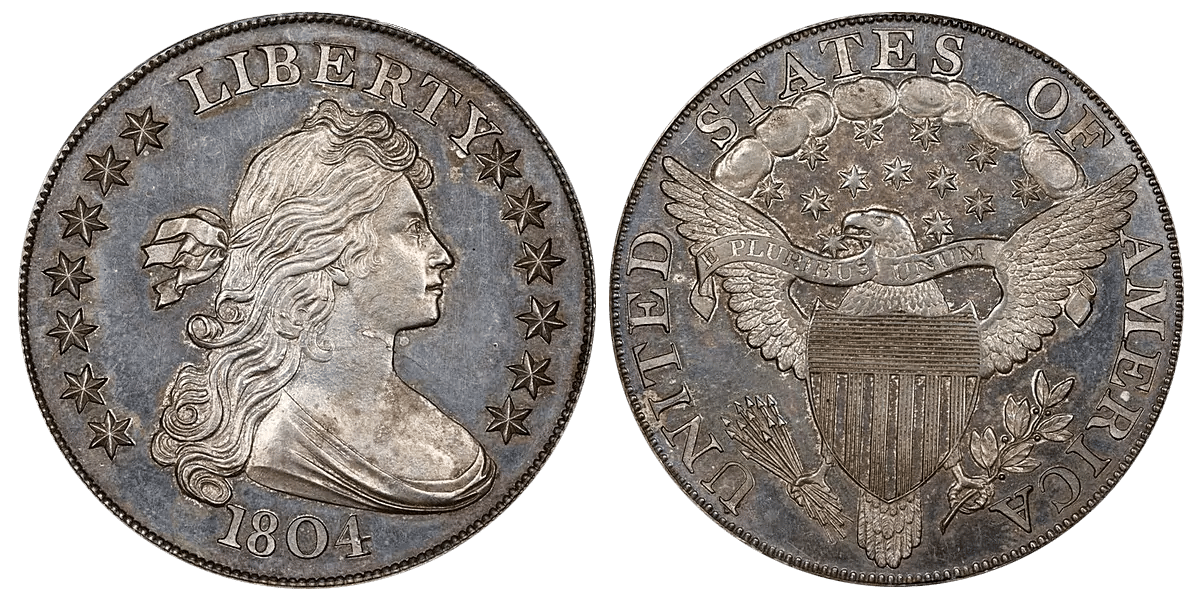
Only one 1804 dollar has ever sold for more: the famed Class I “Sultan of Muscat” specimen, which realized $7.68 million in 2021.
With this result, the Stack 1804 dollar now ranks as the ninth most valuable coin ever sold, underscoring the extraordinary demand for museum-quality American rarities.
Records Fall Across the Entire Auction
The strength of the market extended far beyond a single coin. The auction featured 54 lots, averaging $200,000 per coin, demonstrating remarkable depth across denominations and eras.
Highlights included:
1794 Silver Dollar (PCGS EF-45): $1,020,000
A world record for any 1794 dollar below Mint State.
Two Proof Type I Liberty $20 Double Eagles: $900,000 each
Including the earliest Proof double eagle believed to be in private hands.
1893 Proof Liberty $20 (PCGS Proof-66): $720,000
Shattering the previous record of $408,000.
1867 Proof $20 (PCGS Proof-64+): $660,000
More than double the former record.
1800 Draped Bust Dollar (MS-62+): $264,000
Setting a new all-time record for the date.
1797 Small Eagle Dollar (AU-58): $192,000
Tripling expectations—after being purchased by Stack for just $72.50 in 1947.
1883 Morgan Dollar (PCGS Proof-66 Cameo): $45,600
A record for the issue in any grade.
From early silver dollars to Proof gold and Morgan dollars, records were shattered across the board.
The Omega Cents: The End of an Era
Another landmark auction marked the final chapter of U.S. cent production.
The Omega Lincoln Cents Sale featured just 232 three-coin sets, commemorating the 232-year history of the American cent. Each set included:
A 2025 Philadelphia cent
A 2025-D Denver cent
A historic 2025 Lincoln cent struck in 24-karat gold
The gold cent was the first officially issued U.S. cent struck in gold, and among the rarest non-Proof gold coins ever produced by the Mint.
Demand was immediate and intense:
Set No. 1 opened the sale at $200,000
Set No. 232, the final set produced—complete with canceled original dies—sold for $800,000, the top lot of the auction
Gold Outlook Remains Strong
The broader precious metals market continues to support these historic results.
This week’s releases of CPI and payroll data will guide near-term gold prices, while major institutions remain firmly bullish. Morgan Stanley continues to forecast gold reaching $4,900 per ounce in 2026.
The Federal Reserve has again lowered interest rates by 25 basis points, though internal divisions and upcoming leadership changes introduce additional uncertainty into future policy decisions.
The Debt That Cannot Be Ignored
Meanwhile, just two months into the new fiscal year, the U.S. government is already spending over $10 billion per week on interest alone on the national debt.
That reality reinforces what history has shown time and again: tangible assets endure when paper promises strain.
The Takeaway
From a $6 million 1804 dollar to record-setting gold coins and the final Lincoln cents, the message is unmistakable: history, rarity, and tangible value are commanding unprecedented demand.
Rare coins and physical gold are not just collectibles—they are enduring stores of wealth that transcend politics, currencies, and financial cycles.
Contact Finest Known today to learn how you can protect and grow your wealth with museum-quality rare coins and physical gold—assets that have preserved value for centuries and continue to do so today.
Because when history speaks, smart investors listen.