News, Rare Coin Articles, Reference Library
Rare Coin Market Continues to Strengthen

Dec
As 2025 nears its close, one trend has remained remarkably consistent: the rare coin market continues to thrive, especially on the top end.
Throughout the year, this newsletter has chronicled a steady stream of record-setting auction results—from five-figure treasures to seven-figure masterpieces—and the latest data confirm that momentum remains firmly intact.
According to Numismatic News:
“Market uncertainty meets major milestones as cent production halts, precious metals stabilize, and rare-coin prices surge — signaling a pivotal moment for collectors at every level.”
Recent auctions illustrate that strength across both value tiers and geography:
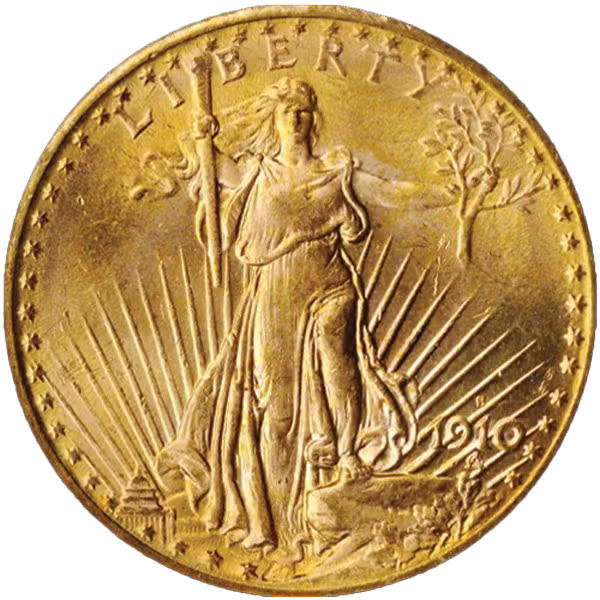
• A 1910-S Saint-Gaudens $20 Double Eagle PCGS MS67 sold for $168,000, nearly doubling its previous high.
• An 1879 Flowing Hair $4 Stella NGC PF66 CAM realized $216,000, attracting an extraordinary 93 bids.
Rare Finds from Europe and Asia
In the United Kingdom, a Roman silver coin hoard discovered in Dorset achieved two and a half times its pre-sale estimate, totaling £16,625 ($22,000). A denarius of Emperor Claudius (A.D. 41–54) brought £3,200 ($4,200)—four times its projection—highlighting robust demand for ancient and historical issues.
Recent auctions in Geneva had many new highs on top end Roman rarities, too many to list, but here are a couple of the highlights:
- Augustus Aureus (gold) 27 BC-AD 14 sold for $606,660.
- Galba Aureus (gold) AD 68-69 sold for $562,164.
Across the globe, Hong Kong auctions confirmed growing enthusiasm in Asian numismatics, with over $18 million realized in sales. Highlights included:
- A 1916 Flying Dragon pattern gold dollar (PCGS Specimen-64+) fetching $504,000.
- A Kiangan silver dollar (MS-62) and a 1921 Chinese Pavilion gold dollar, each reaching $240,000.
- A Russian gold 10-ruble coronation pattern (Proof-61 NGC) selling for $168,000.
These global results confirm what serious collectors already know: the rare coin market is truly borderless—and still gaining strength.
Gold and Silver Resume Their Climb
After a brief consolidation, precious metals are again on the move.
Gold recently broke above $4,245/oz, with analysts now targeting $4,381/oz as the next resistance level. With markets assigning an 88% probability of a December Fed rate cut, investors are shifting toward tangible assets that offer stability amid policy uncertainty.
“No fireworks — just steady buying,” one trader noted, “as dovish Fed sentiment and a softening dollar pull money into gold.”
Michele Schneider, Chief Strategist at MarketGauge.com, forecasts a near-term target of $4,700, calling it “a realistic next milestone in gold’s long-term bull trend.”
Meanwhile, silver has surged nearly 15% in six days, climbing toward $58/oz as investors respond to renewed dollar weakness and expectations of further rate cuts into 2026.
Both metals are benefiting from a clear tailwind: a declining U.S. dollar, renewed safe-haven demand, and a global pivot away from paper promises toward real, physical value.
The Stock Market’s Disconnect from Reality
While gold and silver climb, Wall Street continues to defy gravity—at least for now.
The S&P 500, Nasdaq, and Dow Jones remain elevated, yet the underlying U.S. economy is flashing unmistakable warning signs:
- Commercial mortgage delinquencies hit an all-time high of 11.76% in October—ten times higher than in 2023.
- Subprime auto loan delinquencies reached 6.65%, surpassing Great Recession levels.
- Credit card delinquencies are rising sharply, indicating growing consumer strain.
As The Motley Fool summarized:
“The foundation of the U.S. economy appears to be breaking — and Wall Street has, thus far, turned a blind eye.”
These developments underscore a widening gap between economic fundamentals and market valuations—a gap that rarely lasts forever.
The Growing Debt Crisis
Underlying every market concern is the same systemic risk: America’s $38+ trillion national debt.
Swiss pension funds—long considered among the world’s most conservative investors—are now reducing exposure to U.S. Treasuries, citing concerns over U.S. fiscal stability.
One fund manager noted bluntly:
“U.S. Treasuries no longer play a role in our portfolio.”
Economists warn that political paralysis makes any fiscal adjustment unlikely. With debt now at 99% of GDP and projected to surpass 107% by 2029, the U.S. faces a future in which interest costs could crowd out defense, infrastructure, and essential spending.
As former Nixon-era economic adviser Herbert Stein famously observed,
“If something cannot go on forever—it will stop.”
When it does, investors who hold physical gold and tangible assets will be the ones standing on solid ground.
The Takeaway
From ancient Roman silver to modern American gold, from $5,000 coins to $5 million masterpieces, the story remains the same: tangible assets are thriving while paper markets strain under debt, speculation, and uncertainty.
Gold and silver are once again asserting their role as the world’s true safe havens. Rare coins continue to prove their power as portable wealth that transcends borders, centuries, and currencies.
Contact Finest Known today to learn how to protect your wealth through rare coins, physical gold, and tangible assets that hold real, enduring value.
Because while markets fluctuate and debt mounts, history’s greatest store of value seems to be endless value: gold endures.
CYBER WEEK SPECIALS