Treasure Talk with Bob Evans, News, Rare Coin Articles
Treasure Talk: Episode 9
The Rocks – Gold Dust & Nuggets
Oct
Treasure Talk: Episode 9
The Rocks – Gold Dust & Nuggets
“We are going to find gold dust.”
I made the statement with confidence.
“Nah… what? Gold dust? We’re not looking for gold dust. We’re looking for specie, coins. And gold bars.” Tommy Thompson replied.
“Yes, we are. And we’re also going to find gold dust.”
I was in the early months of historical research about the S.S. Central America, having been recruited by Tommy, my neighbor, in the autumn of 1983. I pored over the fuzzy microfilm printouts of contemporary newspapers, the early white-on-black xerox pages of tiny print.
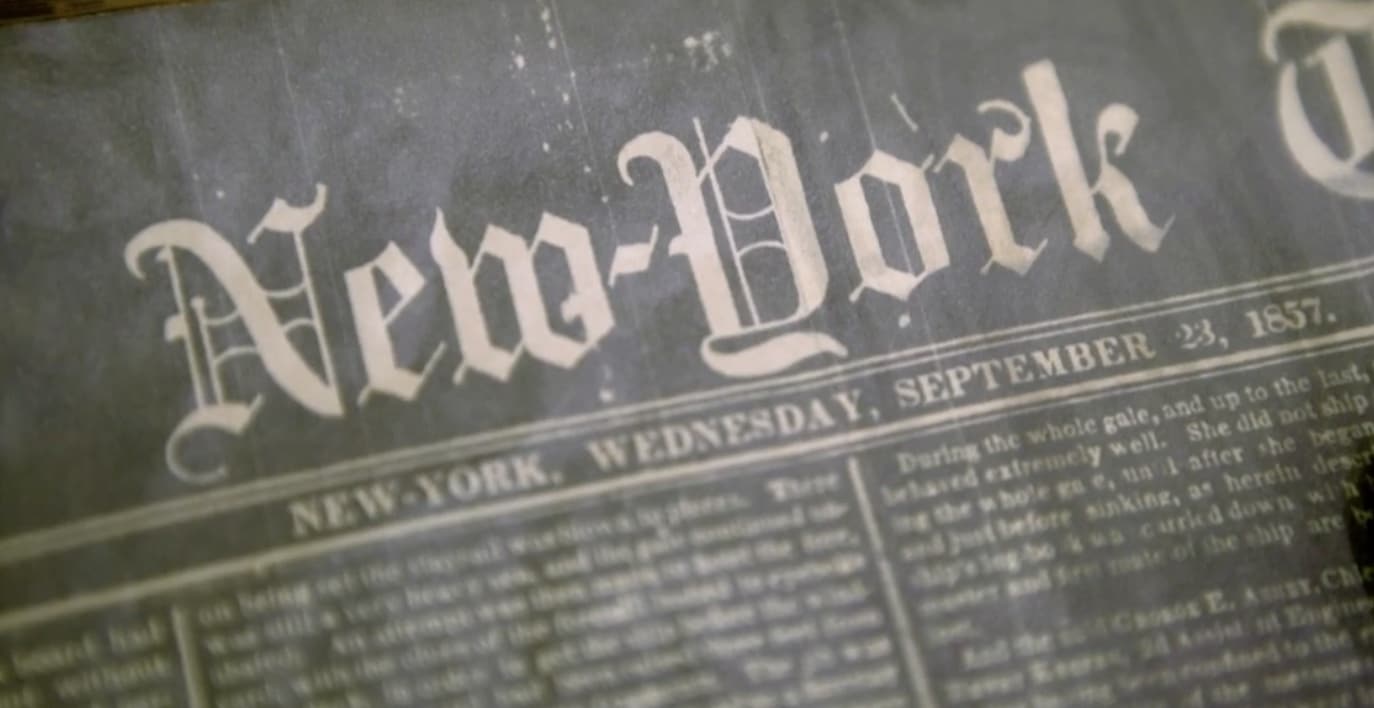
Reading the accounts, I began to envision a shower of golden particles, falling more than a mile, a cloud that surrounded the steamship, and descended with it into the abyss. I began to think about what forensic science might reveal, the constituents of the remaining deposit. Descriptions of the ship’s final moments on the surface tell of gold dust and coins being spread on the deck.
“But as the storm continued to rage, less and less of gold was thought of, and when, on Saturday, it became evident that they were likely at any moment to be buried beneath the waves, wealthy men divested themselves of their treasure belts and scattered the gold upon the cabin floors, telling those to take it who would…
One of the passengers, who has fortunately been rescued, opened a bag and dashed about the cabin about $20,000 in gold dust and told him who wanted it to satisfy his greed for gold to take it. But it was passed by untouched as the veriest dross. A few hours earlier he would have struck down the man who would attempt to take a grain of that which he now spurned from him.” — New York Tribune, September 21, 1857 —
I didn’t regard accounts like this to be completely accurate. $20,000 is a large sum for a bag of gold dust, roughly 75 pounds. So, this account of personal loss could have been an exaggeration. But it was clear that some gentlemen were dumping some gold dust on the decks and in the cabins. My hypothesis about finding gold dust started with that premise.
I frequently resort to math for insights and answers. Some regard it as the Dark Art of Science. For those of you who would rather skip the math, you can drop down a few paragraphs, not missing much storyline, but perhaps leaping past a cool piece of logic. Let’s say that a single gold dust particle is a quarter of a millimeter in diameter. I fully expected that the average California miner could pan and concentrate gold particles at least that small, probably smaller. But let’s start with that.
Native California gold has an average density (specific gravity) of around 17, meaning that it is 17 times heavier than an equal volume of water. Pure gold has a density of 19.3, but native California gold is not pure. In nature it is principally alloyed with silver. We can use the assay ingots of the S.S. Central America as an illustration of this variation in purity, ranging from 580 Fine (58% gold) to 973 Fine (97.3% gold.) This also shows the importance of the assayers’ trade, since gold dust also varied this widely in value
But would we find gold dust? I thought, “Certainly!” having read the accounts of gold dust thrown around and dumped on the deck prior to the sinking.
Let’s say it was 10 pounds, that’s a nice round figure, and a mere fraction of the boastful $25,000 loss attributed to a single individual and reported by the New York Tribune. It’s perfectly reasonable for a “thought experiment.” Tommy was fond of “thought experiments.” I just regarded it as inductive reasoning. The math indicated that 10 pounds of gold (4 and a half kilograms,) would be roughly 265 cubic centimeters of solid native gold. If. Each solid cc makes 40 x 40 x 40 = 64,000 quarter-millimeter cubes, meaning that ten pounds of California gold would make MILLIONS OF PIECES OF GOLD DUST of quarter-millimeter size. Actually, more than 16 million.
So, sometime around 1985, my conclusion was,
“Absolutely! There should be gold dust all over this shipwreck site, if we ever find it.”
Fast forward to 1988. We have discovered what we believe with near certainty is the shipwreck site of the S.S. Central America. The size and length of the visible main shipwreck, and the type of engine works, with 10m paddlewheels, were a perfect match for what we were seeking. “Oh! You know what that is!” was the echoed refrain in the control room as the cameras passed over the paddlewheels the first time.
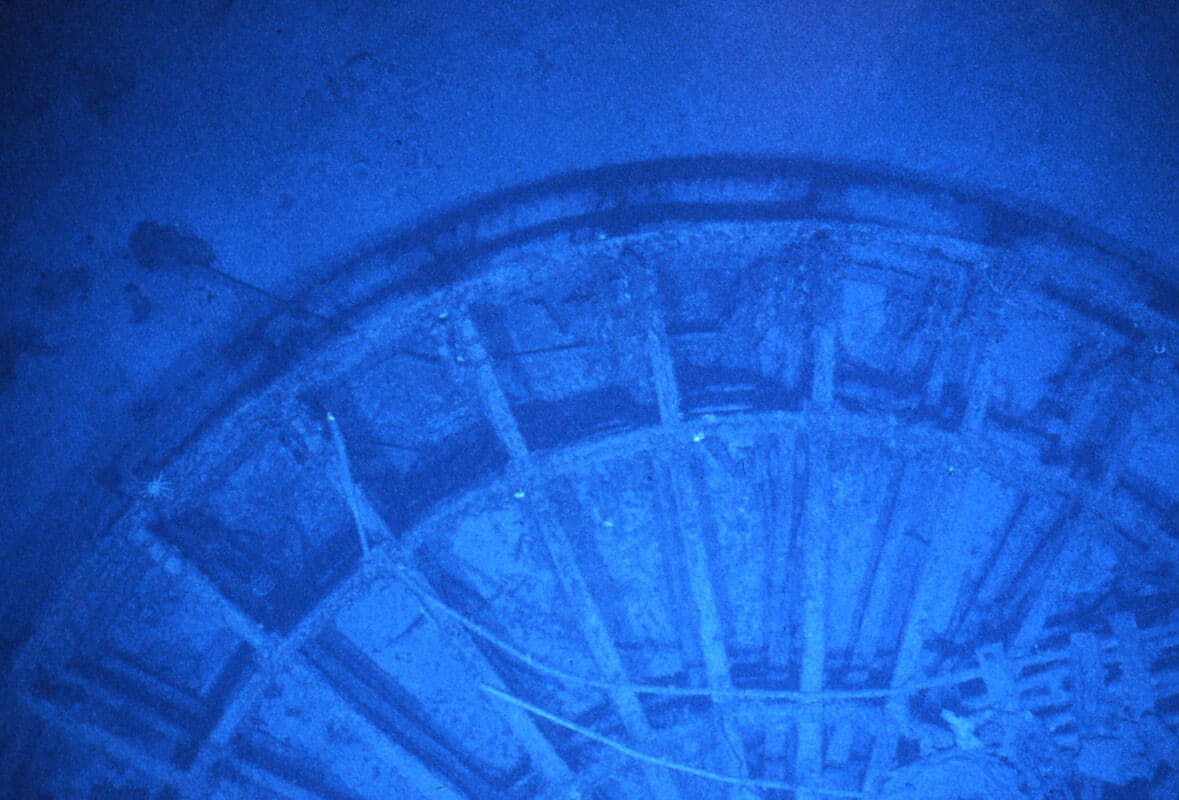
But was this proof of identity?
In Treasure Talk Episode 2, Part 1, back in February I described our earliest efforts in 1988 to pick up an artifact. We were using a manipulator that was different from the previous year’s work (on the wrong shipwreck, covered in previous Treasure Talk episodes.) For retrieval of delicate objects, one of our clever engineers had designed a set springy tweezers, “fingernails” with which the operator could precisely grasp fragile artifacts. After the first survey dives on the real SSCA shipwreck, we landed out in the debris field, off the bow of the main shipwreck, to pick up a bottle that looked interesting.
The collection of the bottle was a success, and we celebrated its arrival on the deck. As I took it below for safe study in my lab, someone announced, “Hey Bob! We got you some mud!”
During the 1987 season, working on the wrong shipwreck, I had become known for mud. I carefully collected sediment that stuck to the 1987 proto-Nemo’s runners and arrived on deck. Don Craft, (Commander USN, ret.) the venerable retired US Navy Salvage Master who helped direct 1987 deck operations dubbed me “Mudpie” for my enthusiasm for the bottom ooze.
Seafloor sediment fascinates me. I studied micropaleontology at the Ohio State University. We studied the kinds of microscopic animals whose shells make up the sediment where the SSCA shipwreck came to rest and deteriorate.
Working as a lab technician for Professor Stig Bergström, the Curator of the Orton Geological Museum, I crushed and dissolved limestone samples in acetic acid solutions to derive their acid-resistant microfossil content for the professor’s studies (and for the Museum’s great collection of these microfossils.) I used microscopes, acid reduction, heavy liquid and magnetic separation; in short, getting perfect training to be a shipwreck scientist.
So, when they announced that there was mud from the bottle dive, I was enthused. For 1988, the main manipulator was mounted on a nested set of aluminum box channels, which allowed the manip base to be extended a couple meters forward of the front of the vehicle’s frame. This greatly expanded the pilot’s reach. I recall that Nemo could reach something like nine feet in front of the forward frame. In extending for the bottle, the box channels had scraped the surface of the seafloor, capturing a plug of sediment that made it to the deck, where the guys washing down the machinery after the dive called it to my attention.
So, I had a sediment sample, and this time it was from what I was certain was the real SSCA. Of course, that evening, I started looking at the sediment through my microscope. It’s what I do. My earlier prediction of gold dust sailed back into my thoughts. I will admit, this was an exciting notion, particularly when I realized I had with me, at sea, all the necessary science kit to test the theory.
Foraminiferal ooze, or pteropod ooze, are the actual technical terms for the kind of mud where the SSCA sits. It consists of countless (billions?, trillions?, I’m not going to try to estimate) shells and “tests” of microscopic protozoans (the foraminifera) and slightly larger pelagic gastropods (the pteropods.) If anyone is interested, I can go on at great length about these animals of the surface plankton, but I won’t here.
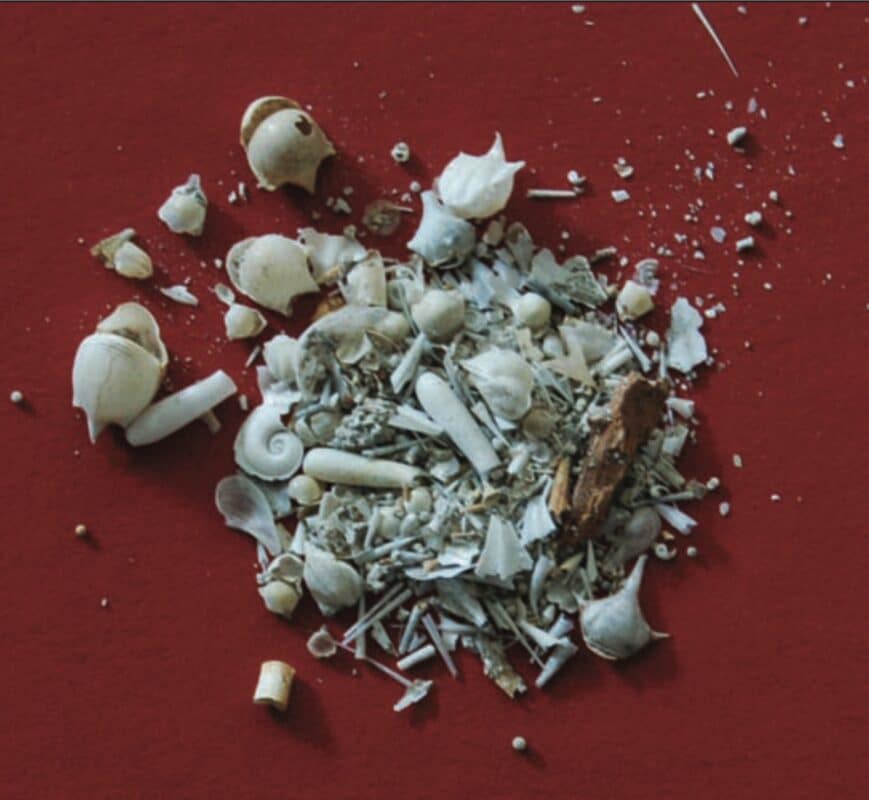
All you really need to know is that the constituents of the ooze are made of calcium carbonate, CACO3, the chemical formula of limestone, and the minerals calcite and aragonite. It is a limy ooze, on its eventual way toward becoming limestone through eons of slow accumulation, ultimate deep burial and compression. But as it arrived in my lab that September afternoon in 1988, my sample from the seafloor surface was about a pint of gray, sticky mud, with plenty of sharp, spiky shells that made it a little unpleasant to handle with bare hands.
So, I set about reenacting the same kind of experiments I had done with the “wrong” shipwreck sediment the year before. The idea was to dissolve all the calcium carbonate component of the sediment from the shipwreck, leaving the “interesting stuff.” This consisted of a small number of acid-resistant biological components, like siliceous sponge spicules. Importantly, the acid-digestion concentrated the “cultural” components: coal dust, cinders, wood, copper, possibly gold.
I never found any evidence of gold in 1987. Probably a good thing.
But, as I contemplated my jar of 1988 mud, fresh and cold from the bottom of the Atlantic. I decided, why not give it a whirl.
I had muriatic acid on board, nothing fancy, just some industrial grade pool chlorine that could serve multiple purposes, including as a cleaning agent, or maybe as a magic gold dust revealer. I took a portion of the sample, something around 150ml, and put it in a one-liter Pyrex beaker. I mixed tap water into the mud until it was a slurry, then slowly introduced the acid, carefully watching the violent effervescence as the foam rose and fell within the vessel. Once the reaction died down to a steady bubbling, I tied it to the shelf at the back of my lab bench, secured against spillage from the ship’s motions, and left it to digest overnight.
The next morning the engineers had things to fix on Nemo, prior to the next dive. A few crewmembers were on deck, awaiting the successful testing of the engineering tweaks, so they could take their positions on deck for the dive. The testing took a few iterations, each one involving a time-consuming unsealing of a pressure sphere, the adjustment of the electronics inside, followed by the resealing of the air-tight chamber. When it became obvious it was going to take a while, the deck crew started to break out the fishing rods. The “dolphin” were schooling around the ship.
Elsewhere these days, the fish known scientifically as Coryphaena hippurus has assumed other names, not “dolphin,” as it is known along the southeast US Coast. I assume this common name has persisted from the earliest European usage, in a way similar to the way people refer to herons as cranes. Dolphins are delicious on the plate, firm, almost steak-like in texture, a little like tuna. But no one wants to be eating Flipper! Sometimes, this name is softened to “dolphinfish.” In other places, particularly restaurants, this fast predator of the open seas is known as the politically correct but Polynesian “Mahi-mahi,” or the politically correct but Spanish “Dorado.”
While waiting for Nemo to work the right way so we could dive, the guys grabbed the fishing gear and started casting. I went below to my lab, to check on that bubbling beaker of oozy mud, by that time reduced to a murky mix that looked like bad chocolate milk. I half-filled a 5-gallon bucket with water, to catch and dilute the acid as I carefully decanted the solution and poured off everything but the remaining sediment. As expected, the calcium carbonate had dissolved, and all that remained was about a teaspoon of acid-resistant components. I dumped it into a Petri dish with a little clean water and started to search through it under the microscope. It was about like the samples I had seen from the previous year’s shipwreck studies, coal dust, wood fragments, etc., with one key difference.
THIS ONE HAD A TINY TABLE-SALT-SIZE CHUNK OF GOLD!
It was unmistakable. I shared this “find” with Tommy Thompson and our experienced shipwreck expert John Doering who were justifiably amazed and delighted. Tommy remarked that this was not something to write to the investors about. We were looking for larger amounts than a tiny grain of golden sand.
In the next three dives we found and recovered the ship’s bell, confirming beyond question the shipwreck’s identity, then photographed and found the Garden of Gold, the commercial shipment deposit with its thousands of mint-state 1857-S double eagles. This sort of overshadowed my tiny fleck of gold in a Petri dish.
But my long conjecture about gold dust being everywhere on the SSCA site was verified. From that point on, collection of native gold, the gold dust and nuggets, became an integral part of the recovery strategy.
Gold dust from the S.S. Central America shipwreck has been recovered in two main ways. Large parcels, both within the commercial shipment and also within consignments inside the purser’s safe, were major sources for gold dust, yielding a whole lot in individual units sometimes weighing many pounds. The other major source of gold dust was the shipwreck at large. As we have seen, gold dust was everywhere, and so “vacuuming up” the sediment while excavating, and processing those particles for gold dust became the standard operating procedure.
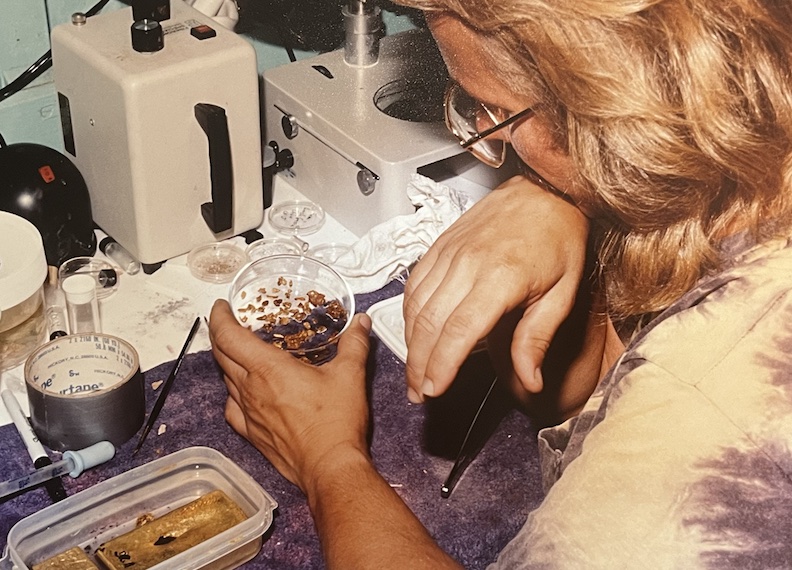
On Nemo, 1988 – 1991, we had a device variously called the “Sea-Vac” and by a few other less flattering names (items sucked into the flow would occasionally get caught in the hose). The core unit of our device was a dredge pump, in fact one designed for sucking up sediment under rocks and boulders in gold bearing regions like California. There are still plenty of hobbyists who put on wetsuits and wade into the creeks after every Spring thaw.
As we explored, excavated, and searched for coins and ingots, we would vacuum our work-area of focus, exposing plenty of the desired treasure while sucking in lots of ooze and shipwreck rubble. The dredge hose was translucent, and if a coin would get entrained in the flow the pilot would hold it up, backlit by a starboard-side light, and work the hose until the coin dropped through. The hose was connected to one of two large sediment traps. We had two sets of these sediment traps, so we could swap them out if processing wasn’t completed before the next dive. They were modified plastic industrial bins of appropriate dimensions. The small one was a foot square by three feet deep, on the port side. The big one mounted on the starboard side was roughly a foot by two by three feet deep, maybe a little more or less with the tapers. So, something around 40 or 50 gallons.
After every dive, it was my responsibility to process the sediment traps. This was both wonderfully surreal and significantly arduous.
I generally processed the sediment traps at night. I did this on deck, under the crane next to the portside scuppers (drains over the side) so the fine mud and junk from my sifting through the sediment would wash easily overboard, keeping the deck acceptably clean. The wee hours of the AM were ideal, since temperatures would drop into the tolerable eighties.
I had bright work lights overhead, and it was easy enough to spot coins, large gold nuggets, and bits of jewelry that had been swept up during our operations. But ultimately, it came down to panning for gold.
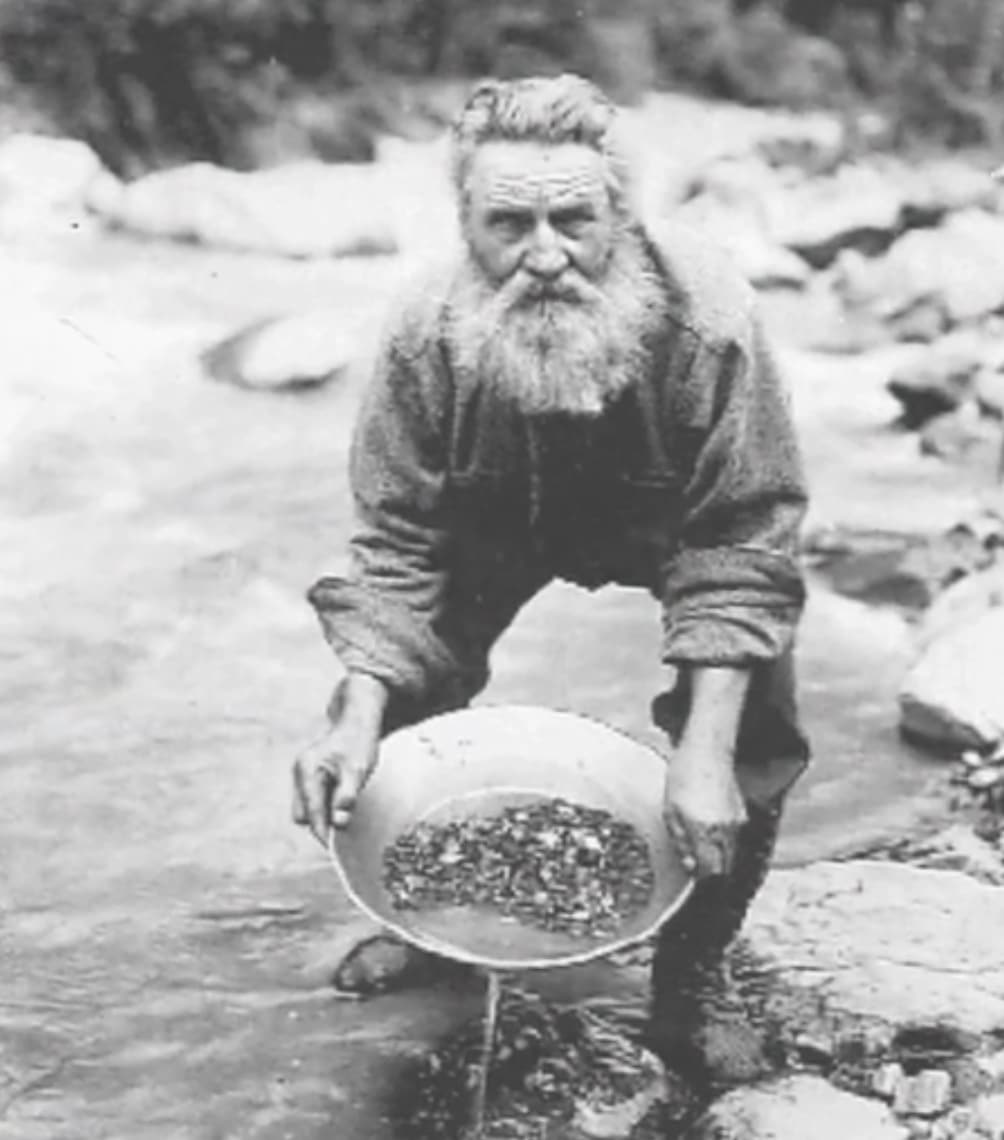
I used a gold pan, following the practice that had been used originally to win these precious particles from the dirt of the Sierra foothills over thirteen decades earlier.
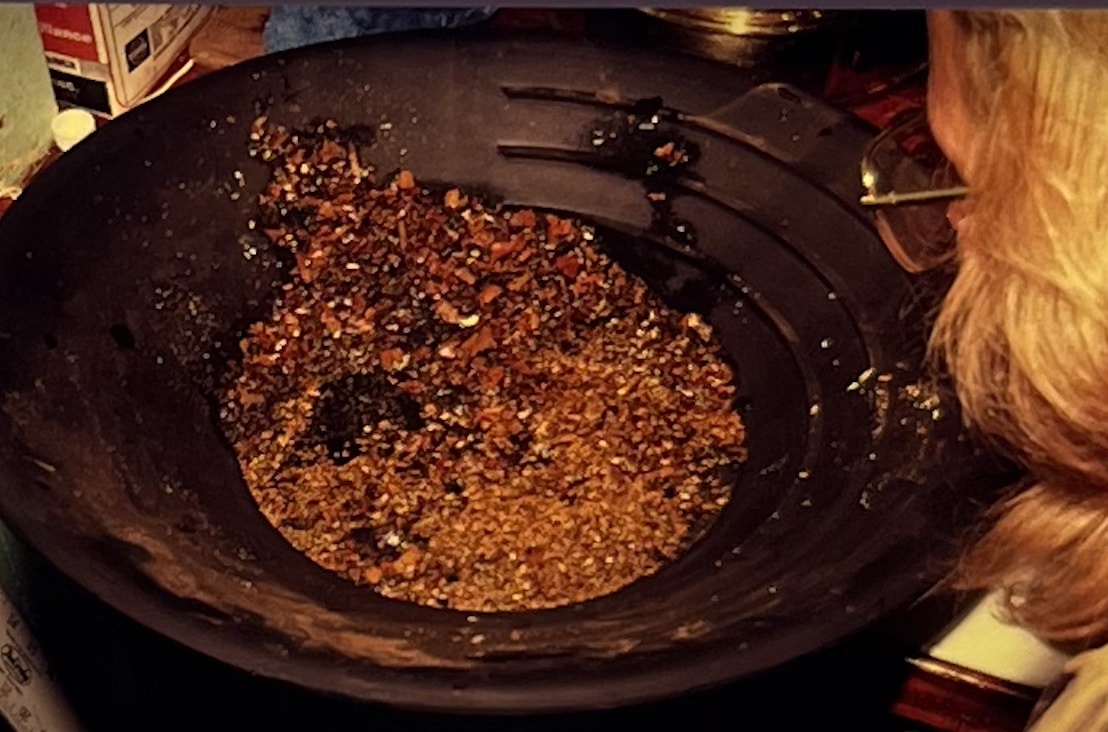
I didn’t need to achieve perfection in this exercise of “gravity concentration,” separating the heavier stuff from the lighter stuff. The goal was to concentrate the “heavies” from each sediment trap into a single, sealed, five-gallon bucket, to be further processed ashore later. In other words, get all the gold dust into one bucket with a bunch of other heavy stuff. I spilled the effluent from my gold pan over the edge and into a series of five-gallon buckets. As I panned and sifted further through each trap, I kept buckets of sediment more and more concentrated with heavy materials, numbered (for instance) 1/4, 2/4, 3/4 and 4/4. The last one, 4/4, held the heaviest fraction, and the gold dust.
One of the ship’s deckhands usually assisted me, just standing by to help moving buckets, managing the garden hose that served as my source of running water for the panning, and tending to other needs.
I sat on the deck of a rolling ship on the Atlantic, locked into the motions, at night with the moon seeming to wave back and forth in the sky overhead, often sleep-weary, while panning for gold, echoing those who did so long ago in California. When I got to the bottom of the bottom, I could just spoon out the gold dust into “high-grade” jars. With the perspective of half a lifetime, I look back on this with experience with wonder almost beyond words.
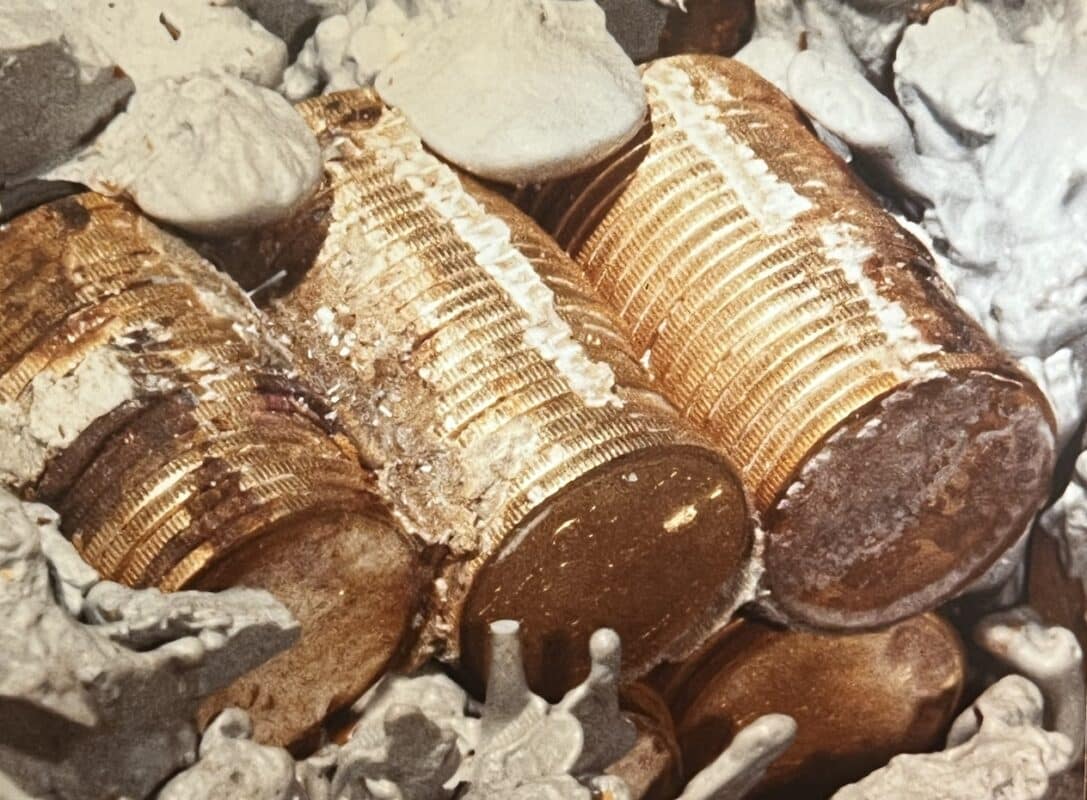
Let’s talk about calcium carbonate, limestone, again. It is the principal chemical constituent of the vast plain of sediment that surrounds the shipwreck, so it is in solution in the seawater in small amounts. Within certain microenvironments in the shipwreck, say at a certain level within the sediment column, or inside a box or bag, calcium carbonate can precipitate out of solution and form a hard limestone cement. In combination with the ubiquitous rust, these two minerals are the reason we saw improbable sights, like a tower of coins, held in their original rolls by beads of limestone, acting as glue.
I believe that most of the gold dust we retrieved from the commercial shipment deposit originated in a single large parcel. It was a box that has since vanished, consumed by the biology, exposing gold dust cemented into a block by calcium carbonate. It also enclosed other interesting gold pieces, a fifty-dollar slug, some Blake & Co. ingots, some amalgam balls.
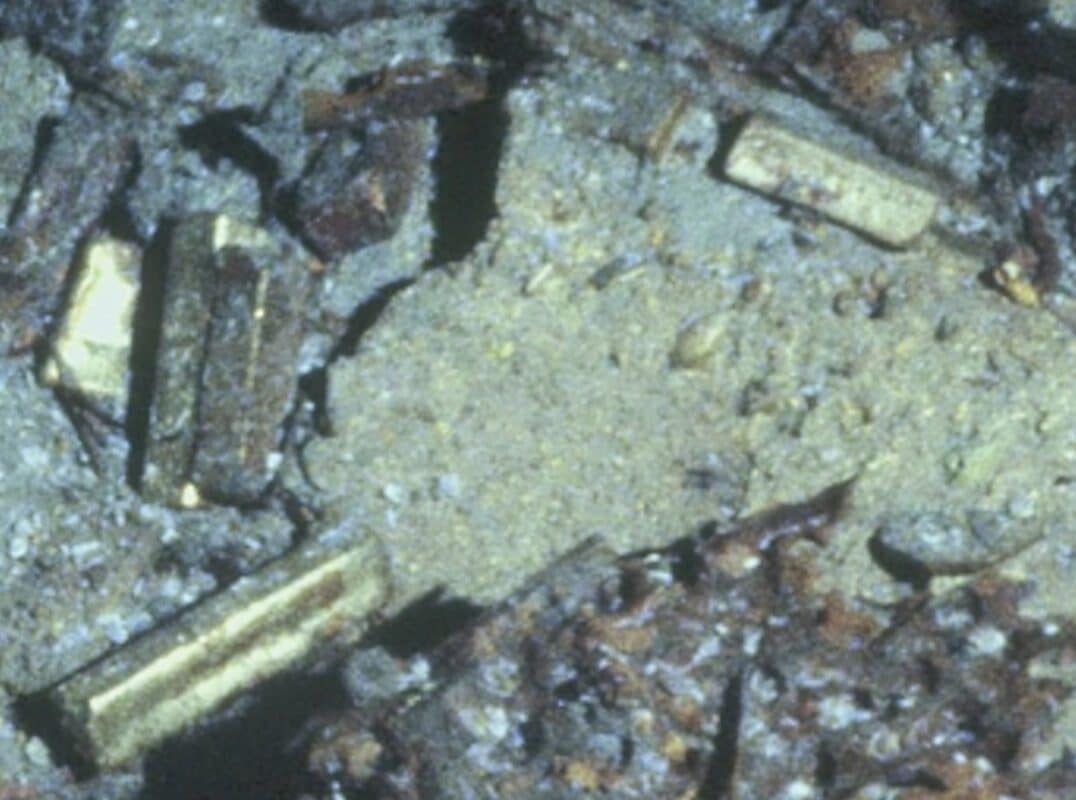
This big mass of “golden concrete” sat within the commercial shipment deposit, near to that tower of coins, and sitting on the edge of a hole into which who-knows-what was falling. When we first saw it, we puzzled over its identity. It was unlike anything else around it. It sure looked like a lump of concrete, except the gravel in it was yellow, and there seemed to be a few small elongate ingots on it and next to it, and one sticking out of the end of the block.
Here is another view, with a better look at the $50 octagonal slug sticking out of the block (right).
This view also gives a better idea of the chasm over which the gold dust block teetered.
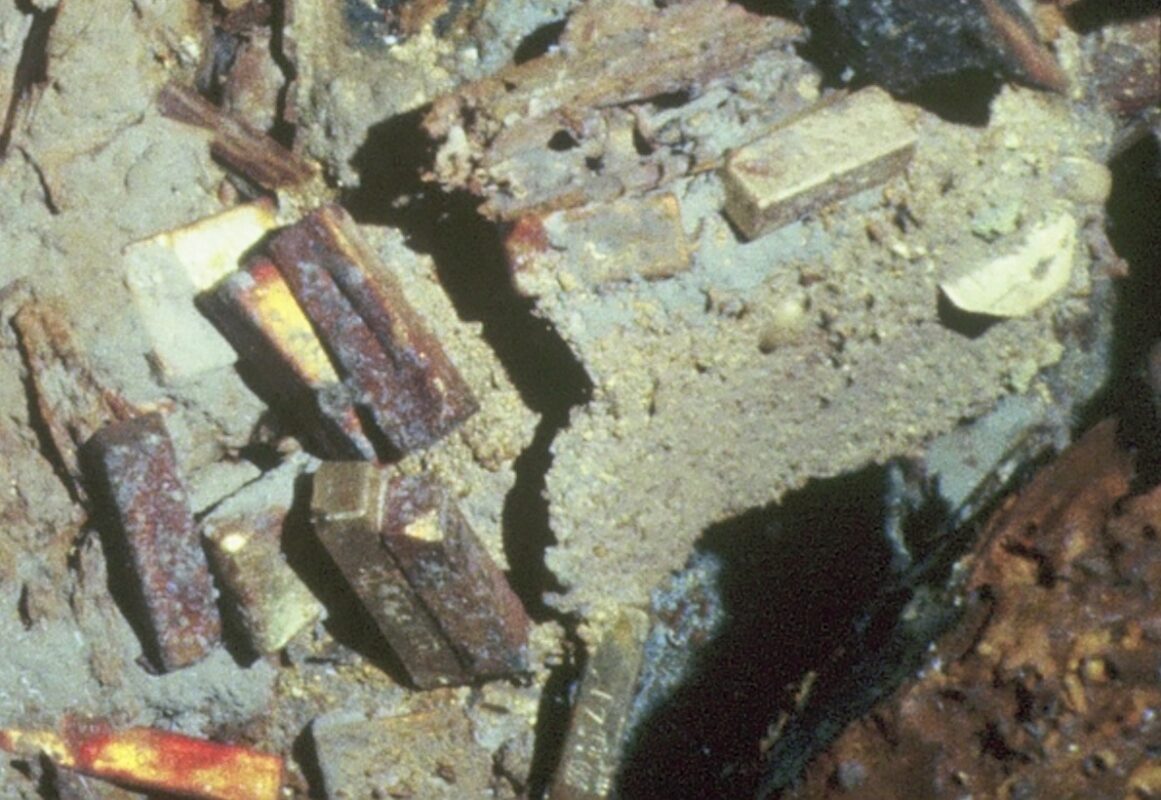
Another view shows that the chasm surely must have swallowed a lot of gold dust spilling out of the box that formed the block. It shows quite a bit of gold dust scattered around coins on the other side of the void. I think they were all part of the same original box.
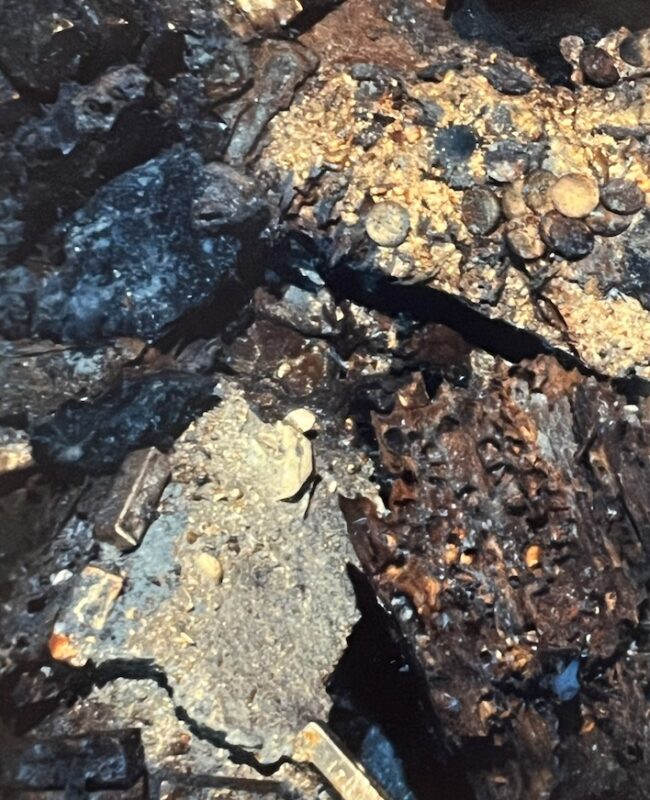
And indeed, vacuuming to expose coins and ingots in this part of the commercial shipment deposit, and within the rubble underneath, always yielded much gold dust in the sediment traps. I would say that most of the gold dust we recovered in those years, 1988 – 1991, came from that one original parcel.
The pilot managed to recover large parts of the block by placing a tray next to it, gently working a spatula beneath, then rotating the block into the tray. It was obviously crumbling during retrieval.
I recall that this rock was one of the most fragile objects I have ever handled. I quickly realized that keeping it “intact” was out of the question, as it warmed and dried and the weak cement lost its grip on the heavy interior constituents. The ingots and the coin popped out soon after recovery.
I removed it from initial storage in the Virginia Brinks vault and brought it to Columbus to see what could be done. Nothing, really. It cracked and crumbled until the pieces reached relatively stable sizes. This concretion had no long-term chances as a coherent object. When we found it on the bottom, we interrupted its slow collapse. These were heavy, dense nuggets and dust particles, very loosely cemented together by limestone. This was natural golden concrete, and gold dust makes a lousy aggregate.
What was this original box? It seemed to be a mixture of gold dust, nuggets, amalgam balls, Blake & Co. ingots, and a single $50 octagonal slug. Perhaps it was one of the shippers, sending a “mixed bag” of gold, to be melted and assayed in New York. Maybe getting a better “deal?” Did it originate in Sacramento? This is suggested by the adjacent and adhering Blake & Co. ingots, made in Sacramento. We will never know, barring a miracle discovery of some document describing such a shipment, hiding in the archives.
As part of the Division in Kind in 1998 (see Treasure Talk Episode 4, Part 2,) this cemented block of mixed gold, and all the attendant gold dust and nuggets went to the claimant Underwriters. Sotheby’s put the largest extant piece on the auction block in 2001, as Lot 46 of their sale of the Underwriter’s allotment. 2.46 kilograms, nearly 5 pounds!
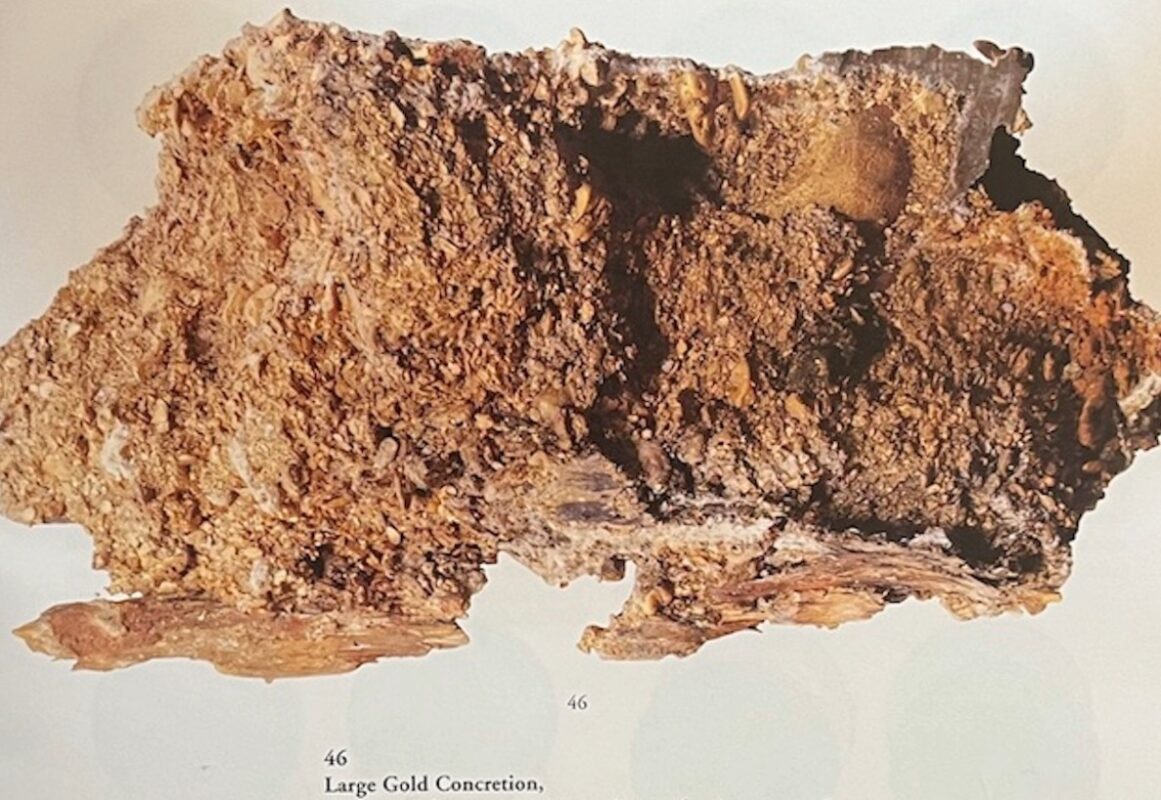
I read the disclaimer at the bottom of the catalogue listing, and I smiled with curatorial understanding:
“Important Note: This lot is extremely delicate, and unstable.
Sold as a lot, not subject to return. Sotheby’s accepts no responsibility for shipping and suggests the purchaser pick up the lot directly after the sale.”
In other words, if you buy it, youfigure out how to handle it and what to do with it.
Finding Nuggets:
Hours spent actively working with the ROV recovering treasure or exploring and learning more about the shipwreck site were known as “Bottom Time.” With such an expensive operation, bottom time was at a premium. Nemo was a robotic vehicle, and required no life support, so dives could run 24/7, for multiple days. The Control Room on the Research Vessel Arctic Discoverer had five essential crew: a pilot, a co-pilot, a navigator, a photographer/videographer, and a science officer.
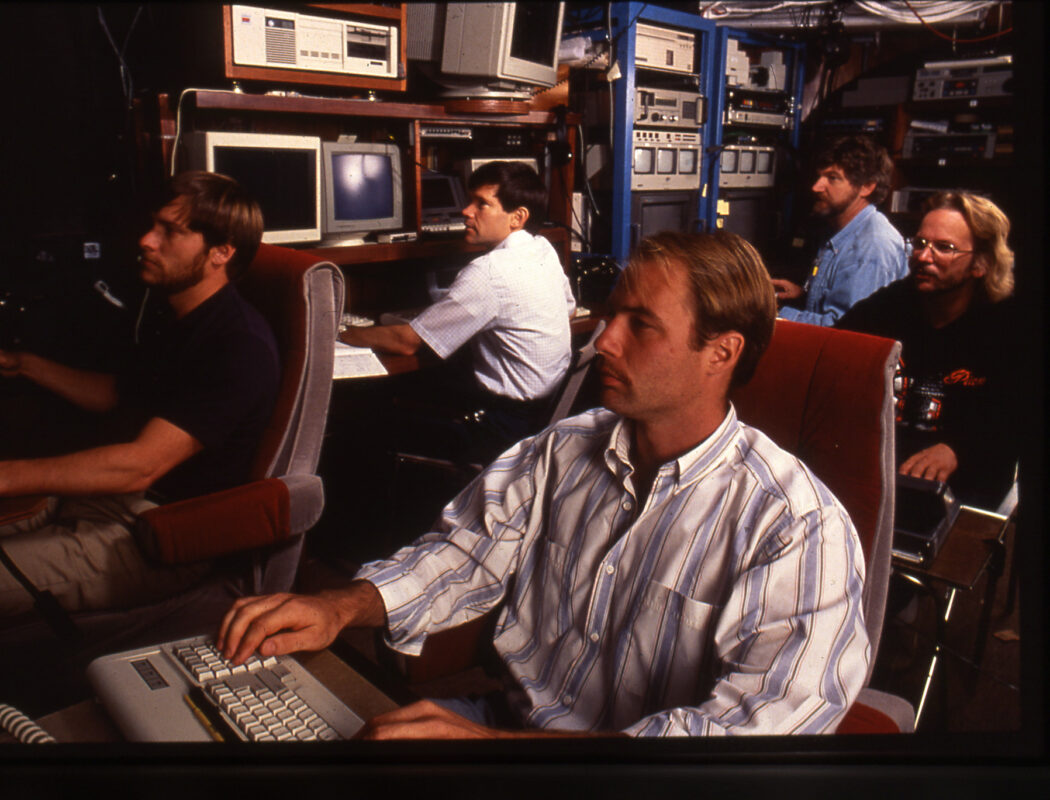
That’s us. Splendid men and crewmates all. I ask their leave to praise them here. Co-Pilot Chris Baker, foreground; Pilot and Chief ROV Engineer Mike Milosh, left; Navigator and C++ Programming Wizard Alan Scott, middle back; Photographer and Videographer Milt Butterworth, in back; and me, the Science Officer, at right in my sweatshirt under the cranked air-conditioner. There are many long stories here, some of which I will tell elsewhere. But, almost needless to say, the discoveries of which I was a part, in the company of these men and their comparable seconds, mark many of the great moments of my professional life.
Each of these crew members had important duties, and each could log comments into the ongoing dive log. If I was awake, or sometimes even when I wasn’t and had to be wakened, I handled almost all the “science officer” functions. On the Dive Log excerpt below, those are my comments marked as SciS, for the “Science Station.”
I had two operational purposes on our expedition: chief scientist, and mission coordinator. The science part is obvious. I made all sorts of scientific observations during the recoveries, entering them through the “Comment” function on the Dive Logs. Being the at-sea scientist meant that I was also the at-sea curator, cataloguing the incoming treasure and artifacts, and making decisions about their care, storage, and security. If someone found a weird piece of slime clinging to the cable as it spooled up from the deep, that usually came to me too, to scrape it off into a jar and try to make sense of it. Science has many faces.
I also planned the dives, and coordinated the mission, our exploration and research as we tried to understand the chaos of the shipwreck.
After a while I had assistants, and everyone in the control room had seconds to handle shifts. By 1990 our equipment had become more sophisticated, with longer, multi-day dives possible. So, two junior members of our technical crew, Mike Kornmiller and Scott Shade, would take turns filling in for me while I slept or while I took breaks for meals.
During three summer seasons of excavations of the commercial shipment deposit, we dredged up a lot of small nuggets and gold while exposing coins and nuggets for individual picking. A number of degraded boxes of coins and bars sat on a fairly solid, or at least apparently solid plank. This may have originally served as a shelf or small deck within the strongroom, wedged into the hold, as far astern as you can go; only one way in and out, and astern of the aft hatchway, through which heavy loads could be lowered and raised. Off to the port of the “solid” plank, the planks of the shell of the hold had degraded, and there were many voids through which treasure had apparently fallen, judging by what was left.
Some remaining frame members still held up remnants of the treasure room contents, improbable beams dripping with gold coins, or with a balanced jumble of heavy ingots, perched on the edge of a drop into the murk.
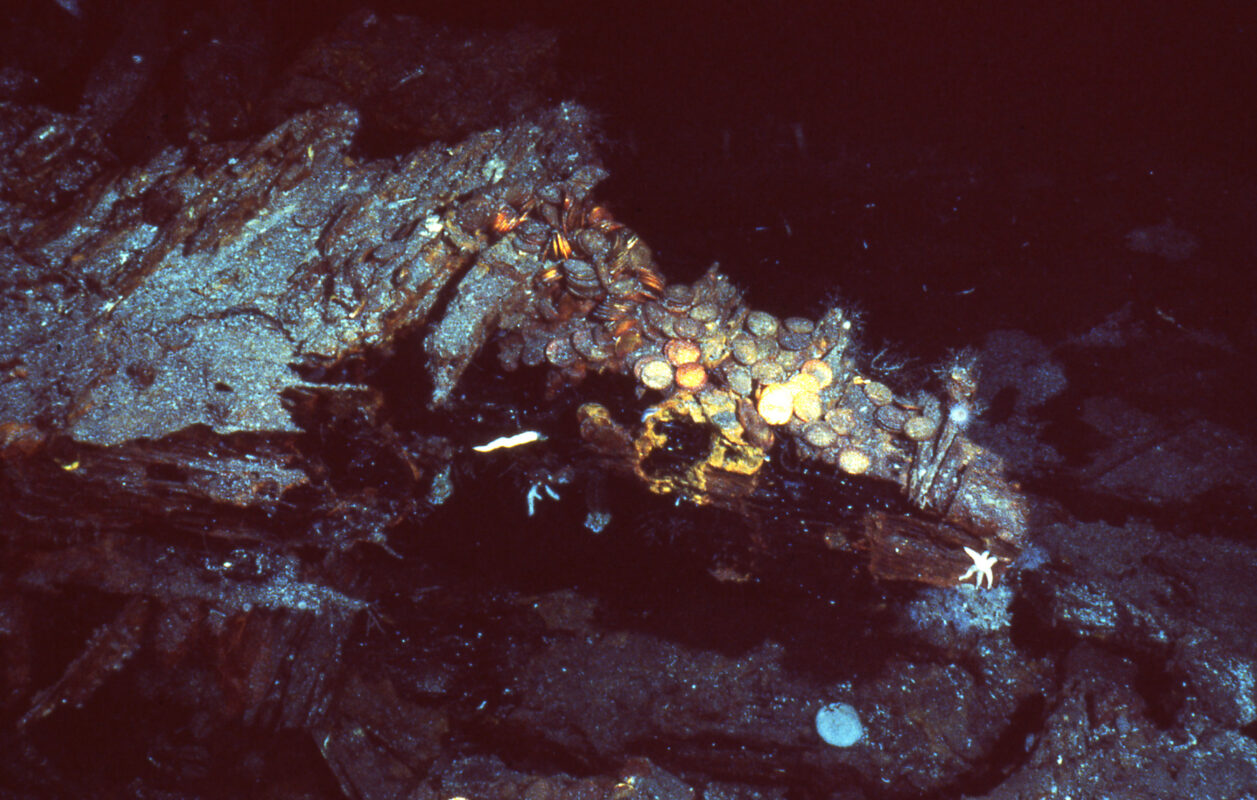
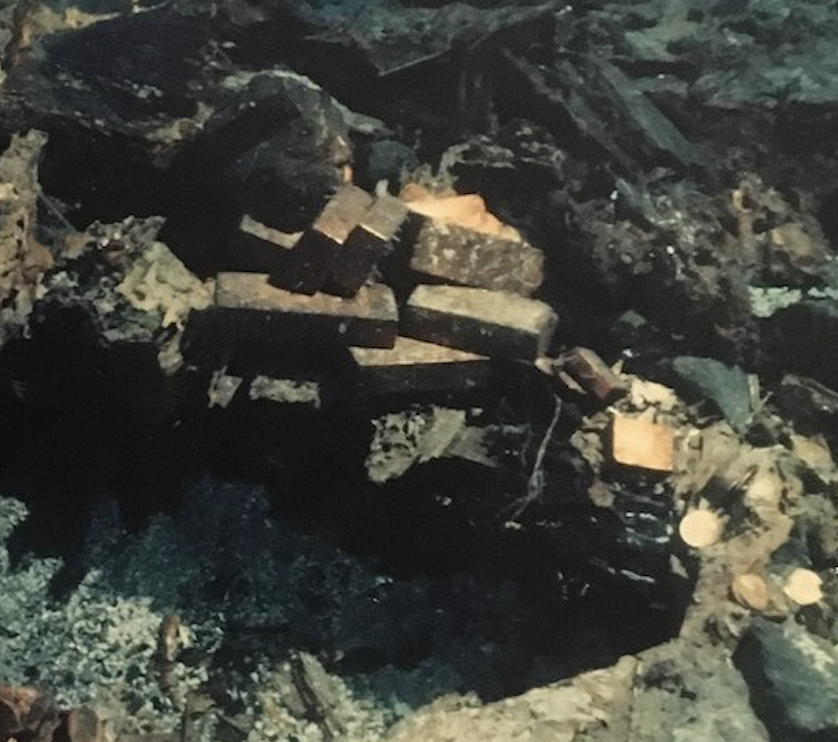
After using appropriate tools to pluck what he could from these precarious perches, the pilot would vacuum and expose other, fallen treasures from the sediment and rubble below. In all the confusion of the tumbled treasure room, it is hard to tell if ALL gold nuggets we dredged from the commercial shipment originated in the box that produced the golden concrete or not. But as we vacuumed and exposed gold to be further picked up by suction picker or manipulator, we sucked up a lot of little nuggets that I collected from the sediment traps.
We worked our way through the tumbled maze of timbers, exposing coins and ingots as expected. The gold bars and coins were interspersed with a jumble of loose debris and collapsed wood sitting atop degraded oaken ship frames that had not yet collapsed, but that looked as though they might at any minute. The pilot used Nemo to vacuum, expose features, and ferret through the jumbled debris and fallen treasure, on the beams and in the rubble underneath.
On the 9th dive of the 1991 season, at 6:30 AM, I logged a notation that we were “dredging a frame to the right of the dust,” which referred to the gold dust block. Then, given the hour, I decided to go grab breakfast. Meal hours were strict.
Log entries:

“Comments” are logged with time codes, and attributed to the Science Station “SciS” and the Video Station “VidS.” “Stereo” refers to 3D video cameras, stereo-vision.
While I was out at breakfast, (at 07:03:29) the videographer logged a comment about “quartz with gold in it.”
I came back and they told me about it, and I said something bland like, “Oh, that’s interesting. I’ll have a look at it.” Then I sat down and we went on with remainder of the dive. A couple minutes later I logged in “heavy clump.”
I had no idea.
These two nuggets, the largest that came from our early expeditions, immediately joined the group of my favorite rocks. They were no-brainers, the kind of nuggets that strike awe. The larger of the two, in terms of total gold content, we nickname “Africa,” since in one aspect it superficially resembled the continental outline.
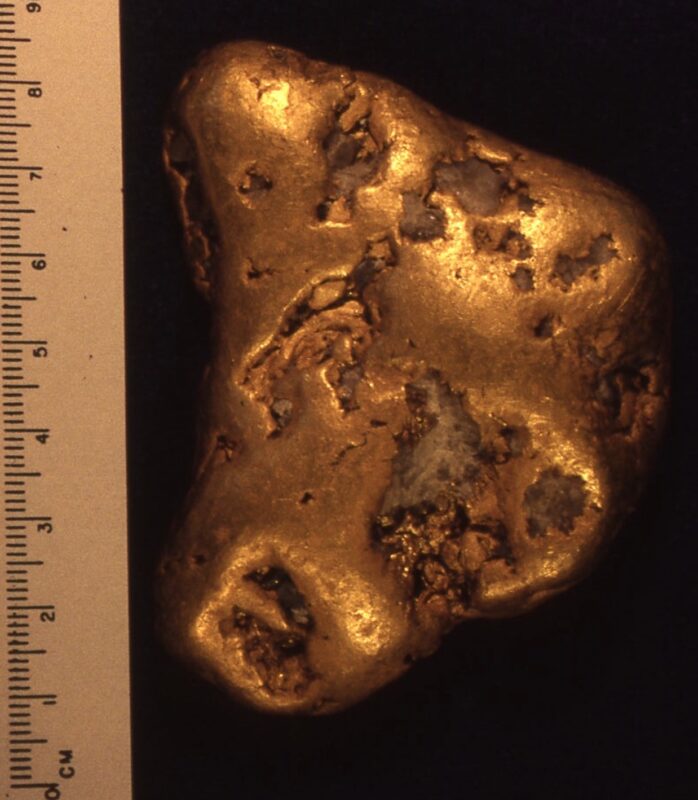
“Africa” was worn smooth, which seemed incredible for such a massive rock. At first, I didn’t know how massive, since it is impossible to weigh anything accurately at sea, but once ashore and in one consistent G, it proved to be 20.3 ounces.
In my mind, although it contained less gold, the other nugget was more spectacular, the “quartz with gold in it.”
I’ll say!
When it arrived in my lab, I marveled over it and the other large lump. As with all artifacts ascending from the depths, this rock was coated with rust encrustations and stains. Beneath the dirt it was obviously spectacular, so I prepared a batch of the solution I use to curate the coins and ingots. An overnight soak was all it took, and the stone was revealed in all its splendor.
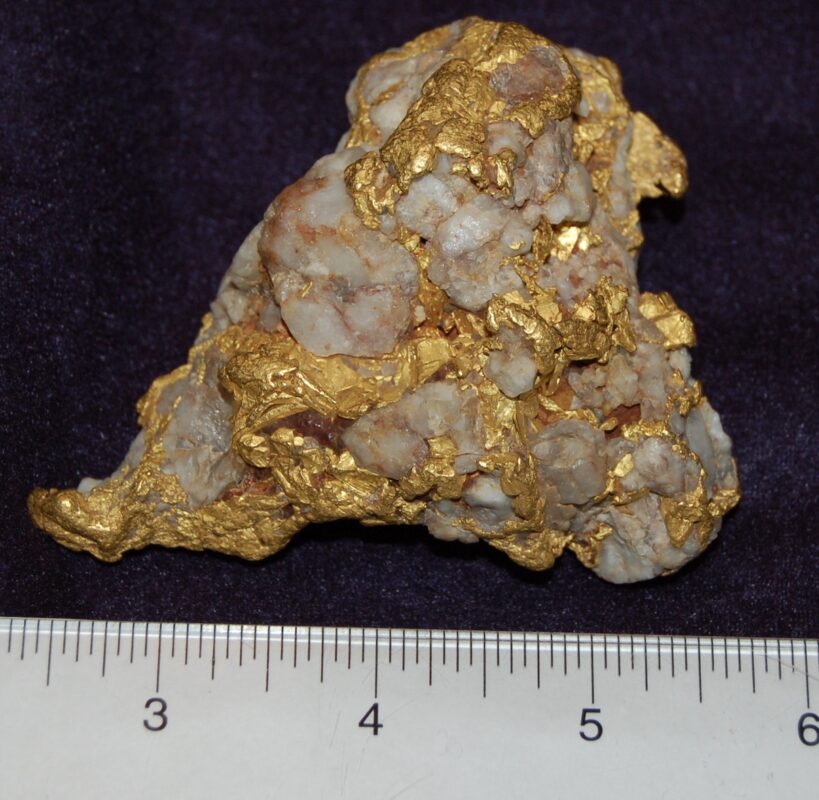
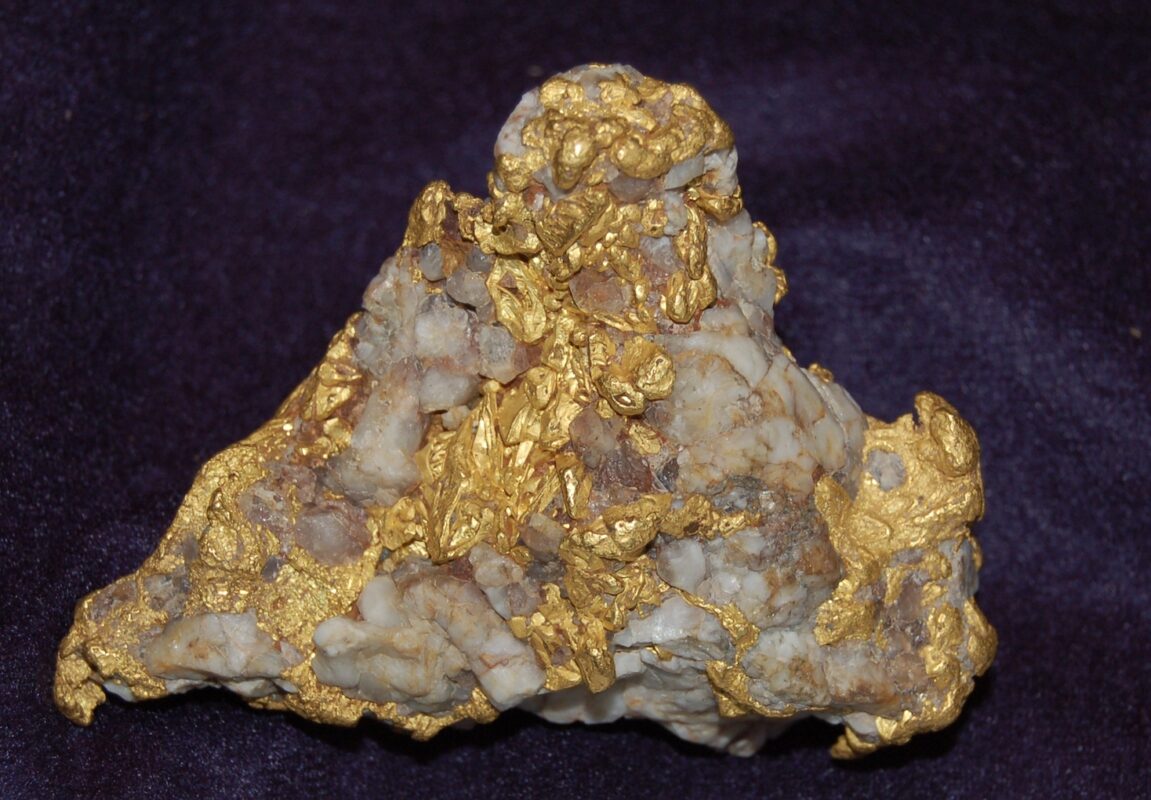
A piece of milky white quartz running thick with gold veins! A piece of the Mother Lode!
The total weight was 17.4 oz. I did some density testing and calculations (specific gravity of the entire piece, of average CA gold, and of quartz) and determined that this marvel contained over 13 ounces of gold.
The Mother Lode of the Sierra foothills in California, the principal band of gold-bearing earth, runs through a series of rocks set with cracks and fissures and associated with the Melones Fault. This particular crack in the earth is a terrane boundary between two very different groups of rocks. It was along this weakness, under enormous pressure deep within the earth, that quartz and gold intruded, cooled, and precipitated, creating wonders like this piece.
It should be obvious that the chances of a geologist in modern times (or anyone else for that matter) finding such a hand specimen are essentially zero. Such rocks are long gone from the Sierra foothills. It is only through the miraculous time capsule of the S.S. Central America, and the marvels of modern technology, that it was brought to the current day and into my lab at sea. I was weak in the knees as I lifted it from the solution, rinsed and dried it.
Our company had adjunct associates among academia and industry, whereby we gave access to our data, photos, video, etc., to interested specialists who would not otherwise be able to study biology and oceanographic phenomena at this exotic location. The coordinator for this program was Dr. Charles Edward Herdendorf, (whom we all knew as Eddie,) Professor Emeritus from the Ohio State University. He had been one of Tommy Thompson’s professors in college (an oceanography program.) He was well-positioned and widely-known as the former director of a Sea Grant Institution (Stone Laboratory on Lake Erie.)
I have written at length about rust in Treasure Talk Episode 5, Parts 1 and 2. The massive rust deposits on the SSCA are the result of both chemical reactions and biological activities, with bacteria playing a major role in building up the stalactites called “rusticles,” or the thick bacteria mats encasing the gold and other artifacts.
Iron is the 4th most common element in the earth’s crust, and so the United States Geological Survey (USGS) had a specialist whose areas of concern included iron compounds, rust, and the role bacteria plays in rust formation and growth, Dr. Eleanora Robbins, who quickly told us to call her “Norrie.” We worked with Norrie to study the rust formations on the SSCA site, to deploy experiments and collect samples to compare them with similar samples from Titanic, which had been sampled a couple years previously. After our return from sea in 1991, we planned a visit to see her at USGS headquarters in Reston, VA (suburban DC.)
Norrie had suggested that Eddie and I bring some sample gold nuggets for a USGS mineralogist to examine with a scanning electron microscope (SEM) and probe, so he and I talked about what we should bring; obviously something small enough to fit within the SEM vacuum chamber stage. But Eddie and I also realized the opportunity this gave us for the ultimate “Show & Tell” among geologists. The “Mother Lode Nugget!” We were confident we were about to walk into our nation’s geological headquarters toting a specimen unlike any other of recent memory. Nothing like this ever walks in off the street!
I cut a square of royal blue felt from my exhibit-display supplies, and I bundled up the three-inch, triangular piece, cinched it with a couple rubber bands, and carried it in my briefcase like any old rock. I also packed a couple “ordinary” 10-gram nuggets in a little jar for examination with the USGS’s SEM. In the early 90s, these items caused no stir among airport security.
Norrie greeted us upon our arrival. She was a senior scientist at the USGS, and, interestingly enough, an alumna of the Ohio State University Geology Department. We had the same professors a couple decades apart. I had them late in their tenures, she learned from them earlier. It was fascinating to share perspectives on those who had taught us.
We enthusiastically discussed the rust research and the activities of the bacterium Leptothrix. The set of microscope slides we deployed for just one month on the shipwreck had collected enough iron stain and bacteria to advance the study and make comparisons with the Titanic samples
Then we showed her the gold. Norrie was floored, suitably impressed to say the least. “OH MY! WE HAVE GOT TO SHOW THIS AROUND, AT LEAST A LITTLE!
She took us to another department to meet with Dr. Gary Cygan, who ran the Scanning Electron Microscope. Once again, a similar reaction. Gary was gob-smacked by the beautiful quartz with its crystalline gold marbling. Once his amazement had subsided a little, we examined one of the smaller nuggets with the electron microscope and its probe, beaming electrons at specific spots to test the chemistry. We talked a little about how it would be interesting to slice through such a nugget, to probe the chemical differences (if any) from the surface and down into the interior. I pointed out that these particular gold nuggets were “collectible,” or at least probably so. No matter how scientifically interesting, destructive testing would have to be very carefully considered.
As we were talking about this, another geologist drifted in, looking absolutely distressed. I forget his name, but we’ll call him “George.” The man was another older scientist, maybe 60-something, in charge of the Geological Survey’s mass spectrometer, a powerful and expensive analytical machine. Mass spectrometers ionize a sample and then measure the mass-to-charge ratios of the components, thus determining the composition. (This explanation is simplistic, but, trust me, mass specs are important tools.)
“George” looked awful, almost in trauma. His machine had lost “a filament.” At least that’s what I remember. I don’t pretend to know what this means, since I never studied mass spectrometry, or used such a machine. But it was devastating. The man was practically in tears as he bemoaned that it was a quarter million dollars and it was a government machine and it would set back the research by months because he would have to write a grant proposal and then it would back up the schedule of other research schedule and what about this and what about that and…
“Bob! Show him what you have in the felt!”
I removed the rubber bands and opened the bundle. Then we watched the true magic of gold.
The lines on George’s face melted as his concerns flowed into a different dimension. He said nothing for what seemed like a long time, maybe fifteen seconds, as his eyes widened. We began to chuckle quietly, allowing the scene to breathe and the rock to cast its spell.
Then he stammered, “Wha?.. How?.. Uhh… WHERE?!!!”
Then, “George” made a declaration that certainly would be affirmed by any geologist:
THAT’S WHAT WE’RE LOOKING FOR!
In the next Treasure Talk: More about gold dust and nuggets, from the “Return Expedition, 2014.”