Treasure Talk with Bob Evans, News, Rare Coin Articles
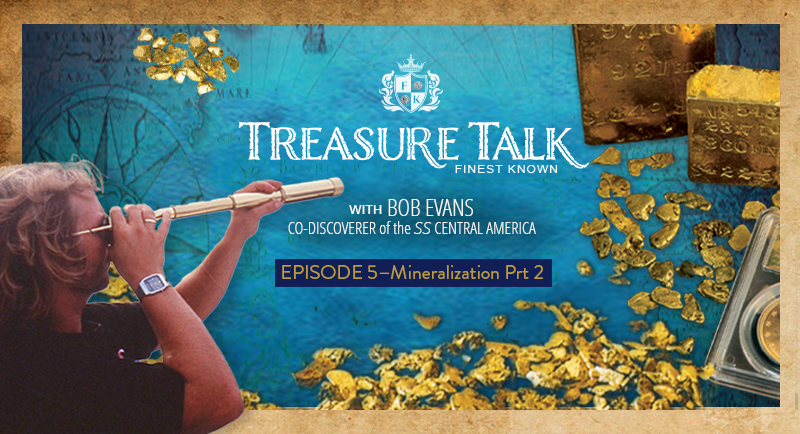
Treasure Talk: Episode 5 Part 2
The Wonders of Treasure Mineralization
May
Treasure Talk: Episode 5 Part 2
The Wonders of Treasure Mineralization
The rust deposits on the SSCA gold come in many types, thick and thin, earthy and stony, red, orange, brown and black. When I am removing the rust it all responds to the solution I use, but sometimes it takes several days and changes of solution. The point is not to dissolve the iron minerals completely, although some is sequestered in the water turning it a kind of yellow resembling urine.
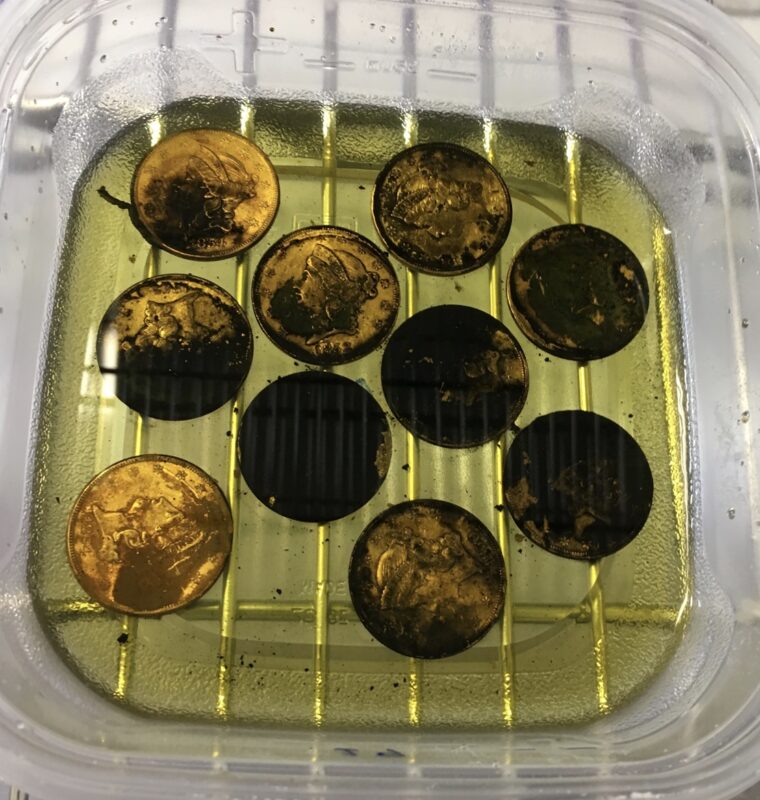
The objective is to alter the rust just enough that it loses its physical grip on the surface of the coin. Again, the bond is physical, not chemical.

In very rare instances large pieces of blackish (oxygen-poor) rust spall off the coins and ingots, showing perfect reverse impressions of the gold surface. The impression is so exact and detailed (down to microns) that the microscopic flow lines from the dies, struck into the coin and imbuing it with mint luster, is replicated in this process of rust mineralization, making a perfect duplication of the original die. A “coin fossil.” Lustrous rust!
The S.S. Central America is full of surprises.
Except for just a few specimens, those with outstanding aesthetic eye appeal and relatively stable deposits, I removed the rust from all the coins. As a geologist, I liked the rust. It was an important part of the mineral context where we found the gold. But I understand the decision given the modern numismatic scene, where high grade coins are graded and encapsulated by third-party grading services.
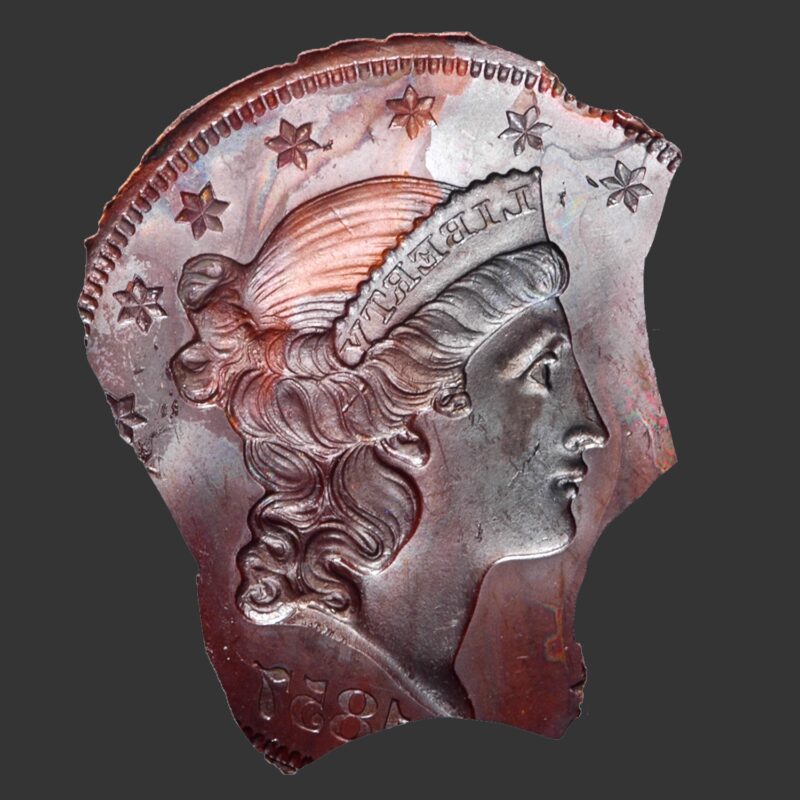
If given the choice between this coin…
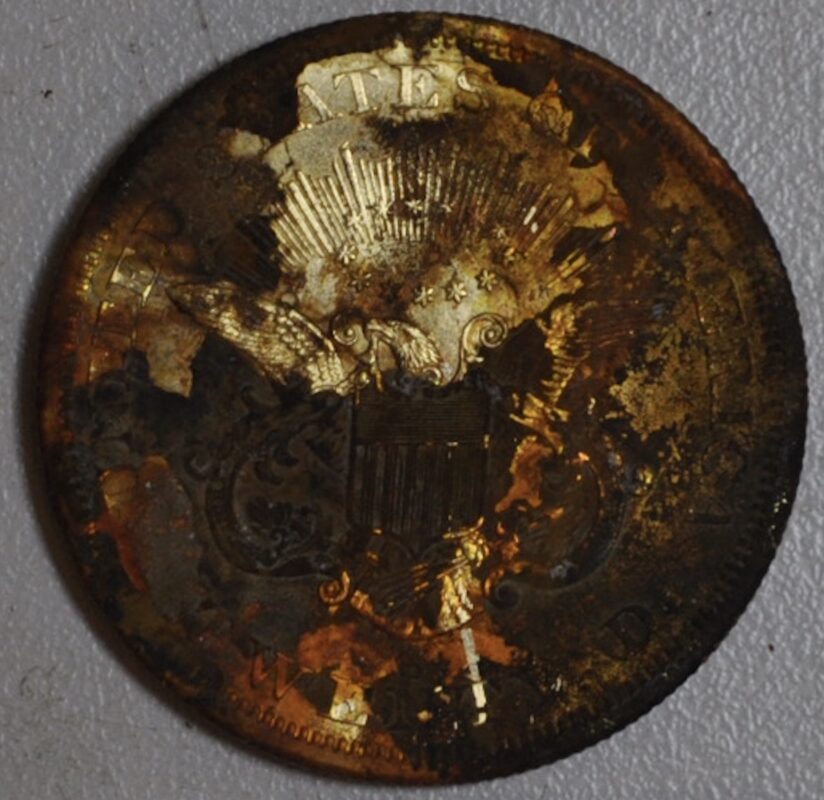
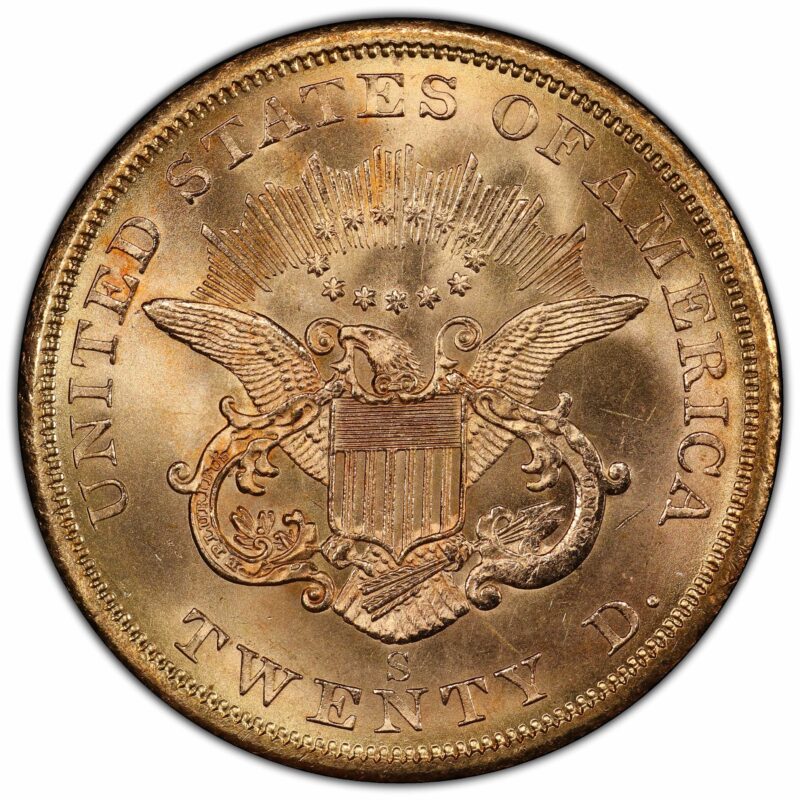
or this one…
most people would choose the this one.
So, the decision was made to curate almost all the gold, to remove the rust and mineral deposits, but to take great care in not affecting the surfaces in any other way. It is a delicate and painstaking process. To begin with, let’s talk about those iron oxides in micron-precise physical contact with a mint-state gold surface. These minerals are harder than the gold. Considerably harder. Pushing a flake of rust across a gold surface could scratch it. So, coaxing the rust off the surface is challenging and commands full attention. My preference is to do this in a bath of the solution, under a binocular microscope, using a sable-hair artist’s brush as the only tool.
The rust and calcium carbonate on the shipwreck have encased and obscured the dazzling gold, but these minerals also perform another fascinating role. In many cases coins and ingots were stuck together, with the minerals acting as cement between the pieces. The result could be “clusters” of coins, for instance a roll of four stacked double eagles. In one case there was a natural wonder we called “The Tower.”
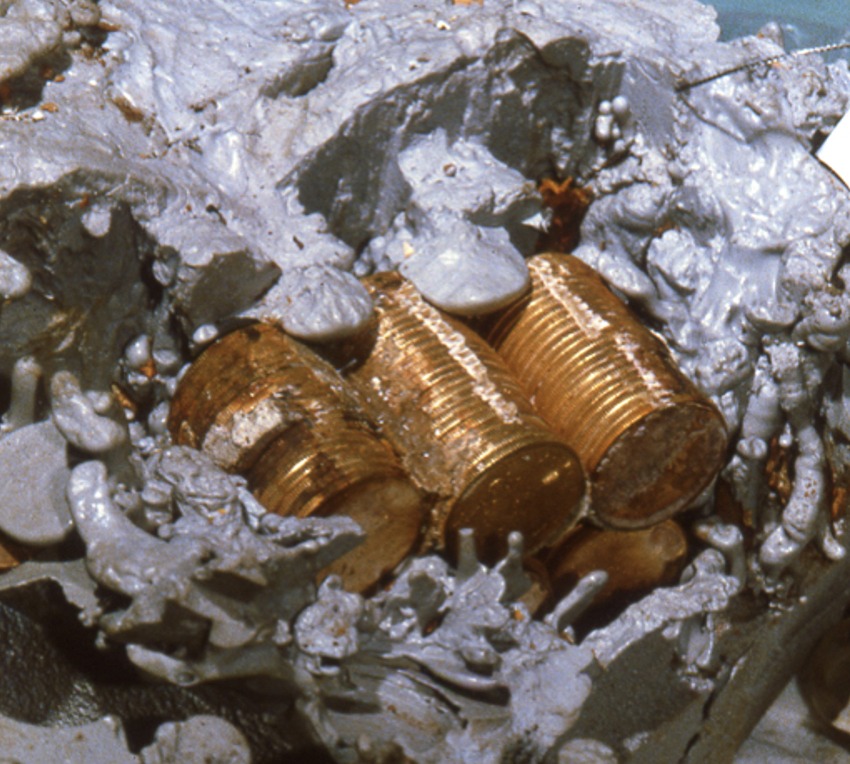
The Tower was originally a box of $20 gold coins. Sometime between 1857 and 1988, the box had been eaten away by shipworms and other animals. Before the wood of the box disintegrated the coins inside were cemented together by the minerals. The resulting pile seemed to defy gravity. Rolls of coins were neatly stacked side by side in a single, solid “rock” comprising over 300 coins. This became a prime candidate for mass retrieval.
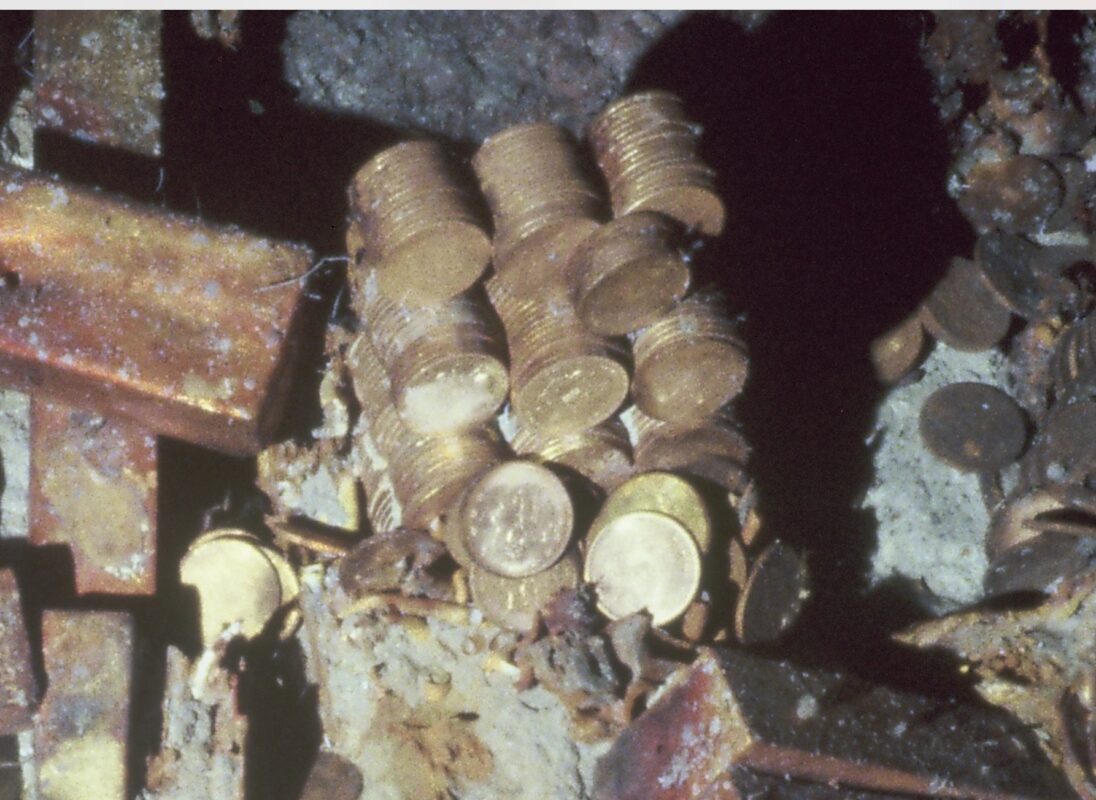
The mint-state coins in the SSCA treasure required great care in recovery. Our preferred method for individual coins was the “Suction Picker.” This was a thin water tube with a rubber tip on it that resembled the rubber darts of my youth. There was a hole in the center of the tube, and it was hooked up to a pump that could either “suck” or “blow.” A very useful tool, the pilot used it a lot to pick up individual coins, or even small ingots. He could use it to blow to clear a coin for picking, then use the suction to grab it with the tip and deposit it a numbered recovery tray.
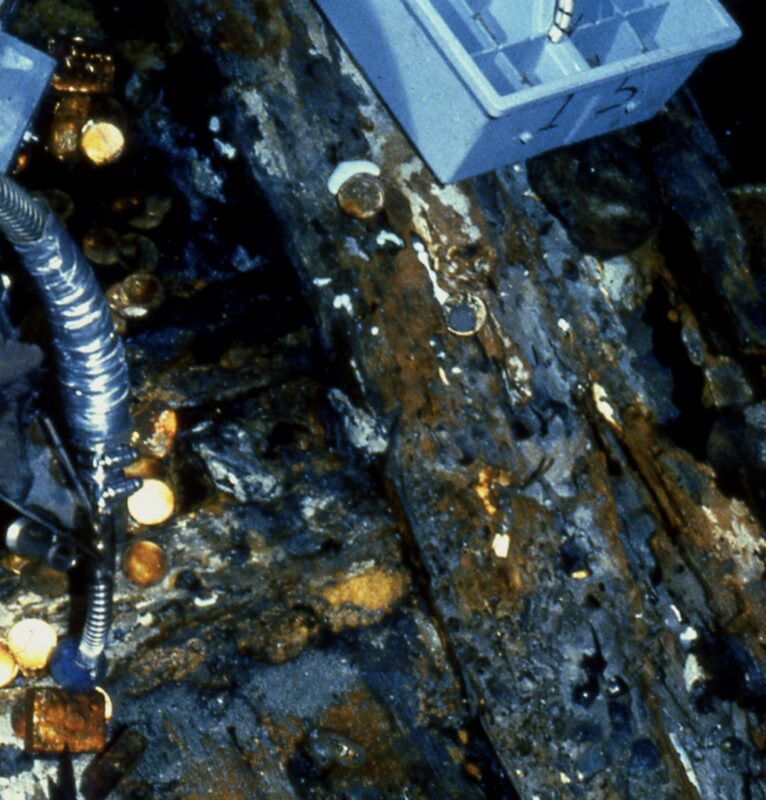
We could pick up coins one by one. That was gentle enough and they were recovered without damage. But after we saw that certain parts of the commercial shipment were in coherent, well-defined stacks or piles, we thought we might try “block lifting.” In paleontology, most notably with dinosaur fossils, it might be more efficient to bring a whole block of rock with many bones in it back to the laboratory for final excavation of the individual bones and groupings, rather than trying to do that in the field with the sun and the rain and the flies.
How could we use that concept with the SSCA treasure?
Major applications of underwater engineering have to do with the installation and maintenance of pipelines and cables. We humans have spread our infrastructure across the world’s seafloors. Sometimes, things break, and they need to be repaired. Undersea pipelines usually carry valuable hydrocarbons, and ruptures are very expensive damage. There is a silicone rubber substance that can be applied as a liquid over a damaged pipe, then allowed to congeal, resulting in an exact replica cast of the damage. This then can be recovered from the underwater scene, brought to a shop, where a customized patch can be fabricated for the repair.
Tommy Thompson, his engineering colleague Don Hackman, and I performed an experiment. The silicone rubber came in two liquid parts, a little like an epoxy, with a “resin” and an “activator.” These two components were mixed, and then the mixture congealed over time, the time required varying according to the percentages of the two components and the temperature of the water. Obviously, it was heavier than water, and it was not water soluble in the least. We took a couple hands full of washers, our experimental “coins,” and piled them in the bottom of a salt-water aquarium packed with ice, coming as close to SSCA conditions as we could. Then we combined the silicone rubber ingredients, and poured the mixture into the aquarium and onto the mound of surrogates. The following morning, we reached in and plucked out a rubber mass with a whole bunch of washers encased within it. The resulting silicone rubber was a little like bathtub caulk, and it was easy to peal it away from the washers, extracting our stainless steel “treasure.” Success.
To deploy this system on the shipwreck, we mounted separate tanks for the two components, and a system with a mixing nozzle that kept them separate until injected over the target piles of coins. The official name was the Silicone Injection System (SIS.) The unofficial name was “Slime Machine.”
Our engineers fabricated molds out of sheet aluminum with additional lead weights. The molds were lined with foam rubber, and they were open at the bottom and the top, like four sides of a box. This worked very well, as long as we could get a good “seal” at the base of the mold so the silicone would not ooze out before it could congeal.
We recovered several hundred coins this way, bringing them up en masse so I could excavate the blocks in the lab.
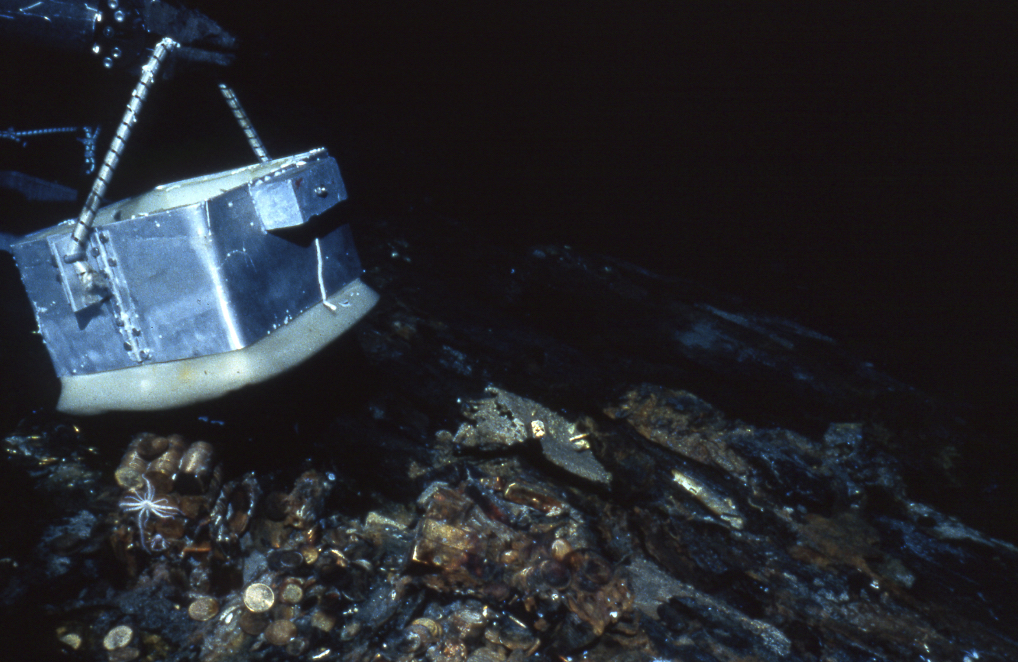
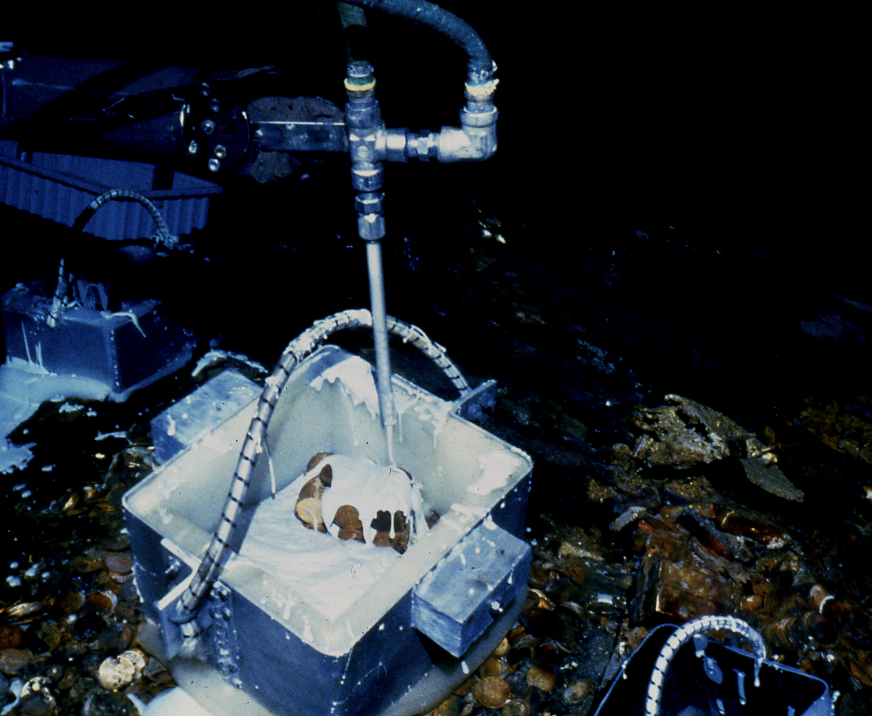
We barely touched the gold in 1988, recovering just enough to establish the success of our search for the investors. Once we had seen the Garden of Gold deposit, it was clear that we needed better equipment; “a bigger boat” would be the Jaws analogy. We didn’t actually need a bigger boat; our ship was fine. But Nemo the ROV need better controls, and a force-feedback manipulator allowing the pilot to “feel” what he was grabbing. Now that we had found the treasure we could afford to tool up; to equip Nemo with all the latest whistles and bells. It was an enormous success, and in 1989 we recovered over a ton of gold.
As we dug down deeper through the commercial shipment, we encountered thousands of gold pieces thoroughly imbedded in massive mineralization. Clumps and clusters of coins became more frequent finds. As we exposed an underlying layer of degraded coin boxes, I mused with Mike Milosh, Nemo’s pilot and principal engineer, “Wouldn’t it be cool if we could recover one of those boxes intact?”
Mike was focused on what he was doing, recovering individual coins with our suction picker. But he was also clearly deep in thought, processing my hypothetical challenge. After a minute or two of quiet consideration, he turned to me, smiled, and remarked, “Let me think about that.”
We finished the dive, and Nemo was back on deck before sundown with a belly-full of treasure. We were excavating down into the mineralized core of the gold deposit, finding more and more clustered rolls of double eagles, and extracting them from the rusty mass. They looked a little like stacks of poker chips They were not at all loose, and they clung tightly to their neighbors.
In previous dives, pairs and trios of coins were recovered frequently enough. Larger rolls were not common, but we did find some. When the pilot trained the suction picker on a single target coin and lifted it, sometimes companion coins would come along for the ride. If they arrived in my lab as one solid piece, I would catalogue these clumps or clusters as a single artifact, with an abbreviated description of the number of coins involved, and any information I could include.
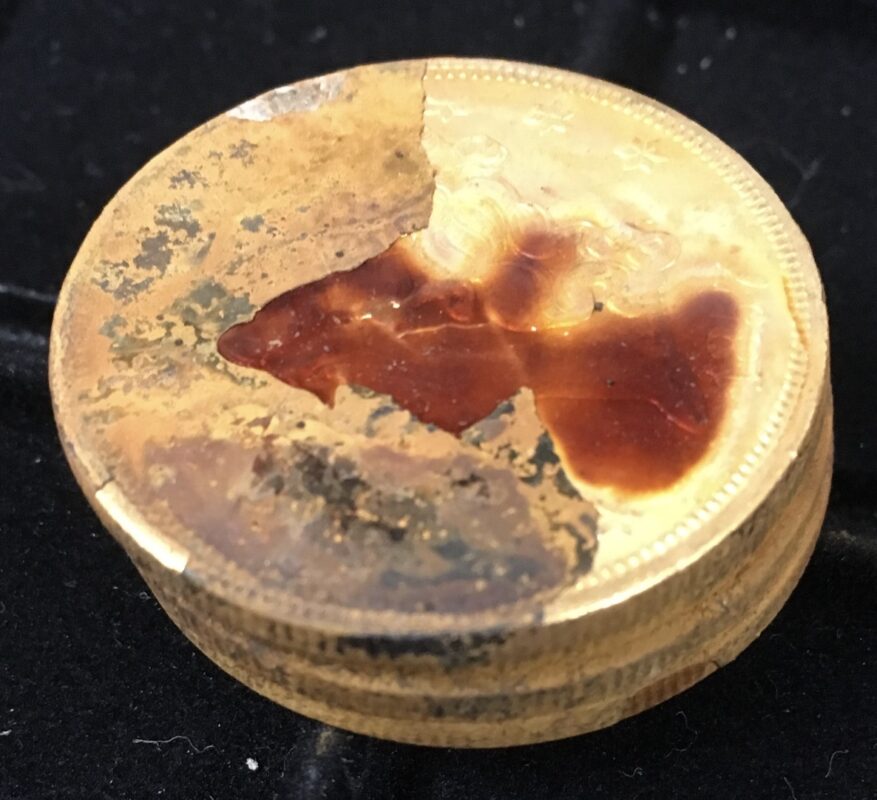
For example, “4×20 1857 – S” would mean a cluster of four double eagles with the date (1857) showing on one end of the composite roll and the mintmark (S) showing on the other
The second part of the description abbreviation could also read “S – S” if only the reverses (tails sides) showed. “Obv,” (obverse) or “Rv,” reverse would indicate that we could tell which side of the coin it was, but we could not see a date or mintmark through the rust. If the whole cluster was obscured in a big concretion, it would be labeled “? -?”

We found double eagles in the commercial shipment rolls neatly arranged in linear stacks inside degraded, custom-sized wooden (pine) boxes that had been sealed for shipment. Here was an example of how the artifacts reveals things not told in the written historical record. We took a sample of wood from a fragmentary box that had held treasure to a paleoethnobotanist, Lee Newsom, at the Florida Museum of Natural History. There are such scientists, who study plants and their relations to the world of former humans. She examined the cell structure of the wood, which revealed that it was from a group of species known as the pitch or southern hard pines. Southern Pine! Probably the widely used Long-leaf Pine, but definitely not Ponderosa Pine or any California-sourced wood.
So, think about that for a moment. Some enterprising sawmill and its associates in the southern states found it profitable enough to ship their boards to California, around the Horn, since that was the only way. In 1857, working men laboring in California were still busy mining gold, not felling and sawing trees. So, even with California’s abundant forests, southern pine was used to make boxes to ship California gold to the rest of the world.
The shipment sank with the steamship, and it sat there, the wood degrading and the whole mass mineralizing, for 133 years before we found it. In that time many once individual coins became fused together by the rusty and limy, natural cement. This clustering of coins meant that we could not yet determine the identity of any of the interior coins in a roll/stack/cluster. Our example group of four coins might read “1857” on one end and “S” on the other, but that did not mean that the interior two were 1857-S double eagles, even though that might be a logical assumption.
After the dive where I floated the idea about picking up a whole box, I had plenty of coins to catalogue and stabilize in the lab and it was well after midnight when I finished. I climbed from my lab on the lower deck up to the Bridge knowing I would find someone awake there. I was speaking with First Mate John Patton, discussing a ship passing 8 miles off, (no problem, probably headed to Charleston) when I noticed activity in our shipboard mechanics’ shop under the forecastle. It was Mike Milosh.
When I got down to the shop, Mike was bending and grinding a sheet of aluminum. Obviously, delighted with the challenge, he was designing a specialized spatula, something he could grasp with Nemo’s claw and slide under the box of coins over which we had briefly mused the day before. I was delighted to find him so interested, working in the middle of the night on an improvised tool. If the spatula could find a decent slot under the box, and if the box remained more or less intact, and if the coins were cemented together by rust and minerals as we thought they might be, then this just might work.
It did work, almost exactly as planned. On the next dive we selected a box of coins that sat at an opportune angle, slipped the spatula under the bottom board of the box, lifted it onto a foam-lined plastic tray, then lifted the whole kit and kaboodle into Nemo’s storage drawer for recovery to the surface. The end result was one of the most spectacular artifacts it will ever be my privilege to handle and display: I have always called it “The Treasure Box.” It contained a total of 123 double eagles, resting on a degraded pine bottom, with two partial sides enclosing one corner.
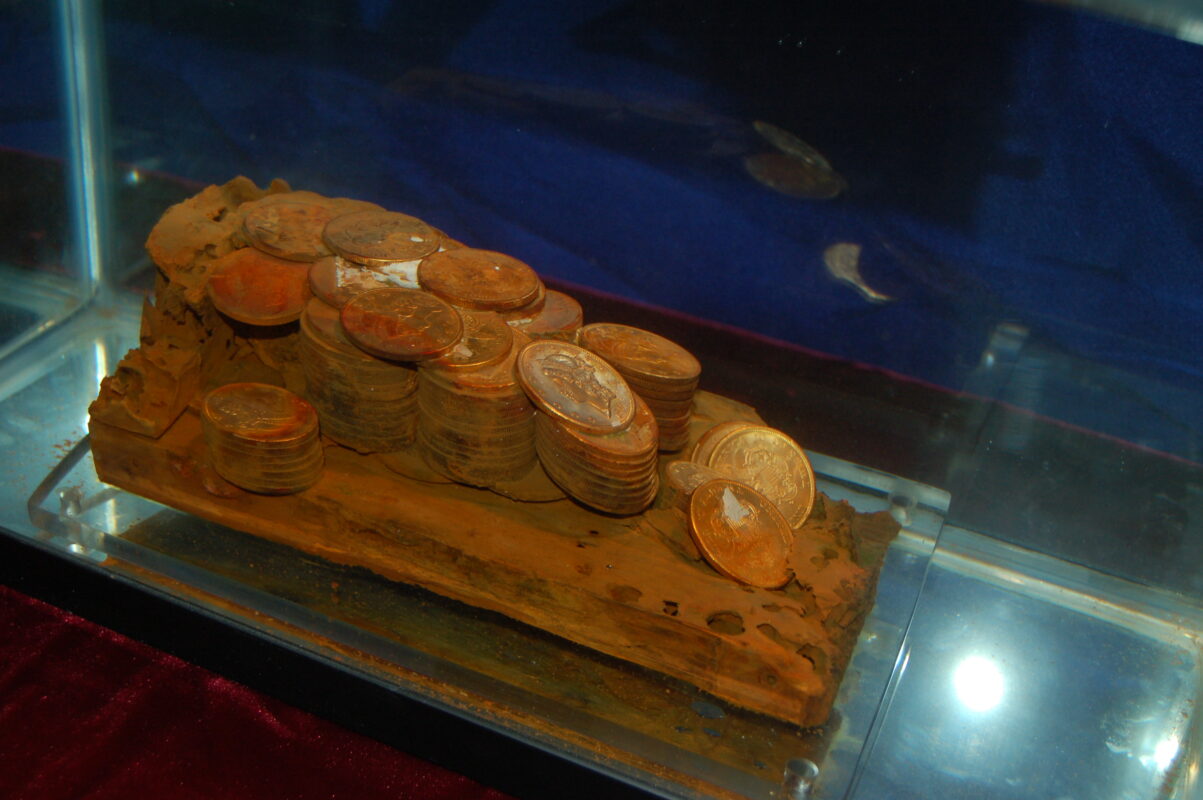
This was an actual treasure chest, not one of those large overblown treasure chests from fiction and fantasy, but a small, compact, and one-time very useful box of gold that represented the real commerce of the California Gold Rush period. This was originally a $3,000 box, with two rows of five stacks, with 15 coins in each stack. The box was built with the interior dimensions to hold exactly that. The coins stayed neatly stacked with no wiggle room. Once screwed shut and sealed with wax on the joints this could serve as a $3,000 unit, without having to re-count it, as long as the wax seals were unbroken. Although small, this little pine box originally held 11 pounds of gold coins.
Once recovered, the box posed some curatorial issues. It was a “composite” artifact, consisting of several materials: gold (contents), wood (box boards), wax (seals between the boards), and, of course, minerals, the familiar rust and limestone. The first step after recovery from the ocean was to determine whether this combination of materials would hold together for storage. I felt a little like the dog who caught the car. I wanted to keep it all together, but could I?
The stacks of double eagles were firmly cemented together by the minerals. The wooden boards were spongy when probed, with numerous holes from deep-ocean shipworms that had eaten the box. It looked like the whole piece would stay intact as long as the heavy one-ounce coins were securely cemented by the rust and limestone, and as long as I kept it in water.

Allowing the boards to dry out would cause them to shrink, which would destabilize the whole artifact. The practical reality was that this was a nine-pound rock of indeterminate fragility, sitting on rotten, spongey boards. I fashioned a rectangular aluminum sheet with holes in the corners to place under the box. Nylon cords went through the holes, and this “lifting bridle” could be used to lift the artifact in and out of water for storage or display without flexing and breaking apart the stacks.
The original storage in clean seawater was switched to distilled water, to discourage uncontrolled growth of algae and cyanobacteria on the wood. Periodically, I would gently wash away the growths that did develop. At one point I replaced the aluminum sheet base with one made of Plexiglas because it looked better. The treasure made its first public appearance in 2000, and this unique box of gold from 1857 was a feature of the wildly popular Ship Of Gold exhibit, which debuted at the Long Beach Coin and Collectible convention in February of 2000.
This was a 40-foot-long representation of the bow of the Central America, with display cases in the side appearing as portholes. An aquarium with the treasure box was the star of one of these porthole display cases; an actual box of gold coins, from the famous shipwreck, right in front of the eyes of the viewer, appearing just the way it was found on the bottom of the ocean. Even veteran dealers and collectors had never seen anything like it, and they came back to the display multiple times to gaze at it and ponder its story.
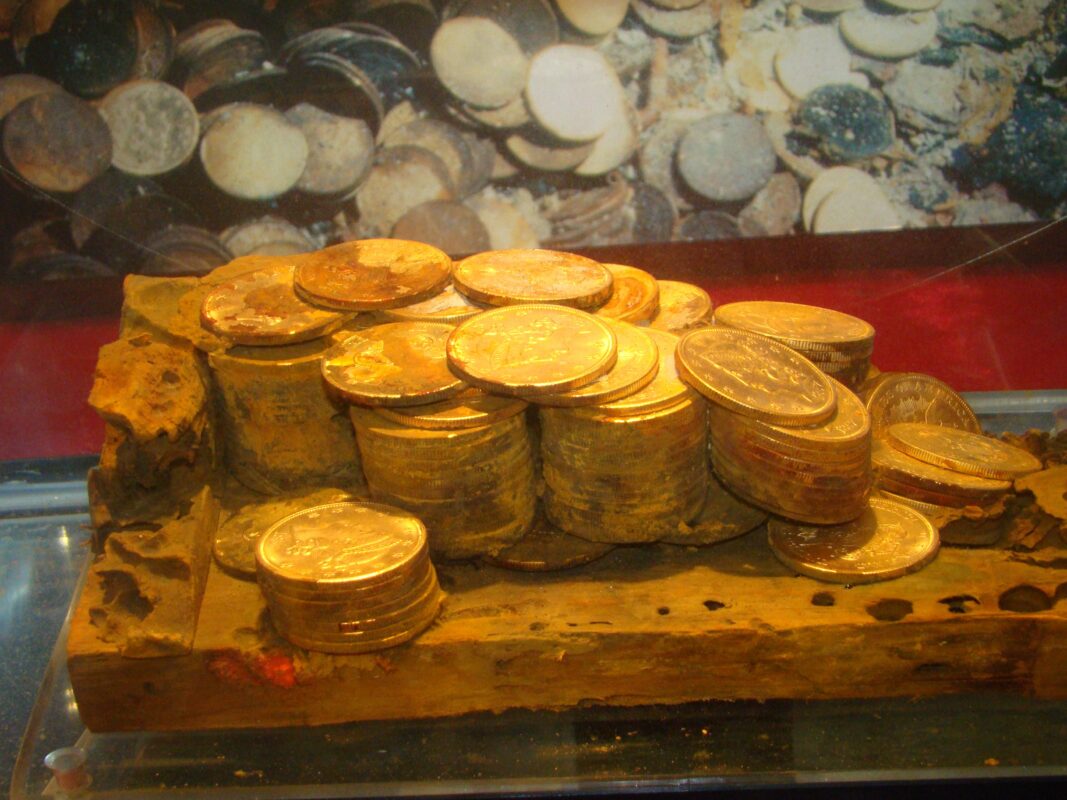
The Ship Of Gold exhibit was modular in its design, and built to travel. Over the next couple years, the display was set up at numismatic conventions, museums, and other venues across the United States: Long Beach, Salt Lake City, Philadelphia, San Francisco, New York, Atlanta, Omaha, even the California State Fair.
In 2005 the treasure box was selected to be a part of a new traveling exhibit organized by the American Museum of Natural History in New York, titled “Gold! – Natural Wonder, Cultural Obsession.” This exhibit covered all aspects of gold: scientific, historical, gold rushes, sunken treasure, cultural uses, jewelry, awards, etc. As a part of that traveling show the box in its aquarium made more appearances, in New York, Houston, New Orleans, Atlanta, Denver, Chicago, and Cincinnati. Everywhere, the aquarium with the treasure box was met with acclaim and wide-eyed wonder.
Throughout these years of storage and display, removed from the environment where they originally formed, the rust and limestone were slowly losing their hold on the stacks of double eagles within the box. I had wonderful discussions with curators at all the venues where we display it. No one had ever faced a challenge quite like this one, and no one had any good ideas about how to stop the artifact’s eventual collapse.
A couple of the coins on the top of the stacks became loose, then a couple more. You see, the distilled water storage that kept the wooden box intact was slowly dissolving the minerals that secured the stacks of coins. Each periodic water change, each gentle rinsing, lifted more and more of the rust off the gold. With every session it was more beautiful and less stable. In 2009, at its most dazzling (in my humble opinion,) during a water change, I posed it for an open-air portrait.
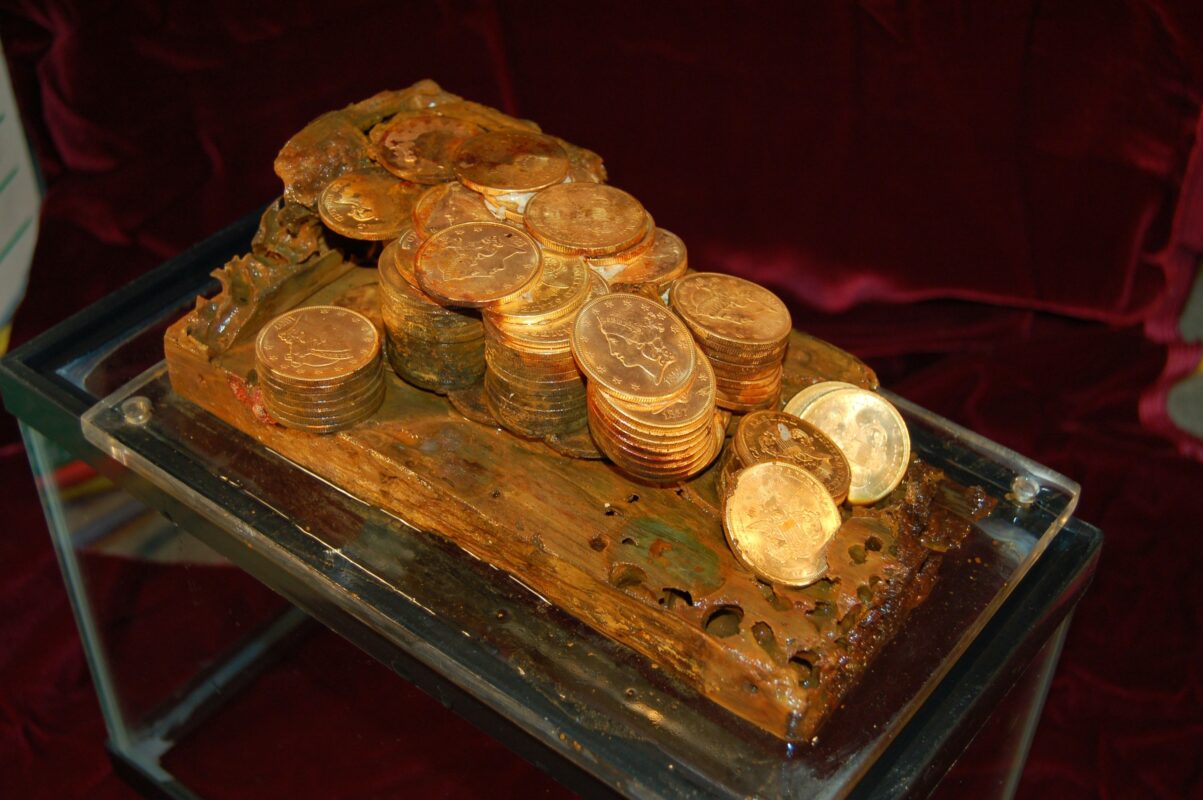
Eventually the artifact could no longer be moved without the stacks of coins sliding and collapsing. Since coins were coming loose and it could not be used safely for display any more, in 2021 we decided that it was time to unpack the box and discover what marvels lay within. And what wonders the coins turned out to be!
123 double eagles was the total count, most of them the “signature” coin of the S.S. Central America, the 1857-S $20 gold piece. As part of the commercial shipment, this would be expected: recent products of the United States Branch Mint in San Francisco. But not all the 1857-S pieces were of the same die variety, and there were a smattering of other dates and mints interspersed in the rolls, showing that this wasn’t a “straight run” from the mint. It was just an ordinary business-like box of three thousand bucks. We found no indications of who the original shipper of this box was, but whoever they were they obviously had visited the United Stated Branch Mint in San Francisco very recently with a deposit of raw “gold dust,” which could also include ingots or foreign coins.
A great many of the coins appeared very fresh, utterly untouched, as if they just came from the mint and were boxed up for shipment. There were many proof-like examples found among these coins, indicating that before striking the mint had just polished the dies, the tools used to impart the artwork, devices and legends to the surfaces. Prooflike coins reflect light like a mirror, and you could actually read print reflected in the fields of these astonishing pieces from several inches away. The shipper’s visit to the mint must have coincided with the time just after the dies had been polished.
Although these coins showed unusual brilliance and flash, they were produced with normal circulation in mind, in other words, “business strikes.” On that day in August of 1857, the mint had stacked them in the supply of coins to be used in exchange for raw gold deposits, and so they ended up in the hands of the depositor, the company that then packed them in a $3,000 box, and sealed it for shipping to New York.
We learned all the details of that exchange after the treasure slowly gave up these secrets, 30 years after I mused to Mike Milosh, “Wouldn’t it be cool if we could recover one of those boxes intact?”
More to come on Treasure Talk Episode 6
Bob