Treasure Talk with Bob Evans, News, Rare Coin Articles
Treasure Talk: Episode 10 – Part 2
More Adventures with Gold Dust
Nov
Treasure Talk: Episode 10 – Part 2
More Adventures with Gold Dust
By December of 2017, the legal and business matters following the 2014 recoveries had been resolved, at least as far as my business was concerned. The treasure was moved to a lab that was prepared for me inside the Collectors Universe building, right around the corner and down the hall from the PCGS grading room. For the next year and a half, I spent half of my waking hours there.
With the “new” treasure to take to market, we dusted off the Ship of Gold display for another big appearance at the Long Beach Coin & Collectible Expo, in February of 2018.
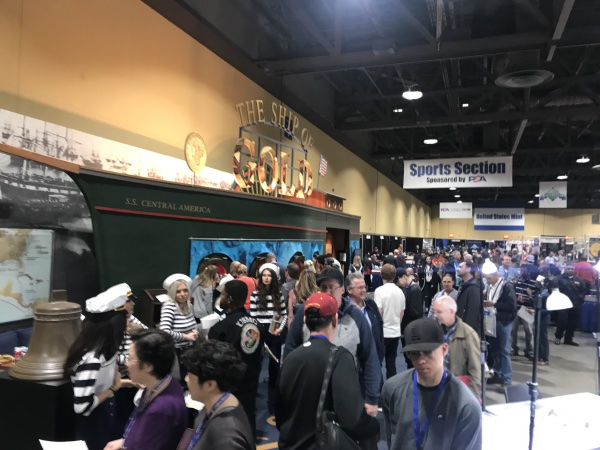
I have described this exhibit in previous Treasure Talks, but the main display is a forty-foot-long modular depiction of the bow of the ship, with portholes in the side serving as display cases. A recessed alcove room gives a space for a walkaround feature display of treasure.
In the old days, 2000 – 2010, inside one of the portholes, we displayed the incredible partially intact treasure box, (see Treasure Talk Episode 5 Part 2) inside an aquarium, giving visitors a chance to see treasure up close, as found, in its original state.
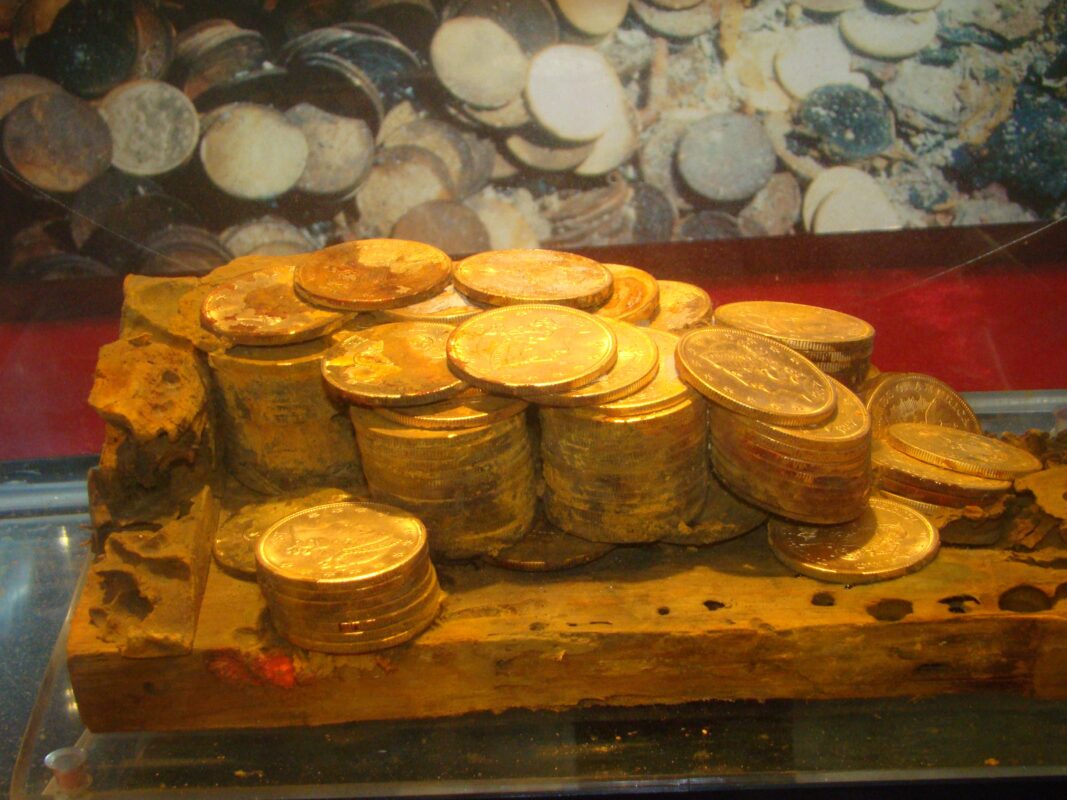
This artifact picked up a few nicknames over the years; the “fishbowl” was a favorite, although not very respectful of its fabulousness.
But now it was 2018, and the box and its coins were not a part of the “new” treasure, the gold we recovered in 2014. The more recently recovered treasure was the subject of the 2018 promotions. What could we use as a substitute?
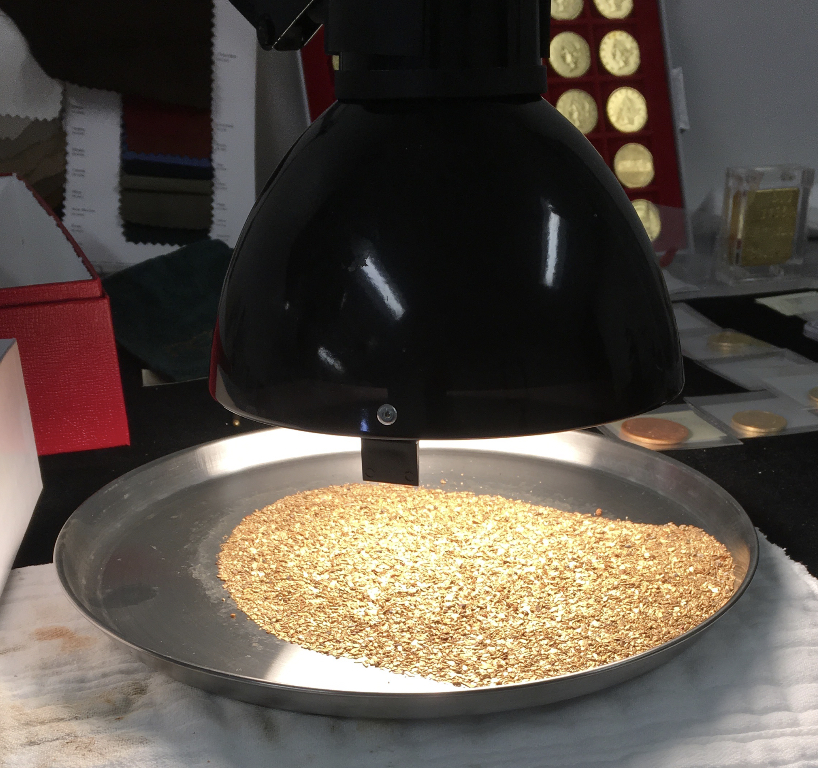
In the lab, I had quite a few degraded bags of gold dust and nuggets, still sitting in water inside Ziploc bags, just as we had packaged it years earlier on the ship. At this point in February, just a month after I had commenced work in the lab, we had processed only a small portion of the gold dust at hand, just a little bit for some opening event promotions.
The big intact bundles removed from the saddle bag were still sitting on the shelf in the lab, where they became consistent objects of curiosity and speculation for the few visitors allowed into this inner sanctum. I had rinsed most of the blackness off them, then set them on a diaper, awaiting further processing.
Then, something clicked, and I had an inspiration. I decided to use gold dust as aquarium gravel.
Because I could!
Who in the world ever gets to do that?! No one!
Such an extravagance is beyond the reach of tycoons and sultans, not from lack of money as much as lack of opportunity. Sitting in my converted-storeroom lab in southern California I had the resources to construct a display like no other ever seen!
As I thought seriously about it, it wouldn’t be easy. It was bound to be messy, and time-consuming, taking perhaps hours; not something that could be repeated easily. It wasn’t like I could stage a rehearsal. I would have to construct the display in place, in one shot. I estimated the volume of loose gold and nuggets on hand… Yes, that should make an inch or two of “gravel” in the bottom of my PetSmart 5-gallon aquarium.
In its raw state the gravel was rusty and not terribly attractive. So, I gave it the curatorial treatment well-tested previously on thousands of gold coins. The rust vanished, exposing the original rocks, now yellow, as the public would expect.
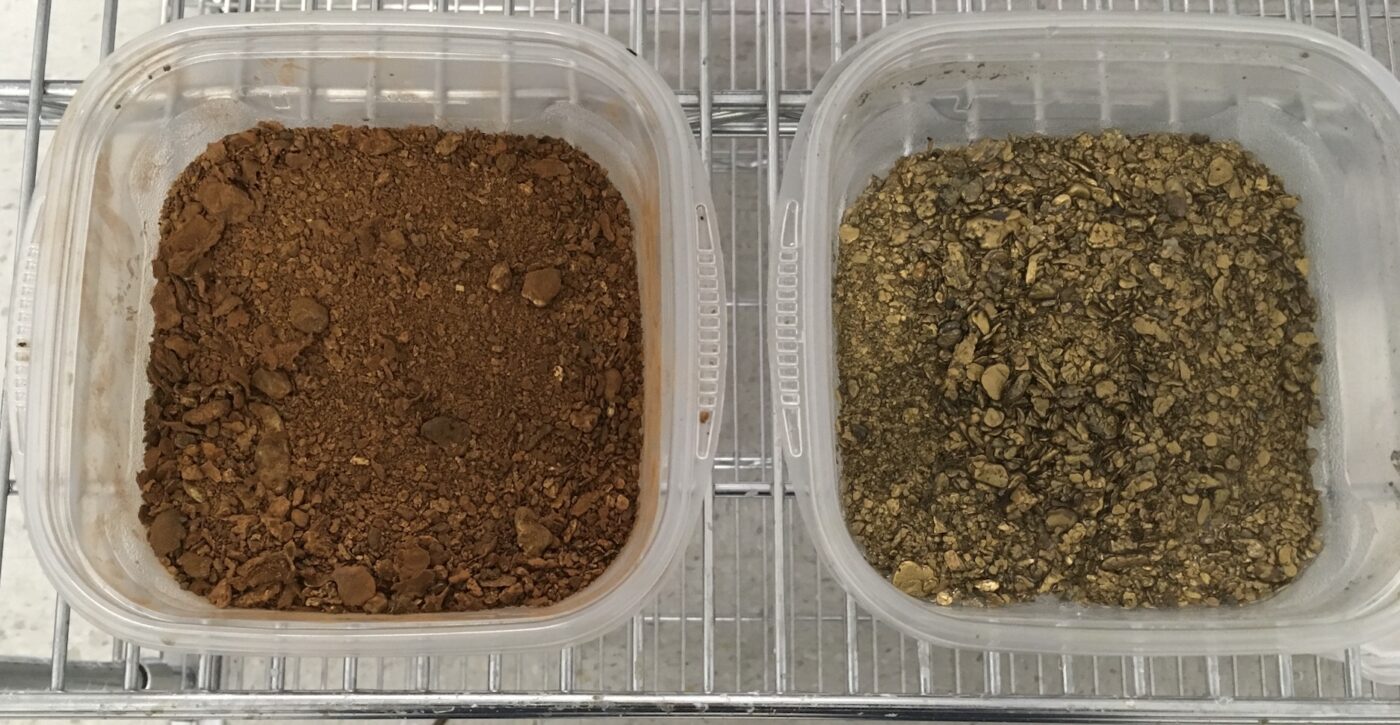
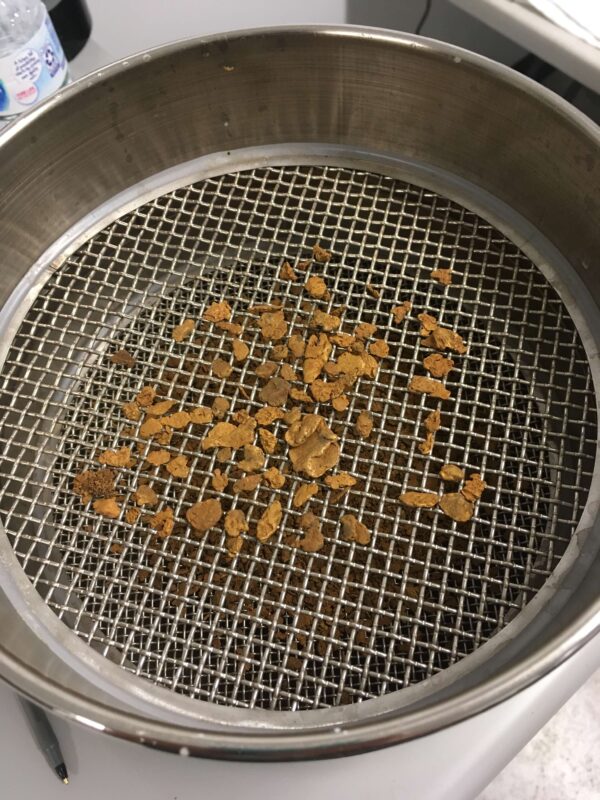
I used a coarse sieve, 4mm, to sort out some of the larger nuggets.
I decided that this porthole display would feature native gold dust and nuggets, with the three remaining intact pokes from the saddlebag as the large artifacts resting on a bed of gold dust. Pretty cool.
Marketing partners were on hand during the installation, helping me make aesthetic and design decisions. This was welcome, because I like including others, and spreading the responsibility. I was the Director, but he was the Producer.
He decided that the aquarium looked a little bare. Although it was an astonishing amount of gold sitting in a $20 aquarium, I had to admit that at first glance it just looked like three old rust-colored cloth bags tied up with string and sitting on a pile of yellow dirt. There was mystery inside the bags, and the yellow gravel certainly was intriguing, but the scene lacked something. So we added the Henry Hentsch Ingot No. 3225, a 119.45-ounce bar, and set it beside the bags, resting at a jaunty angle.
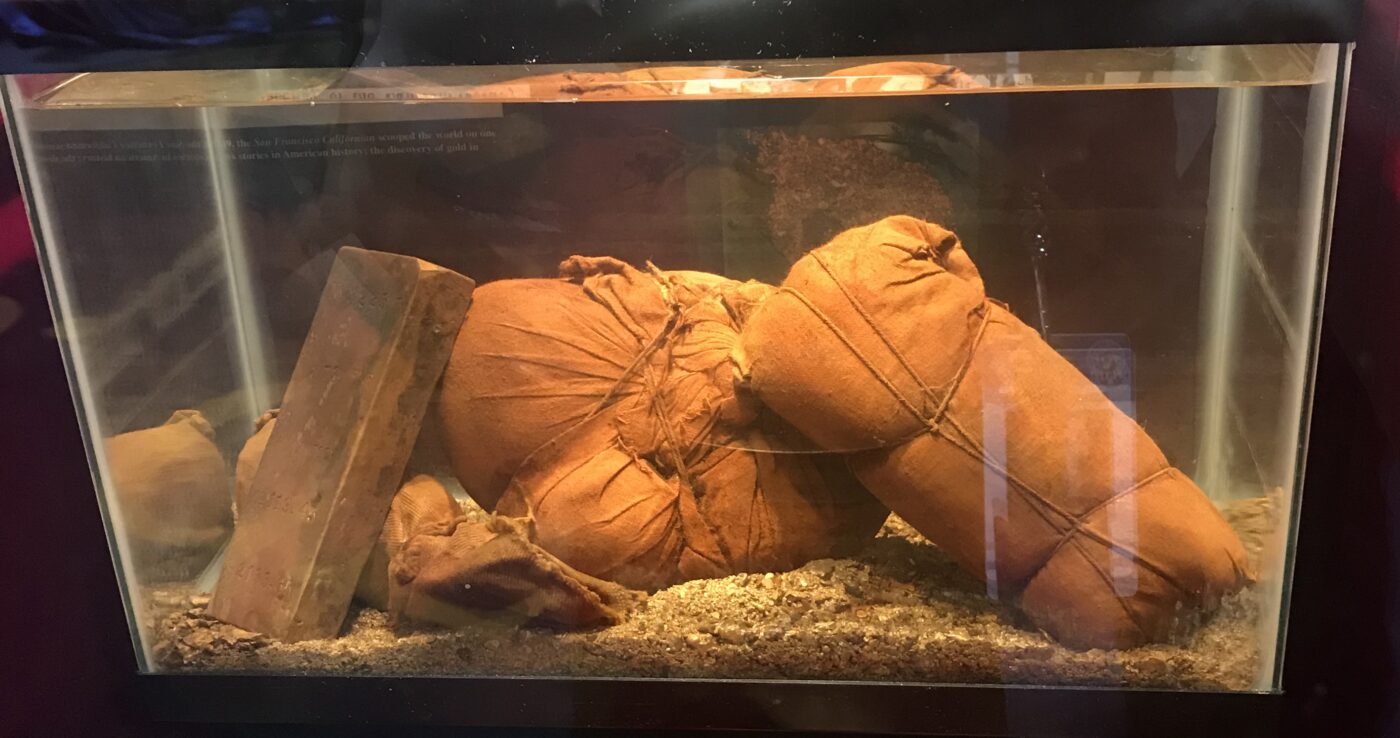
The other three porthole display-cabinets presented other great treasures found in 2014: tubes filled with coins yet to be conserved, a wonderful display of privately-minted “pioneer” $20 gold pieces, and some of the newly encapsulated coins in exceptional grades. The main feature, as far as most of the public was concerned, was a mound of stacked ingots, which we dubbed, “Goldhenge,” arrayed in the central case within the alcove room of the exhibit.
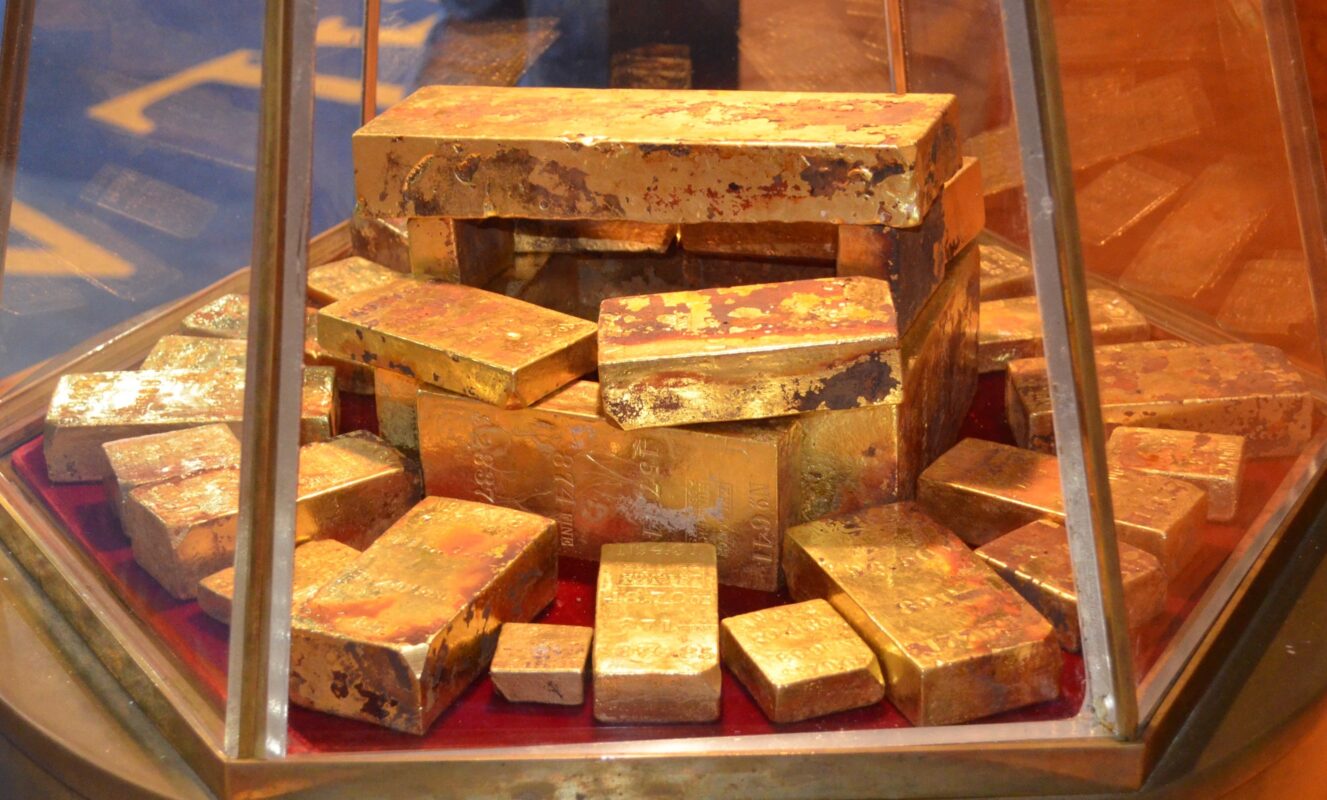
As you might expect, this case with the massive display of gold bars got most of the attention from the public at-large, those without specialty interests. Others were fascinated by the high-grade coins on display in a porthole. An 1857-S $3 in MS67 got some admirers, finest known by a couple of grades.
Our aquarium display of native gold dust, bags with mystery contents, and one lone, leaning ingot got a little action, but generally it was in passing. I staged some petri dishes filled with gold dust, and some of the larger, more interesting nuggets out front, along with some “pokes,” little leather bags that had originally held some of the gravel, now in the aquarium behind. (Note: these bags had degraded and had holes.) And so, they were no longer able to contain the gold dust, which was spilling out. I was fortunate to save this much structure out of the original blackened mess inside those vests.)
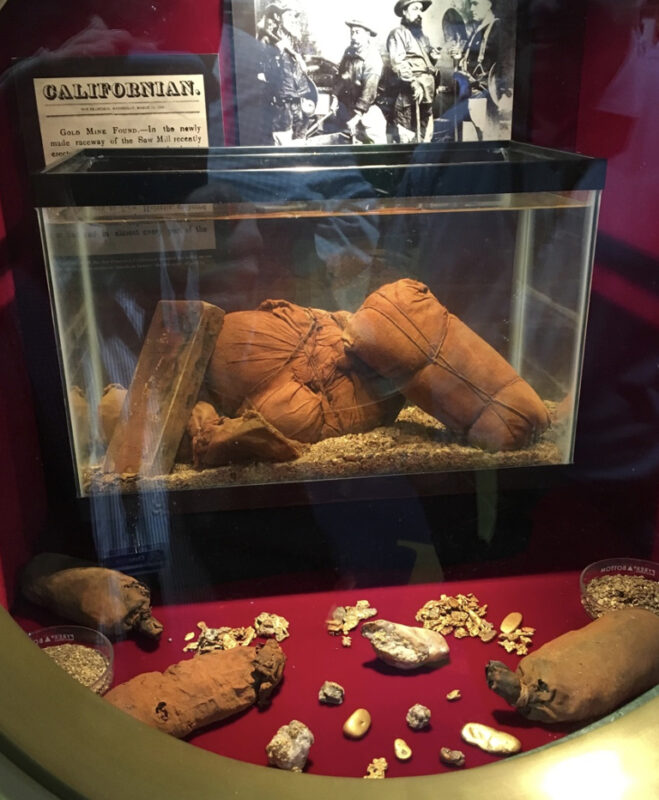
I thought it looked great, but in the presence of Goldhenge and the gleaming high-grade coins…? Most folks would give it 10 or 15 seconds, maybe half a minute.
I think it was the Saturday of the show, so the crowd was not as pressing as opening day, and kids were around. I was enjoying sharing stories with exhibit visitors, when I noticed a shortish man with a ponytail and a beard standing with two children in front of our native gold display. (Note: shortish men are still a little taller than my 5’4”.) He seemed transfixed, with his nose pressed close to the window, and he was saying something to the girls as he pointed at the yellow rocks.
I walked up, more than happy to talk to someone looking so intently at the dust and nuggets.
I chimed in cheerily, “Yeah. It’s the gold dust we recovered from the shipwreck.”
He turned to me, smiling, and rather emphatically proclaiming, “Yeah, and it’s gold dust from the districts that they were mining in 1857!”
And so, I met Erik Melchiorre, Professor of Stable Isotope Geochemistry at California State University, San Bernardino.
Back around 1990, I started thinking about this very same fact. Just as the gold and artifacts from the SSCA are a time capsule of monetary and cultural practices in the 1850s, the gold dust from the SSCA was a geological sample of exactly what they were mining at that time. For a while, still in my 30s, I considered pursuing some kind of university research about this, working toward a PhD or something. But, as I have explained, as an undergraduate, I studied fossils at Ohio State. Pursuing a graduate degree in geochemistry would be a whole new direction. So, my idea of seriously studying the science of the gold dust languished – until that moment.
All of a sudden, I had met another human who immediately recognized the significance of the pieces of native gold; not just their monetary value, but their scientific importance, the evidence and the opportunity they represented. And he had resources: a university science department, with equipment, and students.
Using the SSCA gold and story to inform and inspire education has been central to the project from the very beginning. The original company’s Adjunct Science and Education Program gave specialty scientists and educators access to an exciting new world, a deep-ocean, wooden-hulled shipwreck with all its physical and biological wonders, in addition to all that gold. From the fruits of the early expeditions, 1988 – 1991, academic theses, dissertations, and peer-reviewed articles resulted from these collaborations. I was eager and alert for opportunities to continue this tradition.
Now, out of the blue, a university professor actively teaching about gold dust, “placer gold,” was standing in front of my display. He was unique. I was surprised and delighted at this meeting. “Placer” gold is defined as gold that is found loose, already weathered out of its original matrix rock, and found as dust or nuggets in the soil or in the stream.
Most geochemistry and mining geology courses focus on the occurrence of “lode” deposits, with metal or metallic minerals found in their original context within the rock, which is then considered an “ore.” Erik also taught about placer deposits. He and I hit it off immediately. He had some interest in numismatics, with a personal coin collection in his present or past. That and the publicity about the treasure had led him to drive to Long Beach with his kids for the show.
But I don’t think he expected the gold dust bonanza.
We stood there talking for quite a while, possibly 10 minutes. It became obvious I should cast my attention to some other visitors. The Melchiorres went to look at some other things. Before he left for the day, we exchanged contact information, and he posed for a picture with his daughters next to Goldhenge.
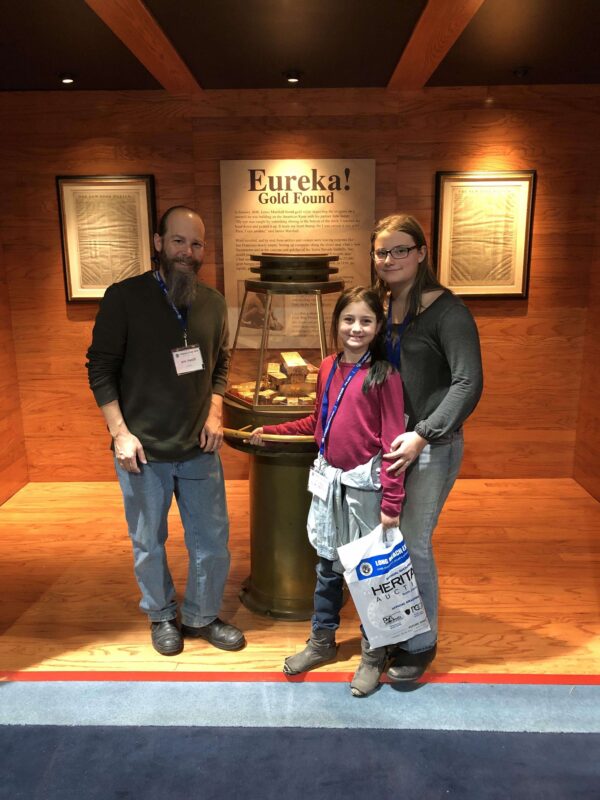
Dr. Melchiorre and his daughters, Bree and Darwin (left)
We arranged to talk further and meet. Soon.
Only a few days later, at my invitation and arrangement, Professor Melchiorre and three students showed up at the front desk of Collectors Universe, introducing themselves as my intended guests. Visitation to my lab was carefully controlled. Of course, internal security and other personnel had access, when necessary, but outsiders had been very few. Only a camera crew or two for publicity.
As I ushered them from the front desk, through two sets of key-coded doors, and down the hallways I instructed them to look but not touch. Of course I did, but it was hardly necessary. I unlocked the door to my room, and we walked in.
The students were a little awestruck. It’s always fun to see the initial impact of great treasure, whether an individual piece, or a lab full of gold. There is magic in the imagination.
Their professor gazed in appropriate wonder, having already seen the Ship exhibit at the coin show. Now he was inside a room with the ingots of Goldhenge arrayed before him. And these weren’t the standardized gold bars of Fort Knox. The ingots recovered in 2014 represented 45 fresh historical assays, experiments that science could check with some modern testing equipment. Professor Melchiorre was a kid in a candy shop.
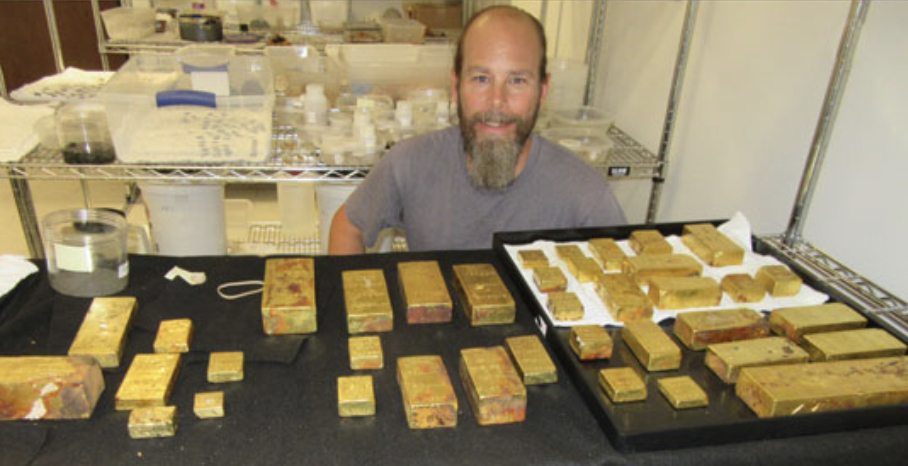
I gave them the “nickel tour” of the lab and its millions. Then we discussed what kind of science might be possible, and the research opportunity presented by this unique “sample” from the “field” and from the past.
Obviously, there was gold dust, and there were ingots, raw specimens of the gold mined in 1857. Then we started talking about the rust encrusting the ingots and coins, in fact encrusting most of the solid surfaces on the shipwreck. As I discussed at length back in Treasure Talk Episode 5, Parts 1 & 2, rust is a complex mineral, and here we had a chance to study a very interesting occurrence of rust, where it was a layered, physical deposit on the host surface, not a corrosion product of the underlying material. The deposit is physical, not chemical,
My collaboration with Professor Erik Melchiorre and his students brought me back into the world of published science. All the geological thought that I had applied during my 3 decades of work on the SSCA now found expression in the broader scientific community of “peer-reviewed” journals. An undergrad, Bryan Seymour, pursued a revealing project taking a microscopic look at the “Black Crusts,” the rust.
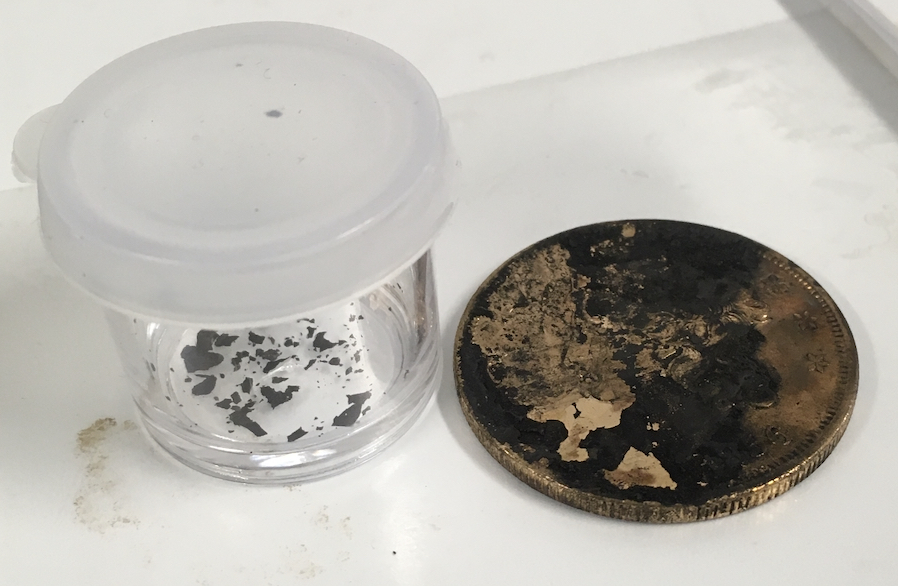
Bryan used a scanning electron microscope to examine the different layers of the rust. Doing so revealed the complexities and mysteries of this residue, which looks like common dirt. The title of our resulting article is typically flowery but accurately descriptive.
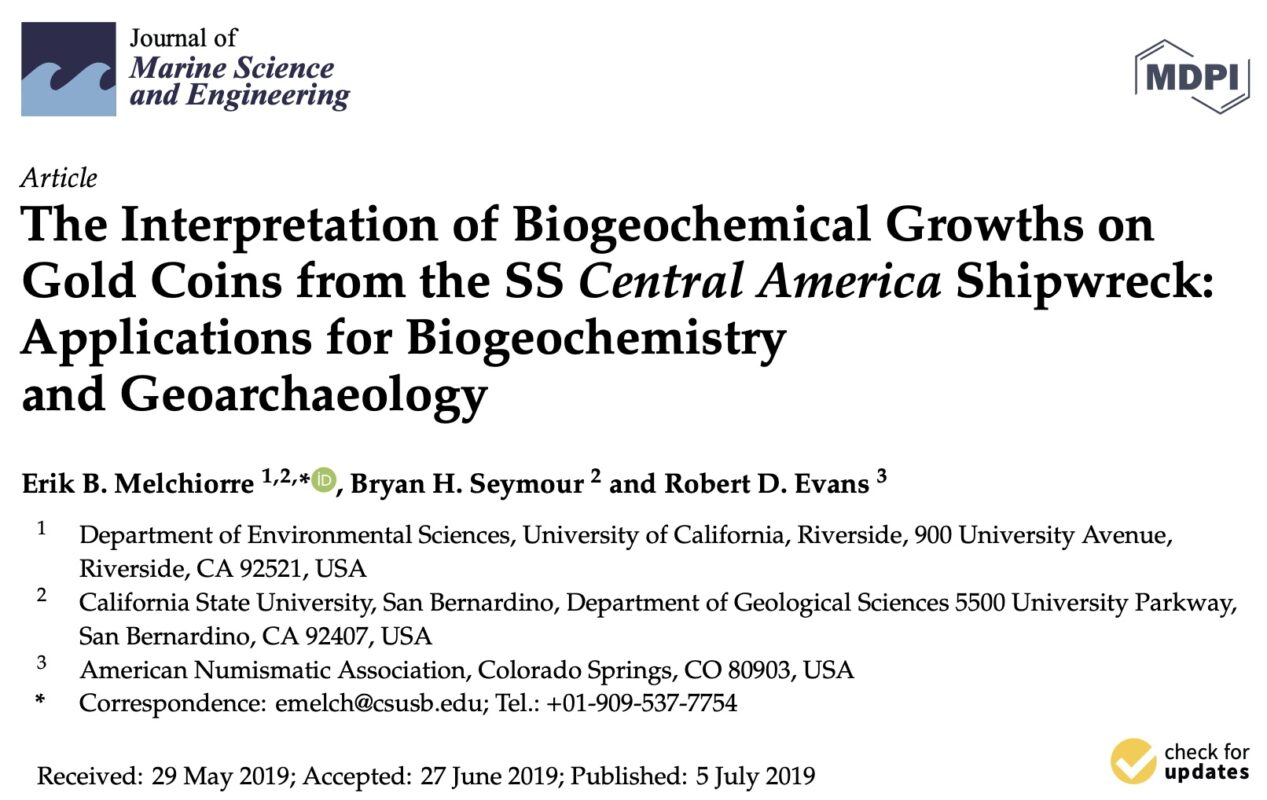
Very briefly summarizing the important conclusions for the lay and numismatic audience:
There is a thin, iron mineral layer directly in micron-scale contact with a gold coin surface. This is the part that can result in shiny lustrous inverse replicas of the host coin, such as with the spectacular “coin fossil” shown in Treasure Talk Episode 5 Part 2. In a spongy layer above that contact zone, there are countless fossil remains of the bacteria that mobilized the iron from the shipwreck along with other bacteria and microorganisms that grew in colonial masses on the coins and other objects, providing the mineral matrix that encased the treasure.
In a very interesting discovery, there is abundant nano-particulate gold flecked throughout this bacterial layer as well. This is gold a micron (1/1000 of a millimeter) or less in diameter, and too fine to have been a part of the originally mined gold dust. The chemistry shows that it cannot have been derived from the host coins either. But it is a product of bacteria specialized to live in the “poisonous” precious metal microenvironment. The chemistry shows that those bacteria used the raw gold dust on the shipwreck as the source for the nano-particulate gold, and that they are the same bacteria that do this in native sources in California. There is no local source for these species.
In other words, the gold dust brought its own “infection” of bacteria with it from California, similar to the way a human disease could be carried and spread to another part of the world.
All this information and more, derived from the rust on an SSCA gold coin.
Kathryn VonSydow, (Katie,) was another of Erik Melchiorre’s students. She was studying for her master’s degree, and chose to do her research and write her thesis based on gold dust found in the “pokes,” the bags found inside the saddle bag that had been displayed in the aquarium. From microscopic traces of platinum found intermingled in the gold dust, she was able to track one particular poke to a couple mining districts along the Yuba River.
Erik, Katie, Bryan and I wrote another article based on x-ray fluorescence analysis of 14 of the SSCA assay ingots.
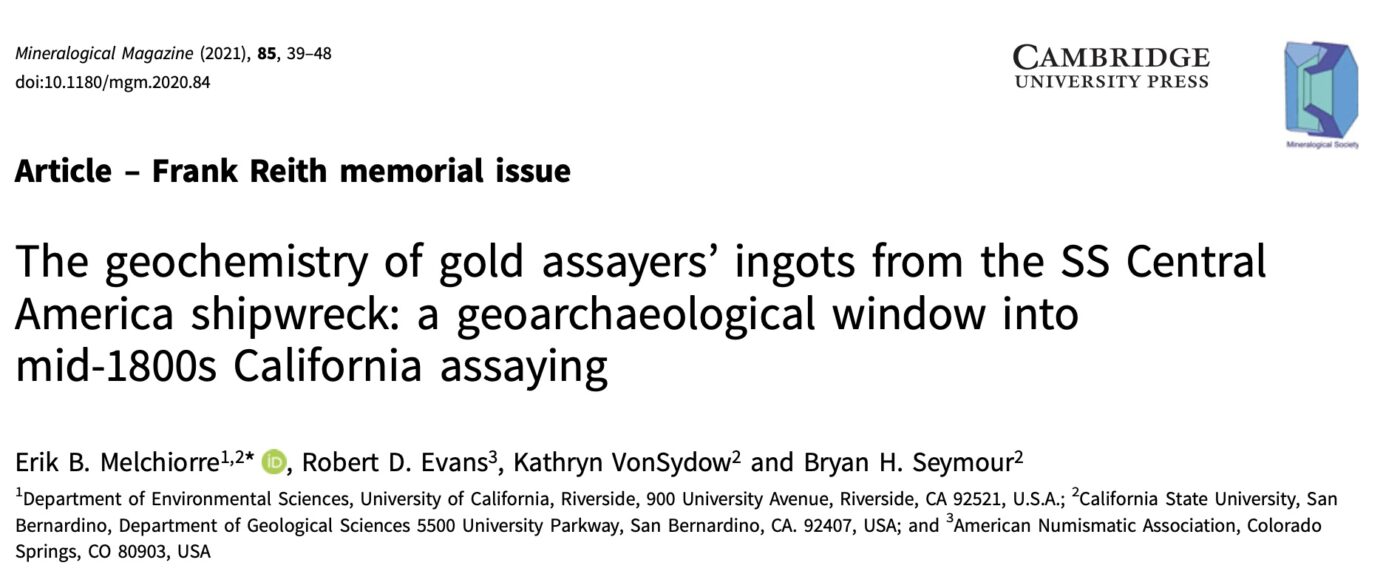
We employed a portable XRF unit, similar to the more sophisticated guns used by coin and bullion businesses. But we used much longer sample times than those usually used by coin dealers (240 seconds for each reading,) and calibrated using known standards. The methods revealed some of the contaminations, particularly brass, possibly introduced by depositors trying to cheat on the weight.
We laugh at this folly, because there is no escaping the assayer’s chemistry. The true weight of pure gold will be revealed, and the true value determined.
The study also showed a uniform trace of palladium in the Kellogg & Humbert ingots, suggesting the use of quality high-temperature tools. The gold assays from the XRF matched the stamped values better for the Kellogg & Humbert ingots than for the Justh & Hunter San Francisco ingots, suggesting some quality control issue, or maybe some shenanigans.
For some reason, the modern measurements are higher than the historical stampings. The time capsule that the shipwreck represents shows itself in many ways, including through the rocks, mined in California in 1857, and being conveyed to New York. With modern testing techniques and electron microscopes, geological science shines light on this part of the S.S. Central America story.
Thanksgiving:
In thinking about this season of gratitude I reflect on my good fortune to be a part of the S.S. Central America Project. I had the scientific curiosity and training to become the co-discoverer and curator of this great treasure. I thank all of those who have aided me in this journey: family, friends, colleagues, crewmates, even some strangers.
One of the oddest coins found on the shipwreck was made by San Francisco jewelers Frontier and Deviercy. Dated 1853, it was a very small 50-cent piece that may or may not have passed at full value in commerce. The reverse device is a supposed eagle that more resembles a scrawny chicken. A sunburst sits behind the bird, giving it a remote similarity to a peacock with its feathers fanned, and so it is commonly known as the “Peacock” variety.
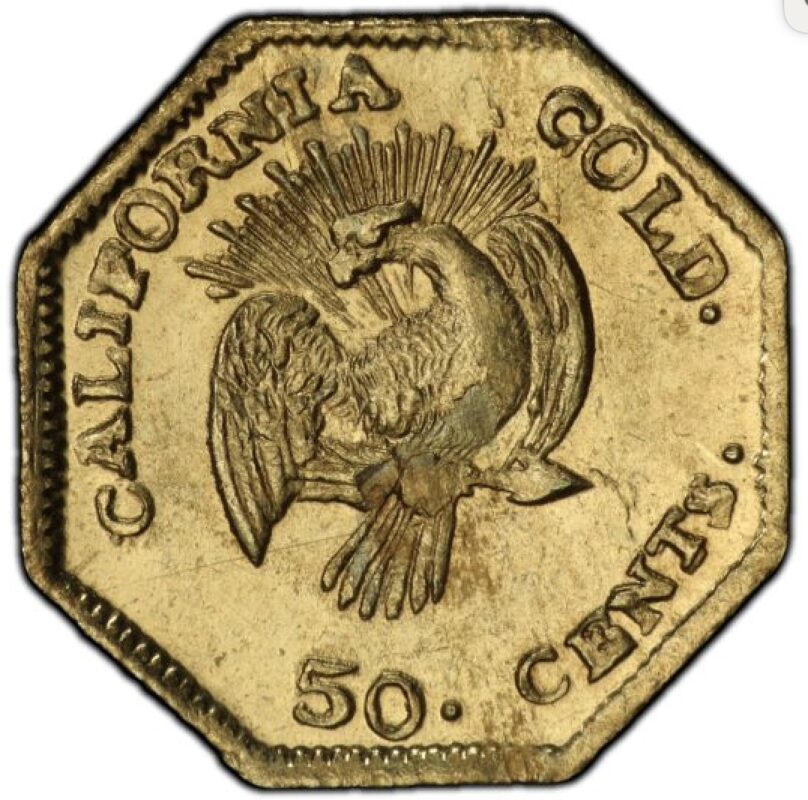
I figure that it resembles a turkey just as much as a peacock.
Happy Thanksgiving!