News, Rare Coin Articles, Reference Library
REMEMBER THE NATIONAL DEBT:
AMERICA’S BIGGEST CHALLENGE

May
REMEMBER THE NATIONAL DEBT:
AMERICA’S BIGGEST CHALLENGE
By all accounts, by both supporters and critics, the Trump administration has hit the ground running, wasting no time to make big changes in US policy.
Nothing has received more attention than the DOGE, the ad hoc Department of Government Efficiency, led by Elon Musk to discover and set up for disposal all sorts of wasteful government programs.
Federal spending stands at over $7 trillion, and the current fiscal year federal budget deficit is up over $2 trillion.
Of the federal budget, the three largest budget items are:
- Medicare/Medicaid: $1.6 trillion+
- Social Security: $1.4 trillion+
- Interest on the National Debt: $1.042 trillion+
Decades of bipartisan policies have contributed to provide the American people with a National Debt totaling $36.8 trillion. Put in a personal perspective that adds up to more than $107,000 for every man, woman and child in America’s population of over 340 million.
The current US Gross Domestic Product, which is a measure of all the goods and services produced by the US economy in a year, is just over $29 trillion. So, the current National Debt to GDP ratio is 122%. As recently as 2000 that ratio stood at 59%. In 1980 it was 34%.
Government spending and the accumulation of debt by our federal government has far outpaced the growth of our economy, which is the engine that makes all spending possible in the first place.
This situation is unsustainable, and it will inevitably have decisive and diverse implications for the US economy and financial markets.
Government spending has been out of control for decades and the inevitable results must be higher inflation and a debasement of the US dollar. Today, our government has put us so deeply in debt, and its debt is avalanching so fast, there is no chance it can repay its debts—except in dollars cheapened by inflation.
Even with budget cuts, our problems with the National Debt will eventually reach catastrophic proportions, because so many of the big-ticket items are “baked into the cake.”
At $1.042 trillion, interest on the National Debt is now the 3rd biggest budget item (nearly $200 billion more than national defense). That figure is 20% of what the federal government will receive in all forms of tax revenue this year and dwarfs much of the rest of federal spending items. Not servicing that debt means default and an unprecedented financial crisis. If interest rates rise, the cost of servicing the debt increases even if we were to stop spending on everything else.
Consider that in 2021, just 4 years ago, the U.S. Treasury department reported that the amount of interest paid on the National Debt was $562 billion. It has nearly doubled in those few short years.
At this rate, in the not-too-distant-future, the government will have to spend more to make its interest payments than it will collect in taxes.
We are, quite bluntly, going broke. We don’t have the money to sustain massive government spending and ever-growing big government policies any longer.
The federal government will not go bankrupt because it is unable to service its debt. To do so would be unthinkable. The government need never default because it has two ways it can secure the necessary funds. First, the government can always tax those subject to its laws to get needed proceeds. It is politically highly unlikely that this option will be chosen. More significantly, it can simply print the money needed so it can repay the debt. As a result, inflation will soar, and the value of the dollar will enter into a nosedive.
There is another aspect to the National Debt situation that many analysts are ignoring: America’s National Debt is increasingly owed to foreigners and that could have profound implications going forward. Consider that the largest single holder of US Treasury debt, Japan, recently made a veiled threat to sell off its holdings in trade tariff negotiations. Now, they walked back that threat soon after making it, but the signal had been sent.
Japan is a US ally and America and Japan have enjoyed a mutually beneficial relationship for 70 years.
But Japan is far from the only holder of US debt.
China is the second largest holder of US Treasury debt and when you combine China’s holdings with those of Hong Kong (China controls Hong Kong), their holdings just about match those of Japan, meaning that China is actually tied for the largest holder of US Treasury debt.
China has also made veiled threats about its Treasury holdings. Many observers believe that China would never sell off its Treasuries because it would be bad for China financially. But consider that there are currently riots in China due to factory and distribution center closures due to the trade war.
Also consider that the Chinese People’s Liberation Army has a blueprint for waging asymmetric war against America called “Unrestricted Warfare,” and included in that plan is financial warfare. To disregard Chinese threats to sell off their Treasuries is not wise.
What would the impact of a sell-off of US Treasuries be? The immediate impact would be a sharp increase in interest rates. When interest rates rise, two things happen. First, the value of existing bonds decline. Second, the stock market declines, perhaps steeply.
Hopefully, President Trump has a plan to meet and overcome these challenges. Unlike career politicians, he thinks outside the box. But “hope” is not a solution. Investors need to act now to protect themselves from the potential financial effects of our National Debt.
WHAT SHOULD YOU DO?
- Above all else: diversify. Diversification doesn’t just mean owning different kinds of stocks. True diversification can only be achieved by allocating a portion of an overall portfolio across different kinds of assets that react differently to the macroeconomic and geopolitical factors that can impact the financial markets. Moreover, it is not enough to simply own stocks and bonds; both stocks and bonds have historically declined during periods in which interest rates are rising.
- Convert a portion of your wealth into investment categories that will enable you to benefit from high inflation and a declining US dollar, rather than having those possibilities erode the value of your savings. Hard assets, particularly gold investments, have historically played that role.
- Put some of your wealth into private, portable assets.
THE NEW WORLD OF GOLD
Over the past 5,000 years, from the Egyptian pharaohs and the merchants of 14th century Venice to the industrialists of the 19th century England and world governments in the current age, man has treasured gold for its utility and value during times of both prosperity and crisis.
Through the rise and fall of great dynasties and civilizations, gold has maintained its purchasing power as a solid store of value for millennia. Today, the demand for gold continues to flourish among world governments, industry and private and institutional investors.
Investment advisors and financial professionals commonly include gold as part of their own well-balanced investment portfolios. Gold is an ideal foundation for a diversified financial plan because the price of gold often increases in response to events that erode the value of traditional paper investments like stocks and bonds. Among the many factors and events that can cause the price of gold to rise are increased industrial and investment demand for gold; bank failures; high inflation; devaluation of the dollar and other currency crises; increases in the price of other commodities, such as oil; stock and bond market declines; and geopolitical tensions.
Though the price of gold can be volatile in the short-term, the value of gold has served as an excellent hedge against high inflation and crisis, as well as the erosion of the purchasing power of paper money.
Physical gold investments are often considered a foundation of your investment portfolio because for thousands of years it has been the primary means by which people, as well as whole civilizations, have preserved their wealth. While traditional investments only provide you with a return on your money (if everything goes well), gold offers you the additional benefit of a history of providing investors with the return of their money (especially when everything does not go so well). In other words, gold has been the ultimate form of financial insurance for millennia.
Like all forms of insurance, you never really know when you’ll need gold’s financial insurance, so the best strategy is always to own gold and to accumulate gold investments in all economic and political conditions whether the price is up or down.
A PROVEN METHOD OF HOW TO OWN GOLD
Rare gold coins offer the intrinsic security of their gold content, plus more profit potential due to their scarcity. They also enjoy added demand from collectors, in addition to investors.
More gold is mined every year, but no one can “make” more rare gold coins.
Rare gold coins may also offer security benefits over and above those of bullion. During the period in which gold bullion was outlawed in the U.S., collectible gold coins were exempted from the laws banning private gold ownership. In addition, rare gold coins offer privacy and portability advantages.
These extra security benefits, combined with intrinsic value and added profit potential due to scarcity make rare gold coins the indispensable component in any properly diversified tangible asset portfolio.
As a leader in the hard asset industry, Finest Known has many ways for you to take advantage of today’s opportunities in hard assets, especially physical gold investments.
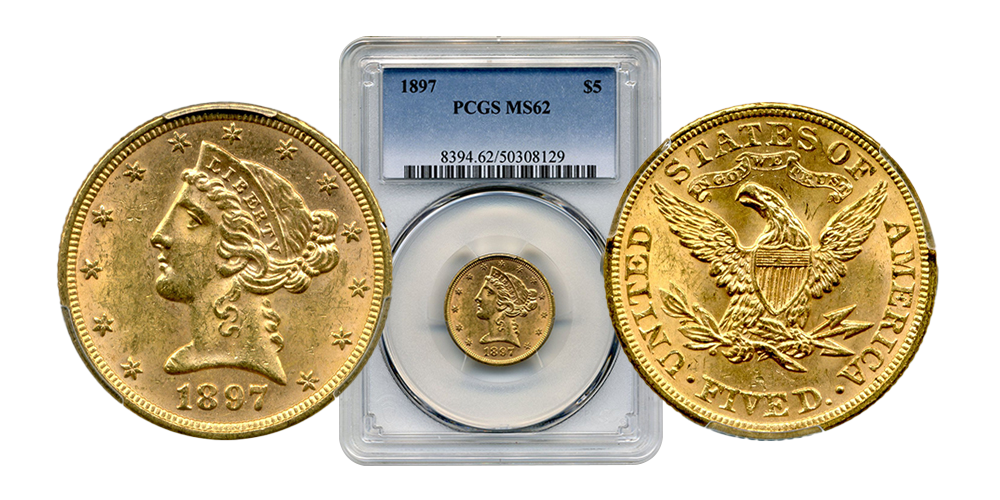
Due to our partnerships, our purchasing power has a significant impact on larger gold deals that surface in the marketplace. One such deal available now is a small cache of pre-1900 $5 Liberty coins dated 1897.
We secured this deal before gold made its recent move above $3,300 and we are passing the savings on to you. We have a limited offering of these pre-1900 $5 Liberty Head coins and if you act now, we will provide you with a $100 discount code off our already current low price listed on our website.
These coins are all PCGS certified and graded MS62 and have a PCSG price listing of $1,025. With your discount code and our already low price, these coins are well under $900. Log on now and take advantage of this special offer.
Contact Finest Known today at 888-751-1933 for specific recommendations to suit your needs and goals.
Call Finest Known today at 888-751-1933