Treasure Talk with Bob Evans, News, Rare Coin Articles
Treasure Talk: Episode 12 Part 2 – Have we found the S.S. Central America?
Feb
Treasure Talk: Episode 12 Part 2 – Have we found the S.S. Central America?
Between the 1987 and 1988 seasons, the engineers and the tech team designed improvements on the ROV for the following season, including ways to excavate a large pile of coal. We acquired our own ship, the Research Vessel Arctic Discoverer, which gave us flexibility independent of having to arrange and modify leased ships for our purposes. As the scientist, during the winter I took stock of all we had learned, the artifacts we had recovered, and the data we had generated.
At the very end of the 1987 season, after the Liberty Star and another pesky rival had withdrawn from the area, we brought Williamson and his team back aboard to spend a few days expanding our 1986 sonar coverage, surveying adjacent to the perimeter of what we had already covered.
So, after the ’87 season I had additional sonar files to review, and I took another look at the entirety of the ’86 files as well, not just the “Hit Parade.” I found that the records included an image of a “large geological feature” that had not made it into the pantheon of cultural anomalies in the “Hit Parade.” After spending a few dives scrutinizing the “ground truth” of the deceptive sonagram of Site A2, and a couple dozen dives comparing the reality we saw on Site H to its rather amorphous sonagram, I had learned how tricky sonar images could be.
Comparing the sonagrams of Site H and the “large geological feature” revealed similar reflectivity. Could this site, now designated as “Foxtrot Alpha” or “FA,” also be a large pile of coal? Considering what we had learned in 1987, it appeared to have many attributes fitting the hypothetical target model. We decided to use it as a test site at the beginning of the 1988 season. It was located conveniently 20 miles closer to shore than the more distant coal-bearing shipwreck we had worked in 1987. So, we could check it out during sea trials at the beginning of the season, then proceed to Site H after we had satisfied our curiosity.
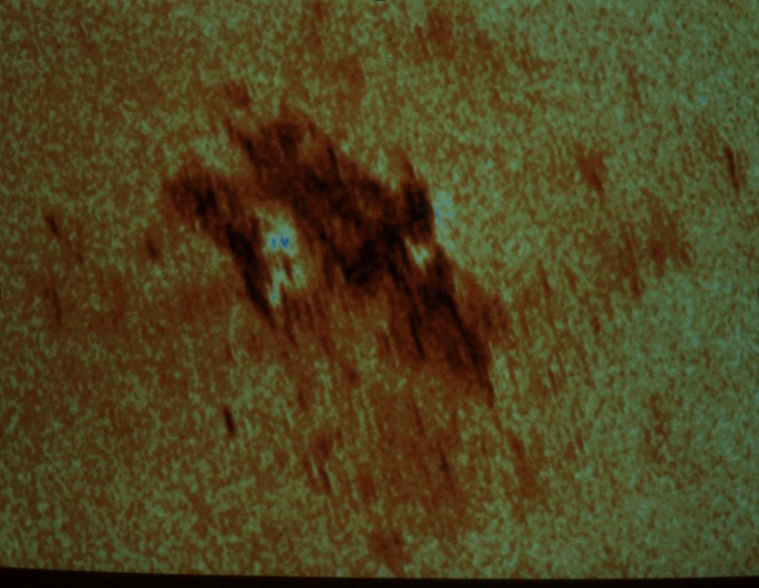
I was very excited about finding this sonar image, lurking amidst the “geology.” I had learned through months of comparison of photos and sonar pictures that there were some things that could be discerned with sonar and some things that could not.
I could see why Williamson and Associates had dismissed FA as geology. Of course, I had been staffing the home office during the ’86 survey, so I had no personal recollection of the discussions over this anomaly when it was imaged. Tommy had been there. When I pressed him about it, he recalled that there had been some discussion, but the sonar team were more concerned about getting back to that promising target in the middle of the high-probability area. There were other long sinuous features, some half a mile and longer, showing on the sonar records in the vicinity of Site FA, so the “large geological feature” had been dismissed from further consideration because it was thought to be just a brighter spot in these fainter features that snaked across the images.
Now that I had some experience, I could see that the FA sonar record showed characteristics that Site H lacked. For one thing, FA had a sonic shadow cast by some hard, tall feature that filled the center of the anomaly. We were not sure how 19th century iron would survive after 130 years submerged in the deep sea, but we had not found a lot of iron machinery on Site H. Was it under the coal? Alternately, was that large, central, bright area casting a sonic shadow on Site FA the yet-to-be-found massive engines of the SSCA?
I twisted myself in knots for months over this conundrum, and I anxiously awaited our first dive on the proposed “test site.”
Outfitting the project’s own ship came with its own set of challenges. Our project’s irascible, retired, navy salvage master, Don Craft, (Commander Donald C. Craft, U.S. Navy (ret.)) found the Canadian Fisheries Research Vessel A. T. Cameron, decommissioned by the government and frozen in the ice at the dock in St. John’s, Newfoundland. He saw the potential; that it met the needed specs, and that this former fishing side-trawler qualified for light icebreaking could be modified with the proposed deck and propulsion equipment to serve as a deep-sea salvage mothership.
We would be using it to launch and recover Nemo our ROV (5-tons-and-growing,) and the ship would need to maintain station on a single spot above the shipwreck during recovery operations, “dynamic positioning” (DP,) no matter the weather and currents. (Way too deep to anchor.)
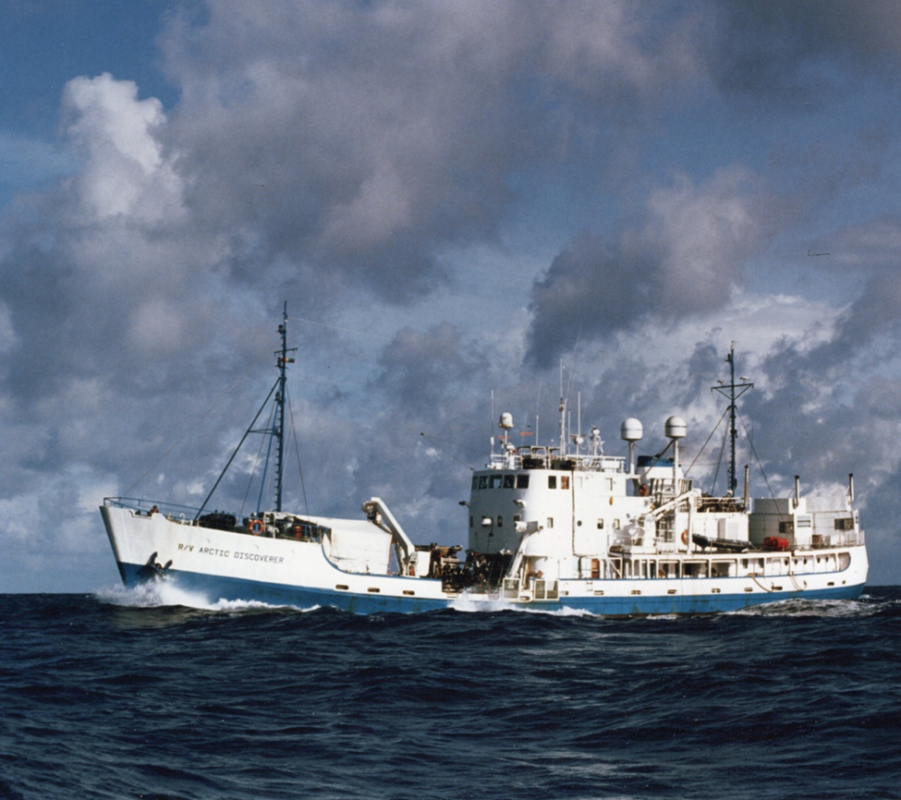
Our ship officers were overqualified for this vessel, which we renamed the Arctic Discoverer, in tribute to its origins and its intended function. Several officers held credentials sufficient to serve as Master of ships significantly bigger than180 feet ship and 754 Tons. A few months into the season, after the Coast Guard boarded us at the fuel dock in Charleston, I heard a CG corpsman’s incredulous remark, “Everyone on this ship is a Captain!”
William B. Burlingham III was the Master, “Captain Bill” to us all. He and 8 crew members assembled in Newfoundland, knocked some of the ice off the decks and rigging, fired up the Arctic Discoverer, and on April 1, 1988, they steamed south to Florida. The logbook showed a journey of 7 days, 10 hours, and 15 minutes, from the icy docks of St. John’s, Newfoundland to the humidity and Spanish Moss of Green Cove Springs, Florida, south of Jacksonville, as far up the St. Johns River as ocean-going ships can navigate.
(A couple different Saint Johns figure into the geographical names, John the Baptist for Newfoundland, and “St. John of the Harbor,” San Juan del Puerto, for the Spanish Mission established near the mouth of the Florida river in the 1580s.)
In the next few months, the project added a crane, as well as our winch from the previous year, capable of handling a couple miles of oceanographic coax cable. Everything was thoroughly overhauled and assessed. The Chief Engineer examined every detail and prepared a massive notebook, a manual for any other engineers who might follow.
Modifying and mobilizing most of the systems and spaces onboard the ship was straightforward. Much of the work was just about restoring the vessel to the kind of working status it maintained during 25 years of Canadian government work catching and studying the cod off the Maritime Provinces. There was sandblasting, priming, painting and cleaning, checking every pump, line, valve and switch. And there were a few specialized additions, satellite navigation and communications equipment.
The dynamic positioning system (DP) was the real issue for most of the month of August. To operate a tethered ROV in places too deep to anchor, the platform (a mothership) must be able to dynamically position, maintaining a tight “watch circle” directly above the ROV, so the cable does not tug on the vehicle and impede its operations. On the Nicor Navigator in 1987, we could achieve this with twin props in the stern and a “tunnel” in the bow, with a propellor running athwartships, for rapidly changing the heading. The Arctic Discoverer had much simpler propulsion, a single stern propellor with three 34-inch blades powered by twin diesel engines of 1000 hp.
We needed to install an auxiliary system of props to achieve the dynamic positioning capability we would need. This took the form of two thrusters, like giant “eggbeaters” or perhaps “trolling motors,” that were mounted along the starboard side, fore and aft. These were powered by auxiliary diesel engines and hydraulic pumps mounted all the way on the stern and connected to the thrusters by 4-inch hydraulic lines (huge) that ran along the inside of the starboard rail. When in operation, the lines would issue a moderately loud whine, almost a moan, that resonated throughout the ship. Our ship sat in one place and sang its song into the sea for hours and days at a time. One wonders what the whales thought.
You can see the thrusters, shown along the starboard side (the base of this drawing) in this plan-view schematic of the Arctic Discoverer.
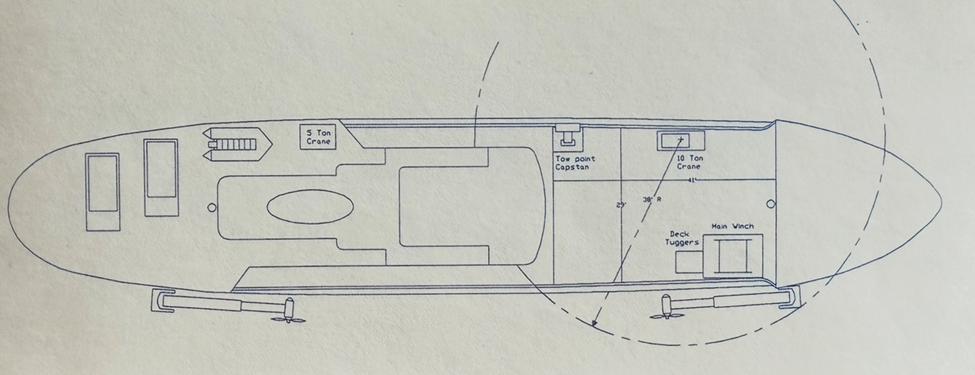
The thrusters were mounted to the side of the ship, the propellors locked into their stored positions just outside the starboard rail. The mounts allowed the thrusters to pivot, lowering to a straight-down position. When operational, they extended clear of the bottom of the hull, so they could each independently thrust at variable speeds and in any direction, driving the ship to wherever it needed to be, while holding the heading in the optimal direction to get the best ride. A computer system would link into our Starfix satellite navigation (pre-GPS) as well as our grid of transponders surrounding the shipwreck on the seabed, and it would keep the ship and ROV comfortably connected and operating. It looked good on paper.
Twice, in August, we steamed out into the ocean to conduct trials of the DP, and twice we came back into the St. Johns River to the barely adequate Daly’s Boatyard, where the thruster experts attempted again and again to get their equipment working properly. I will admit to being very frustrated, eager for the first dive on Site FA.
At the end of August and into the early days of September, we tried again. More sea trials, of the thruster, the navigation systems, and of the newly designed and installed system of winch, blocks (big pulleys) and the new 10-ton crane for launching and recovering the ROV, something that had never been done from this ship’s deck before. Unlike the earlier aborted tests, this time everything worked, at least well enough.
Finally, we were ready to proceed to the “test site” for our first dive of the season to full ocean depth. We had a new and improved Nemo, the ROV, and we had our own ship with most of the kinks worked out.
Tommy believed almost obsessively in secrecy based on the “need to know.” He told me to not share my analysis and speculation about the “large geological feature” with any of my crewmates, and I did not. Even though I was bottled up with anxiety, I kept my counsel about Foxtrot Alpha, not even mentioning it by that name. If asked, I related that it was just a test site. But the tech team, most of whom had been present during the ’87 season, could tell that something was up. Tommy and Bob had a specific spot they wanted to “test.”
Our experience in 1987, using the prototype version of Nemo as a towed camera sled, had taught us that pinpointing the exact location of anomalies imaged by the SeaMARC 1A sonar fish towed miles behind the mothership is no simple matter, even if the mothership has precise navigation records. Fortunately, the high-resolution pass that had imaged Site FA had also imaged another fairly nearby anomaly on both that pass and a second reciprocal pass in the opposite direction. The sonar operators apparently had dismissed the importance of the “large geological feature” while focusing on a much smaller and brighter object. But, their chasing of this ultimately unimportant feature gave me additional, comparative numbers allowing me to calculate the “layback” much more accurately. Combining the course of the mothership with the winch-wrap counts and the bathymetry (depth contours,) gave me enough to tell how far the sonar fish was tracking behind the Pine River, and so we had a good estimate of where we thought we would find Site Foxtrot Alpha.
Tommy had Alan Scott check my math. I didn’t mind. Alan, our key electrical engineer, C++ programmer, etc., had much better math chops than I did, fluency with calculus and all that. But the current problem was survey stuff, triangles and angles and numbers, algebra and trigonometry, part and parcel of my academic study and professional practice as a geologist. I presented my plot and figures to Alan, and he concurred with my numbers. We drew up a trackline, a path along the bottom over which we would tow Nemo a few meters above the bottom, while we learned the ground truth about Site FA.
The idea was to lower the robot down a couple hundred meters from the target coordinates we had calculated, and “acquire the bottom,” get to where we could see the seafloor below, and allow the vehicle and its more than a mile of tethering cable to settle out. Then we would begin the trackline approaching the target coordinates.
It is my distinct impression, reflecting on my years at sea, working on the SSCA site, that the best weather occurs during hurricane season. The calms between the storms can yield smooth, glassy seas. Here is the Arctic Discoverer, enjoying a couple hours of DFF conditions, (dead f***ing flat.) This has happened for a few cumulative hours of my over three cumulative years on ships at sea. This is the starboard side, with the outboard thrusters in their stored positions outside the rail, similar to the schematic shown above.
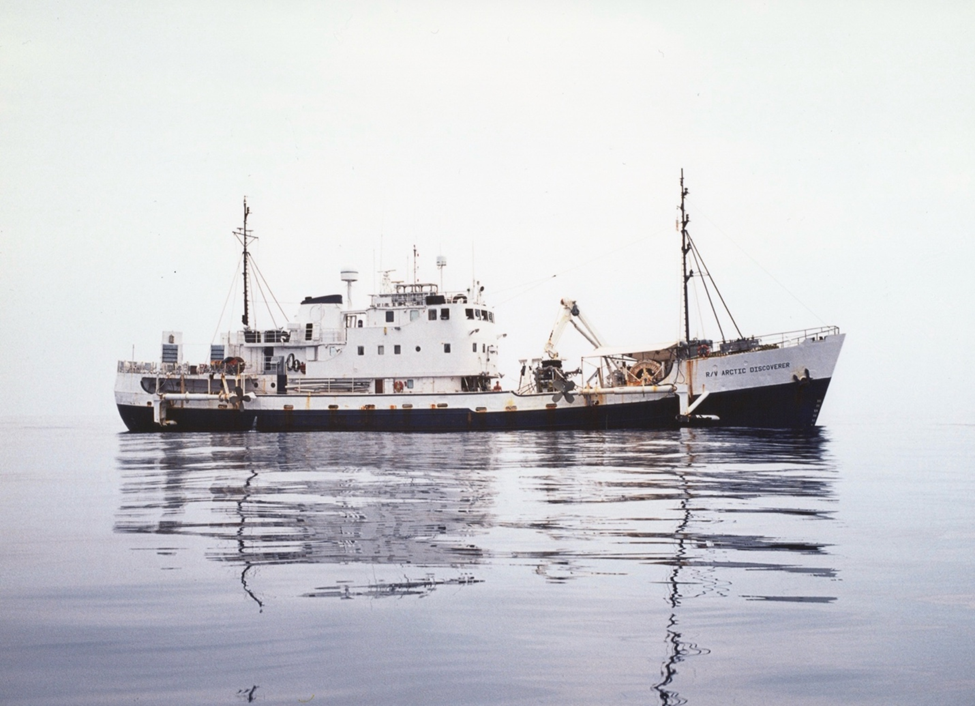
Of course, the storms can be monsters. We were ready at last to proceed to the FA test site. And then the weather turned nasty.
The evening of September 4th, the winds picked up, and the seas began to rise. Our tests with the ship and its equipment had instilled in us some confidence that we could operate in 6-foot seas with little difficulty, with the upper limits yet to be tested… if we had to. Let’s just say that everyone preferred calmer seas for our first real dive of the season, with all the new stuff.
By dawn on the 5th, we were being buffeted around as we motored slowly, back and forth near the proposed test site. My reference books spilled over their fair-weather bungee restraints, off the shelves and onto the deck of the cabin and lab. I piled them in dry corners, battened down everything else, and waited. I started reading Moby Dick, for the second time in my life.
By evening of the 6th, we were in a full gale. John Patton, the First Mate reported southwesterly seas 15 to 22 feet, with winds of 25 to 35 knots, higher in the squalls. Looking back on this week a long time ago, I must say that it may have been one of the most profound philosophical trials of my life. Somehow, I had invested almost all my hopes in Foxtrot Alpha, which experts had called a geological feature, a pile of rocks that was throwing one last thing in our way. I thought about how we were in a storm looking for a ship lost in those same waters. I waited, and read Melville. Finally, the seas calmed. On September 11, on the very first track we hit the mark. The math I had checked with Alan Scott was spot on.
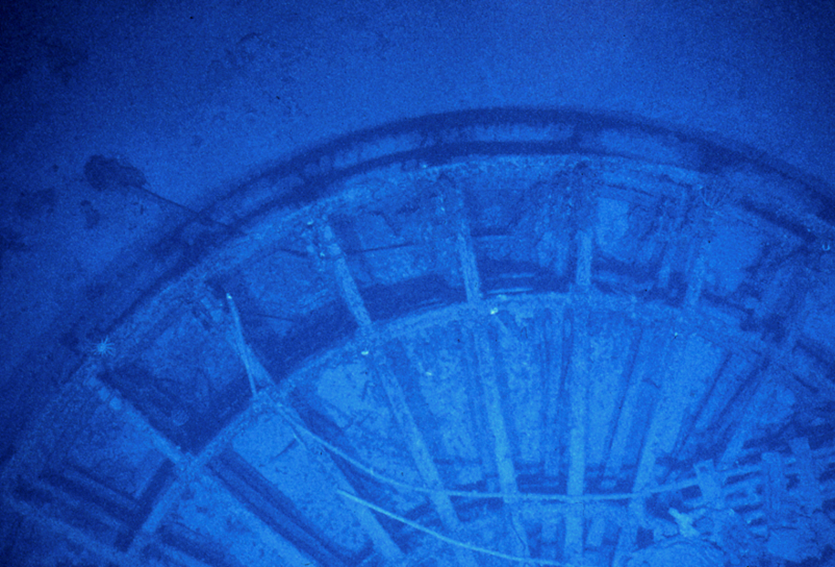
We passed over an enormous paddlewheel frame, the one architectural feature that shouted, “S.S. Central America!” to the six of us sitting in the control room. Whoops and laughter and exclamations of “You know what THAT is!” filled the room.
And yet, although we were 99% confident that we had found the SSCA, I still harbored a small sliver of doubt. What about those shipwrecks lost the October 1866 hurricane, the Evening Star and the Daniel Webster? They were both sidewheel steamers that sank well off the southeast US coast.
The massive engines would provide an answer. Both the Evening Star and the Daniel Webster were powered by enormous “walking beam” engines. Such engines have one giant cylinder propelled upward by steam pressure, then venting at the top of the stroke. This thrust pushes one end of a mammoth teeter-totter (the walking beam) that rocks on a central fulcrum. The other end of the see-saw is connected to the crank that turns a foot-and-a-half-diameter shaft connected to the paddlewheels on either side of the ship.
The SSCA’s engine were a different configuration, two inclined cylinders, each with a 65-inch bore and a 10-foot stroke. Our initial pass over the paddlewheel prompted us to circle back for a closer scrutiny of the engines and other parts of this “large geological feature,” now transforming into our dream treasure shipwreck. We saw that the starboard paddle wheel had disengaged from the rest of the drive train, along with a length of the shaft now jutting upward from the spokes lying flat on the seabed, topped by an offset that was part of the “crankshaft” of the steamship.
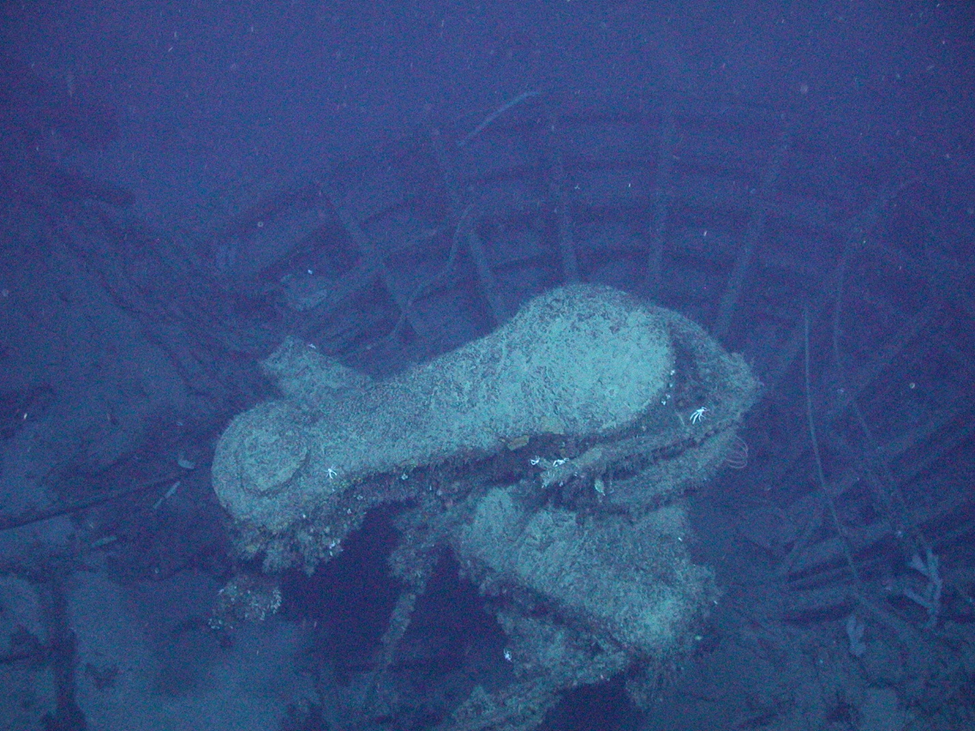
In between the two paddlewheels we found two sets of inclined cylinders with crossheads and linkages, their forms now murky and mineralized within an enormous mound, hundreds of tons of rust.
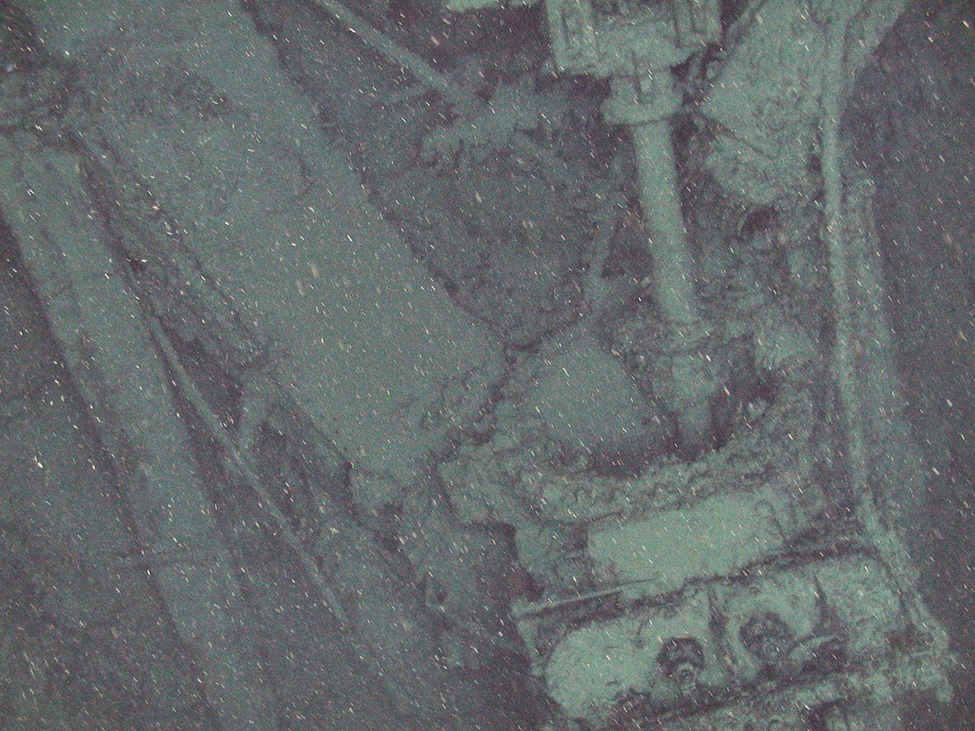
The piston rod extends out of an inclined cylinder (65” bore) to a crosshead linkage.
This was enough for me. We saw the kind of engines expected only on the SSCA, and I shared this analysis with Tommy. He seemed surprised that I was even checking such details, because we had seen the paddlewheel! My scientific skepticism apparently was not welcome at that celebratory moment. There should be no question about it; I was excited. I remember it as one of the greatest days of my professional life. My hunch about the “geological feature” had proven true! And my math had been correct! Since I spent four months at sea on the wrong shipwrecks the previous year, I just didn’t lose my mind, and my objectivity. My reservations had been justified. Now, I was certain we had found the S.S. Central America.
We wanted more than a picture of paddlewheels and a rusty engine, to justify announcing the find to our investment partners. After the months of preparations and the frustrations with the DP system, and now that we had found the “real” SSCA, we worked with focused energy for whatever was left of decent September and October weather.
The 1988 version of Nemo was a step up from the 1987 model. Nemo had acquired a new manipulator, a hand with which to grab artifacts and other objects. Testing our manipulator, with flexible fingers, reaching for a bottle, we accidentally scraped half a liter of sediment, in which I found gold dust. (See Treasure Talk Episode 9)
We already knew we had found the SSCA, but we were looking for flashier proof, and Tommy felt a piece of gold the size of a grain of salt was not worth announcing to the investment partners; not the return they were awaiting.
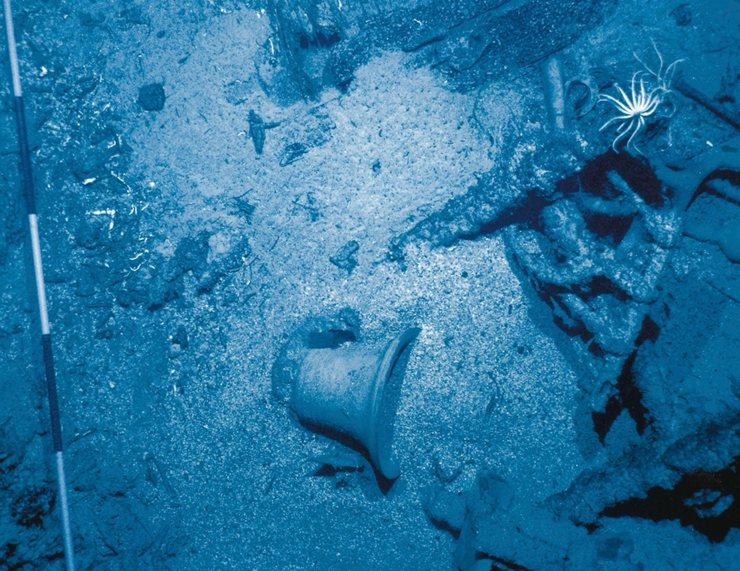
During photographic surveys we found a bell inside the main shipwreck, up near the bow. We dropped a measuring stick nearby to get an idea of its size. My calculations yielded 24 inches wide at the lower flange, unusually large. John Doering, the crane operator and assistant photographer thought it had to be smaller. 24 inches was huge for a ship bell. John thought it was 12 or 14 inches. How could we recover it? Maybe it had the ship’s name.
The engineers installed a small winch in the center of Nemo’s underside, like the units mounted on the front of some four-wheel-drive working trucks, equipped with a stainless-steel cable that could tug a couple tons. A large recovery module, an aluminum-framed basket, was fashioned from spare ROV frame parts, a square four-foot module two feet high, with a brace across the middle of the top. This would accommodate something 24 inches wide, so we all agreed it should be adequate.
Launching Nemo and this additional underside cargo basket from the deck of the ship was tricky. The crane hoisted the robot above the deck, with cable trailing out of the winch, which was attached to the basket that still sat on the deck. Then the deck crew pulled the basket under Nemo while someone in the control room operated the little tugger, spooling in the cable and cinching the basket upF and against the ROV base. Then the crane operator hoisted the combined unit over the side and into the water.
On the seabed, this process was reversed. The pilot lowered the basket onto the sediment next to the bell, then maneuvered into an adjacent position and landed with the bell directly in front of our cameras.
This operation illustrates one of the significant ways in which our operation varied from others. The engineering is well beyond my scope here. But, using the motion compensation system designed by Tommy and his team, we could land heavy equipment firmly on the bottom, providing us a completely stable platform from which to do manipulative work, ranging from delicate to very heavy. We had managed a delicate recovery during the dive when we plucked the bottle from the seafloor and accidentally muddied the robot with gold-dust-bearing ooze.
This recovery would be very heavy. We could see that there was an inscription on the bell, but we couldn’t read all of it. We could all see that the bell was very large, and I wondered aloud if it was even going to fit in our 2-foot basket slot.
After some discussion, the pilot decided that the best way to approach this piece of bronze that might weigh 200 pounds or more was to insert the manipulator into the bottom of the bell, pushing all the way to the top of the interior, then lifting it up and out of its oozy half-burial.
As the manipulator penetrated the cavity inside the bell and began to lift, we saw the sediment cascading off the bronze, somewhat obscuring the scene in a dramatic cloud.
With the bell balanced atop the manipulator arm, the pilot moved it over the basket and slowly lowered. The flange at the base of the bell wouldn’t fit; obviously it was a little wider than 24 inches. The top tang of the bell flipped down and settled onto the base of the basket, while 2 or 3 inches of the bell flange remained protruding above the top-line of the basket. We paused to consider whether we could recover it this way, ultimately deciding that we could. We would tug the basket and bell up against the robot’s underside, as well as we could, without damaging anything, artifact or equipment.
A camera had been installed alongside the underside winch, so that we could monitor its work. I recall Nemo carried a lot of cameras, used to monitor the operation and condition of the machine, to watch its various arms and tools, and providing the ability to read hydraulic gauges on camera instead of relying entirely on electronics for such information.
Through the winch camera, we observed the liftoff, as the bell and basket lifted free from the bottom in another dramatic cloud. Then we watched as it listed sharply to the side where the bell now nestled. We decided it was unlikely to completely flip, so the pilot began to winch it in slowly.
Nemo was always an experimental ROV, always changing. It was not a production model, and it was never made “idiot-proof.” Very few features were added for safety’s sake, the safety of the machine. It could damage itself severely, and the bell recovery had to proceed very carefully and deliberately. As the dangling, unbalanced and misaligned basket made its first contact with Nemo’s underside, everything stopped. We checked the alignment the of basket with the robot frame. It wasn’t perfect, but we decided to winch it in ever so slowly and see where it settled out, making certain that nothing was hanging up or getting snagged, as Nemo firmly embraced the precious cargo.
There was a little bit of an angled gap between the vehicle and the basket when it arrived on the surface, but we still had the bell. Hoisting it onboard was similar to the landing on the bottom. The crane operator held Nemo aloft above the work deck while the Pilot inside in the control room unspooled the winch lowering the basket into an excited gathering of happy seafarers. We whisked the bell to one side and secured it while we finished landing Nemo and began the post dive wash down and checks.
We had measured it as it sat on the seabed, and I knew it was big. But seeing it in hand on deck, it seemed larger than life.
The S.S. Central America has many stories to tell, but it hasn’t given up secrets easily. And, if the personification of ships is female, she wouldn’t give us her name!
We had coal, paddlewheels, the right engines, even gold dust, and now the giant bronze bell inscribed: “MORGAN IRON WORKS NEW YORK 1853”
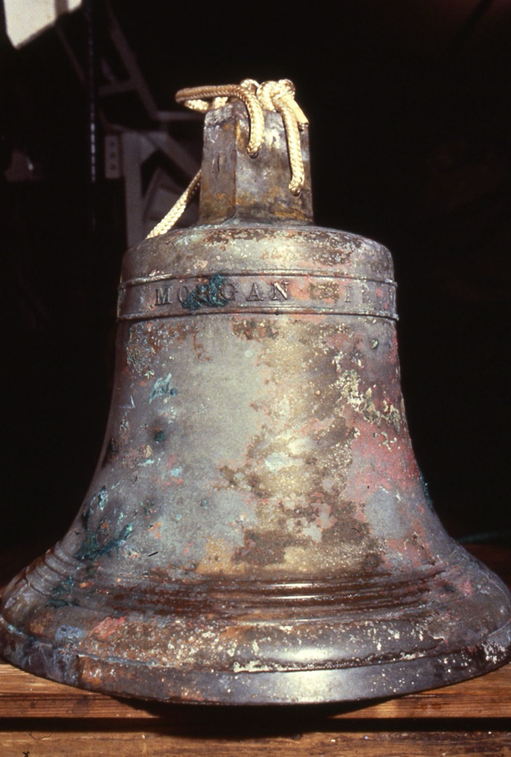
Morgan Iron Works had built and installed the engines as the SSCA was being built.
Full confirmation. Proof beyond doubt of any kind. We had found the S.S. Central America.
A few days and a couple dives later, this no longer mattered. Photographs taken during some survey passes over the stern showed gold coins cascading off rotten wooden beams, and rectangular blocks of varying size that sure looked like gold ingots.
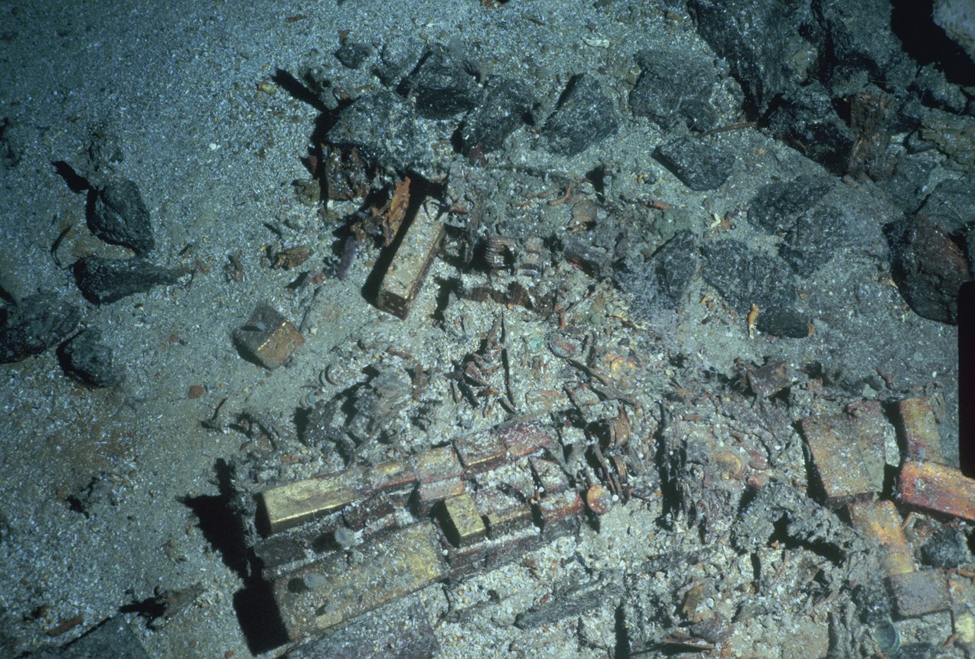
On the dive following this discovery by photograph, we landed next to the pile, dusted away some of the sediment with a forward mounted thruster, and were the first to see the magnificence of the greatest lost treasure in United States history, now found.
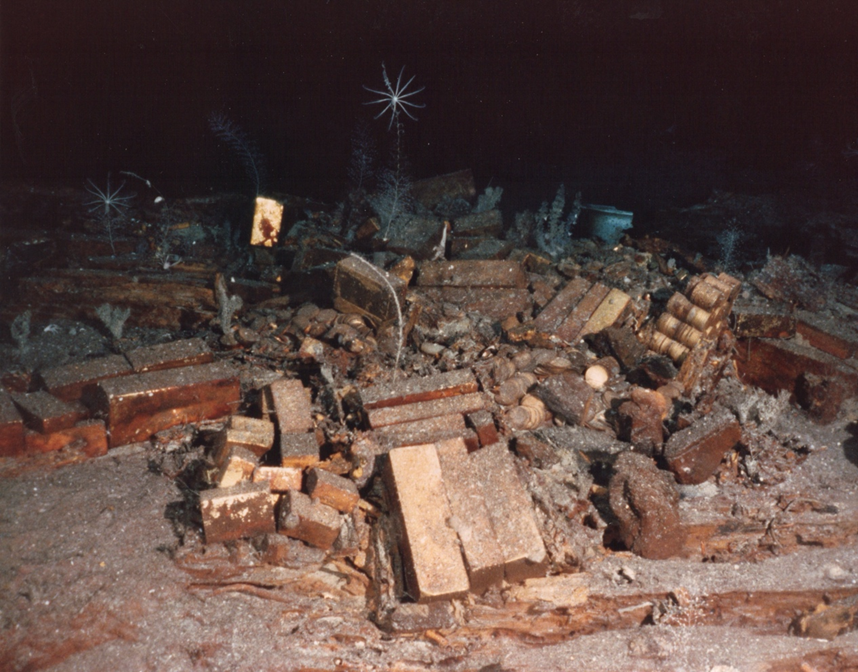
Thousands of mint-state 1857-S double eagles erased all questions or concerns about the shipwreck’s identity.
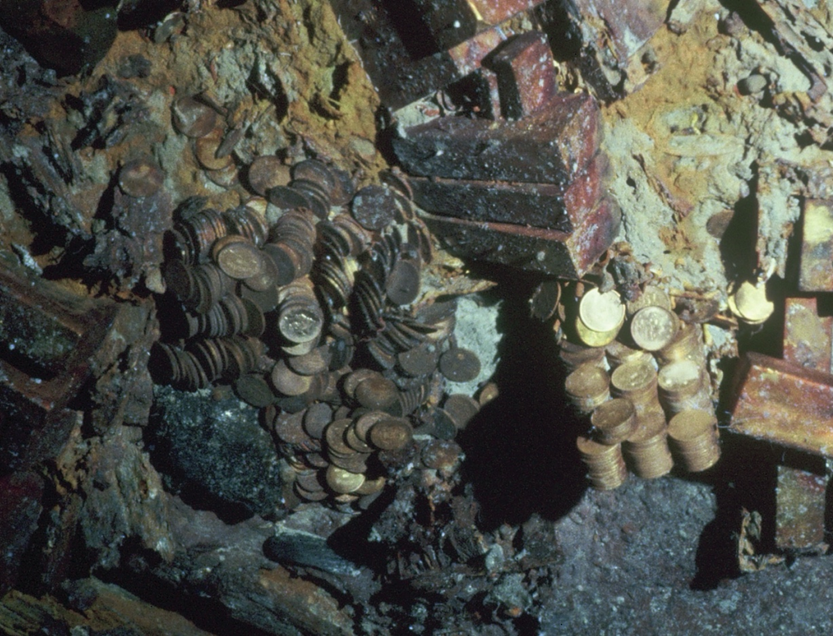
Still, she didn’t give us her name.
Epilogue:
In 2022 the bell was donated to the United States Naval Academy, where it now sits in the Yard right next to the Herndon Monument, a landmark tribute to Commander William Lewis Herndon, USN, the Captain of the S.S. Central America.
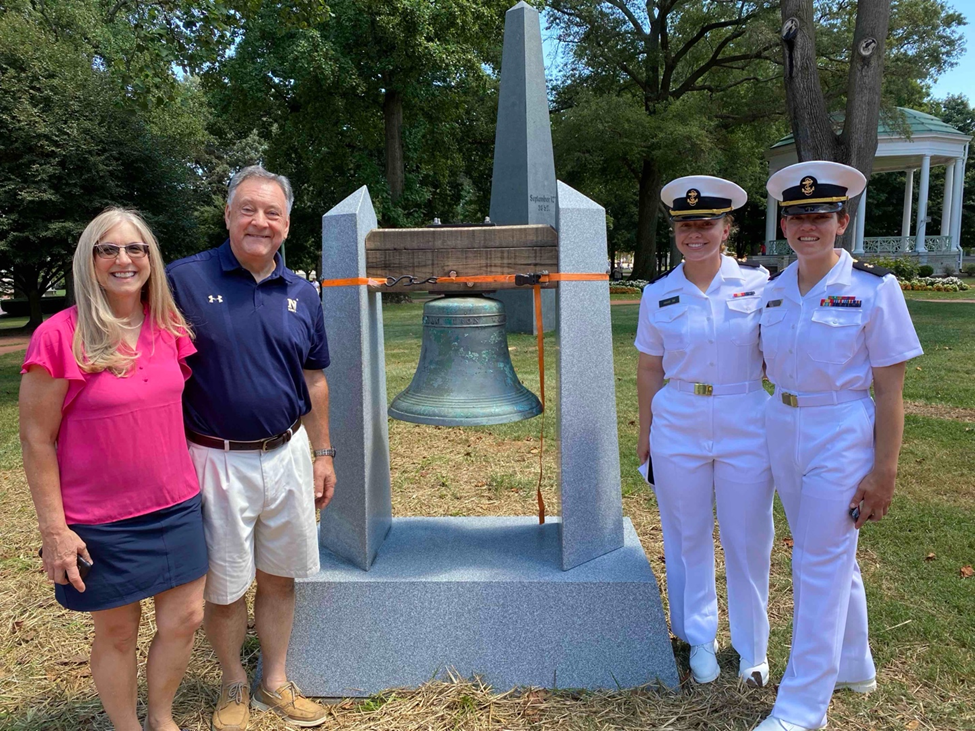
The bell is seen here, fresh after installation, near to the Herndon Monument, (the obelisk behind,) with two members of the Class of 1983, who hosted the dedication of the bell in 2022, and with two of the then-current Middies.
The Elusive Name:
In 2014, we found the cast iron purser’s safe lying 28 meters outside the portside timbers of the main shipwreck. In Treasure Talk 6: Part 2, I covered the recovery of the ship’s money, including almost 9,000 dimes, from a parcel on the lower shelf of that safe. Other parcels inside the safe were passenger consignments, containing a wonderfully diverse suite of US and foreign gold and silver coins, as well as many bags of gold dust.
In a top compartment we found a bundled, blackened, externally gooey, bundle of what appeared to be paper. It was sent to a qualified laboratory, Northeast Document Center, to see what could be saved.
It was revealed to be the purser’s bundle of ticket receipts. He had the receipts for the final voyage, which was wonderful since we had found some with well-known names from the historical accounts. But these did not have the name printed, since passengers (and the company agent in San Francisco) did not know which steamship would await them on the Caribbean side of Panama. They were unspecific, designated for “Steamship running in connection with the United States Pacific Mail Steamships.”
But Purser William Hull also had the outbound receipts from New York to Panama in the bundle.
There, emblazoned in black ink across the top line, we finally saw the ship’s name:
“UNITED STATES MAIL STEAMSHIP CENTRAL AMERICA”
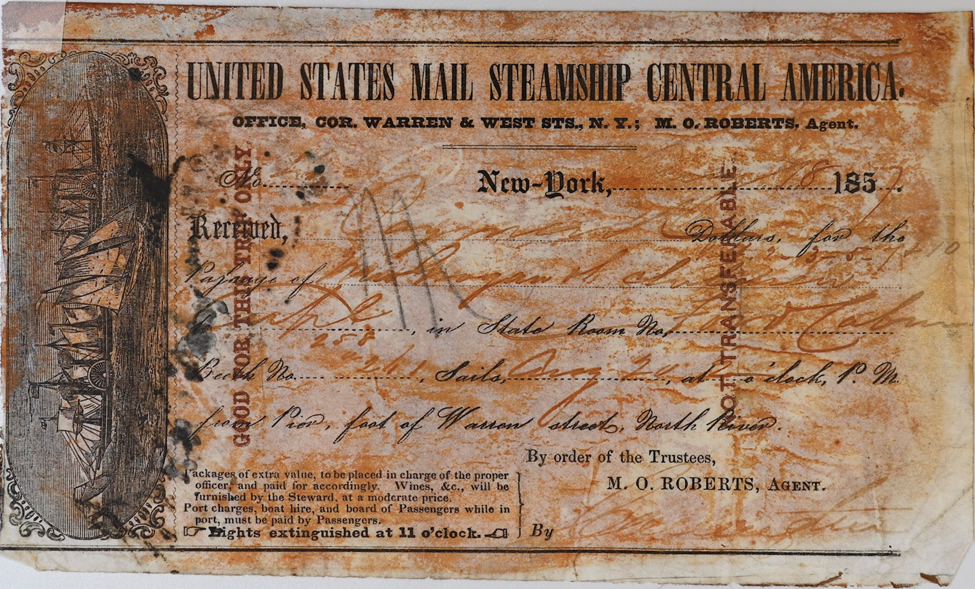
I remember being startled when the conservation lab revealed the nature of these bundled documents. Just to finally see the name in print was such a jolt, a quarter century after we first saw the paddlewheel.
More, next time…