Treasure Talk with Bob Evans, News, Rare Coin Articles
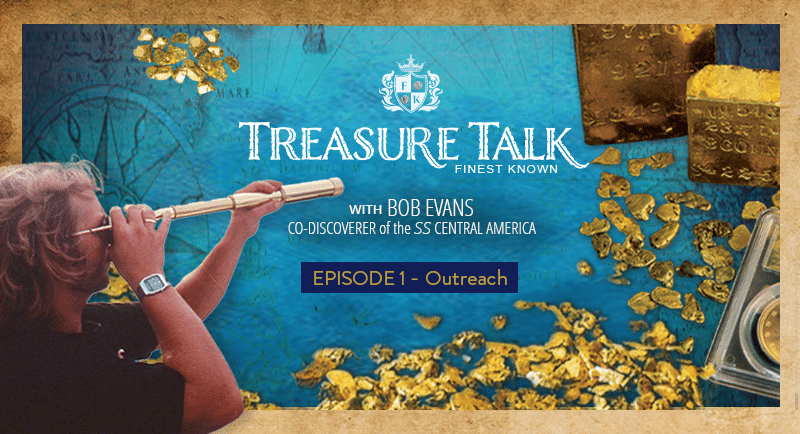
Treasure Talk: Episode 1 – Outreach
Jan
Treasure Talk: Episode 1 – Outreach
“Gold! Lots of it!”
This was my very first public statement about the gold of the S.S. Central America, my first chance to tell the story.
It was October 5, 1989, and my crewmates and I had brought ashore over a ton of gold to the dock in Norfolk, Virginia. We were met by US Marshals, since legal activity regarding our find was adjudicated in the US District Court in Norfolk. Local law enforcement was fully represented (of course,) seemingly every high-powered, elite unit of the Norfolk Police. They had snipers on nearby rooftops monitoring the action. Armed Brinks agents posed with their vehicle, right next to the dock, ready to whisk the gold off to secure storage as soon as it could be loaded into the armored truck. There was also a very large crowd of happy investors, family, friends, and the award-winning marching band from Herndon, VA High School.
Our research vessel, the Arctic Discoverer had finished its 1989 season, a very successful season, and it was time to proclaim our discovery to the world. We had located the greatest lost treasure in United States history, and now we were going to show it off.
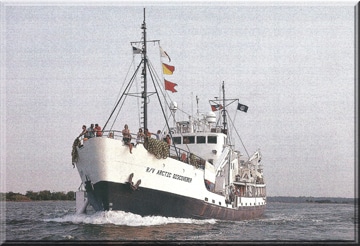
I felt like I had landed on another planet.…
We had been at sea, almost constantly, since I came aboard on July 6, three months earlier. There were a few two-to-three-day breaks, when we came back ashore for bad weather or supplies/repairs/maintenance. But mostly, I had spent all summer and into autumn on a ship with the same two dozen people. I knew everyone on the ship pretty well. The world at large was full of strangers, and this prospect felt strange, and a little chaotic.
In the hours as we steamed into Hampton Roads and toward the berth at Norfolk, I was frantically working below decks, preparing the treasure for the dockside transfer to Brinks, and selecting a representative group of gold coins and bars to present to the eyes and cameras of the world. It was 67 hours and 45 minutes from the time we left the shipwreck site until we docked at Norfolk. The task of preparing the ton of gold we had in the shipboard vault, and sealing it into manageable-weight portable containers, entirely consumed my time and focus. I managed to sleep maybe six or seven hours over the three days. Our onshore personnel had arranged as much advanced publicity as they could, and news helicopters (and I assume police aircraft as well) hovered over our ship as we neared the harbor. Local and national media were present. We knew a large crowd awaited us.
As we arrived, cannons were fired, and the band struck up some wonderful, rousing music.
We had a plan: my crewmates would help me carry the sealed containers of gold from my cramped lab below deck up to the open-air work deck, to stage them for examination by the Marshals. Then we would carry them to the Brinks truck.
Actually, this didn’t look too impressive, and I suppose this important first legal function of our arrival, the arrest of the treasure by the Marshals for the US District Court, was visually disappointing for many in the crowd. We weren’t carrying gleaming piles of gold, like in some fantasy movie. Our containers looked like just any old ammo cans, small totes and wooden crates. I gave one to each of my fellow crew, to carry upstairs from the lab to where our Captain, Bill Burlingham, supervised staging them for inspection. I set aside a special assortment of gold for an arrival display.
I emerged into blinding sunlight carrying the last ammo can full of gold ingots, and searching the assembled crowd on the dock for familiar faces. I saw my wife Jane smiling, her red hair shining in the sun. A wonderful, glowing feeling settled on me. It had been a while. My parents were there as well; coincidentally their 48th wedding anniversary. And my brother Bill, who had always supported my science pursuits and adventures.
Once the treasure was arranged on deck and all the initial accounting was finished, every member of the crew participated in carrying a container of gold off the ship and to the Brinks truck. As I carried mine, I grabbed a quick moment aside, a hug and kiss with Jane.
With the gold safely in the Brinks truck, we turned our attention to other matters, including the gold remaining for display. I brought it up from the lab, and we set up a display and a podium on the port rail of the deck, facing the throng gathering on the dock, who were more than eager to see what we had. I fussed with the arrangement of the pieces while my colleagues began delivering remarks to the crowd.
Project founder Tommy Thompson was first. He acknowledged the accomplishments of our expedition in general, and thanked the investors, many of whom were assembled and smiling. Barry Schatz was Tommy’s multitalented hometown friend. An accomplished wizard with words, Tommy recruited him early in the project, to be our close collaborator in explaining the technical, scientific, groundbreaking project to the investors, the media, and the world. Barry spoke of how exciting and significant the whole project was.
Then it was my turn. I stepped up behind the display and adjusted the microphone as someone in the crowd, probably an excited crewmate, shouted, “What’ya got, Bob?” A couple of excited voices on the dock offered answers. Then I leaned into the mike and announced emphatically, “Gold! Lots of it!”

Preserve a Piece of American Gold Rush History!
On December 5, 1848, President James Knox Polk ignited a national frenzy when he announced to Congress that gold had been discovered in California and in extraordinary quantities. The Gold Rush was born, reshaping America forever.
Now, thanks to rare and fascinating circumstances, you have a unique chance to own a piece of this golden legacy. Discover the captivating story of the California Gold Rush Monetary Ingots and the astonishing recovery of the legendary Ship of Gold.
Unlock the secrets of history, adventure, and enduring wealth!
Call us NOW at 888-751-1933 or Click here to claim your FREE report and uncover the gold-fueled spirit that helped build the United States. Don’t miss this golden opportunity!
I didn’t mean to steal anyone’s show, in fact I was too exhausted to do any such thing deliberately. But the phrase completely summed up the excitement of the moment, and it was the sound bite that led the story in the national news broadcasts.
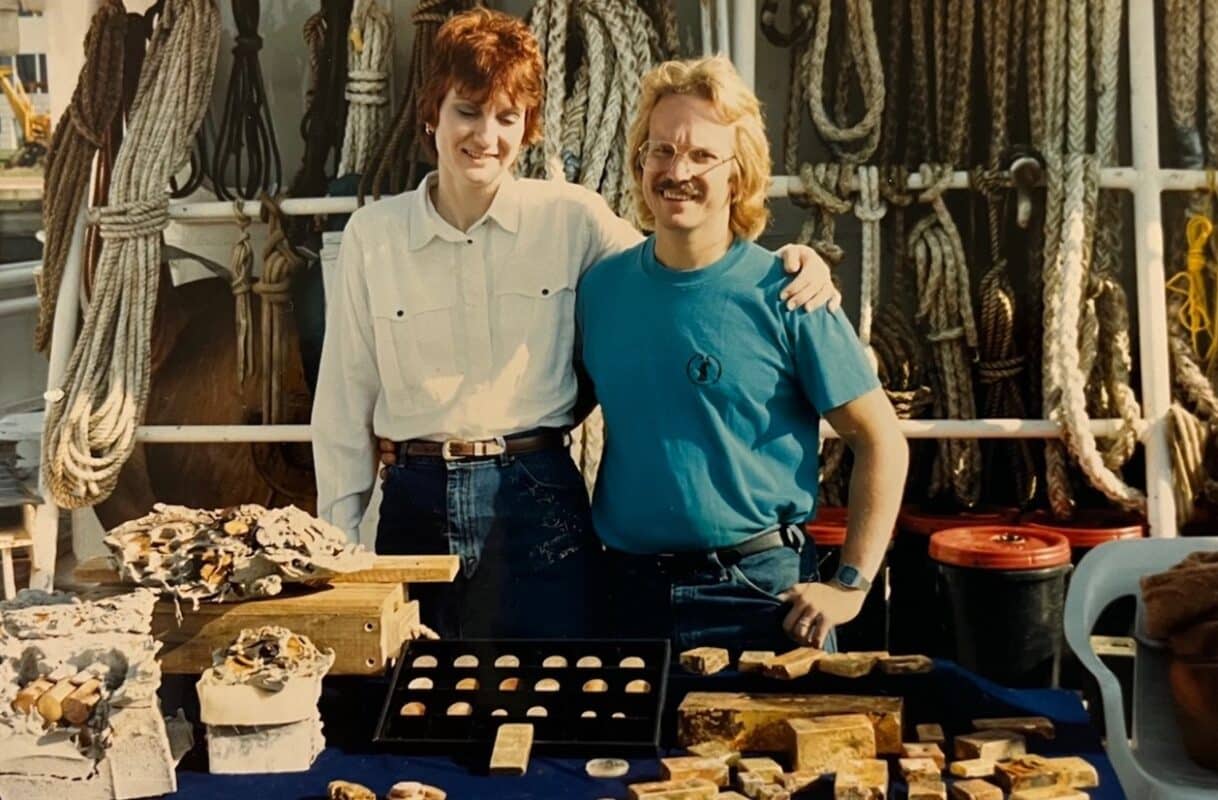
The following day I went to the Brinks vault to retrieve some of the gold for a larger display we arranged on the deck of the ship. This would be for a national news feature segment to be broadcast that evening. I posed with Jane behind the treasure on the deck of the Arctic Discoverer. I think Mom took the picture, although it might have been my brother.
Ever since then, it has been my great pleasure to share the stories of the S.S. Central America and the tales involving my own time with it.
Public outreach fell into my lap early on, as the company principal dealing with scientific and historical matters. Secrecy had been one of the secrets of our success: the site location data, the technology, the legal and business strategies. Those things were Tommy’s focus, along with other parts of the team. I studied the science and history: the stuff we could talk about.
I think it is fair to say that our company was necessarily secretive during the 80s and 90s. There were competitor claimants to the treasure. Insurance companies filed suit at the same time we were coming ashore with the treasure. There were rival salvors who had challenged our rights to the site in a landmark legal case beginning in 1987. We used technology employing a whole host of trade secrets. But we tried to maintain the public excitement about the project to a certain degree.
After the big splash in Norfolk, there were television shows. We were invited to show the treasure to the Tonight Show with Johnny Carson. I was tapped to be the personality for this show rather than Thompson. I had a much greater ease with cameras, and spontaneous answers without pregnant pauses. I could always steer an interview back to science and history, looking to entertain while I informed. The show with Johnny Carson, April 10, 1991, was definitely one of the highlights of my professional experience. I took a number of gold pieces to show, including the largest ingot we had recovered up to that time, the mammoth 754-ounce Justh & Hunter ingot #4051.
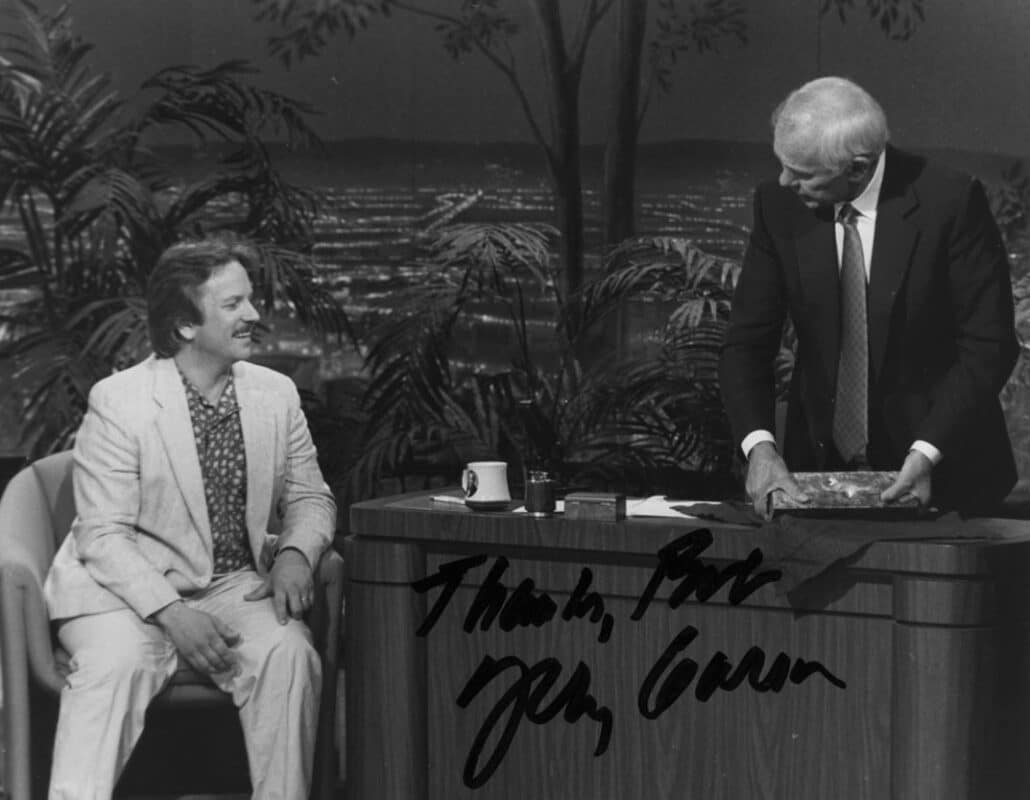
Johnny struggled with it on stage, having not seen it in person before that moment of live taping. I saw the muscles in his neck tense as he hoisted it. He sent me an autographed photo that commemorated that moment.
There were a few more events and outreach efforts during the 1990s, but they were very carefully controlled and targeted. I did some slide presentations for schools, elementary through college. (We still used Ektachrome slides back then!) There was the noteworthy Life Magazine article, “The Greatest Treasure Ever Found.” There was the non-fiction bestseller, “Ship of Gold: In the Deep Blue Sea,” by Gary Kinder. There were a couple of large exhibits in Columbus, OH, at the Museum of Art and at the Zoo. (In the exhibits, we showed cool 3-D footage of the shipwreck site and its animal life, and a limited selection of the gold dust and nuggets.) There was an episode with Dateline: NBC. But the company was much more directed toward the legal efforts to keep our finds. The full reality and magnificence of the treasure remained under wraps, subject to a legal and business chess game.
Heck! Even I saw only a small portion of the gold out and visible at any one time during those years.
The vast majority remained in several dozen sealed containers, locked up in an impressively secure Brinks vault facility in Virginia. Remember, we had tons! I removed a limited number of pieces for curating, study, conservation, and display, all carefully tracked. I visited the vault facility annually with an independent auditor who produced reports for the business, organized as a Limited Partnership. At Brinks, I hosted representatives of the claimant underwriters, for whom I provided access to whatever sealed containers they requested. But we cracked the seals and inspected the contents one container at a time. So, we saw the wonders one piece at a time, carefully repacking, resealing, and having the ever-present Brinks guards take it back into the vault, at the end of each day’s examination.
The Life Magazine appearance was an exception to the one container at a time rule. We took a large number out of the vault on November 12, 1991. The photographer shared his idea for the arrangement. Could we create an “amphitheater” of gold bars with piles of gold coins in the foreground?
I looked him straight in the eye and laughed, “Yeah. We can do that.”
It was a bold notion, and I thought we could, but it had never been done before, so we spent the rest of that day planning and building the amphitheater.
We cleared off the Brinks regional manager’s desk, still within the Brinks building complex, and arranged the gold for the shoot on top of it, figuring that it was sturdy enough to bear a few hundred pounds without damage. The next day we finished two “poses.” First was the large double-truck wide shot that we had prepared the previous day. Then we broke that down for the single-page arrangement ultimately chosen for the article. No one had ever seen as much of the treasure out in the light before.
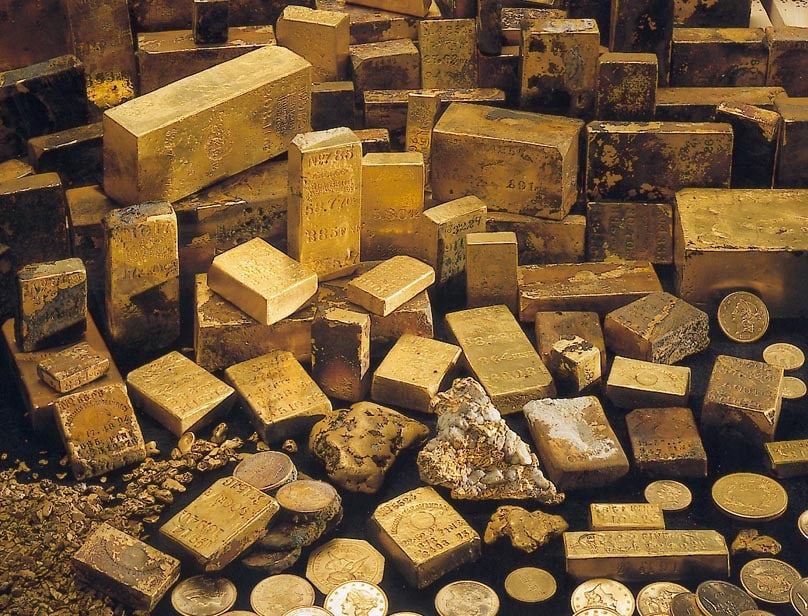
It was spellbinding. We had a lot of work to do, assisting the photographer. We adjusted the bars and coins so they glowed in the camera’s eye. We tracked our serial numbers for each individual $20 gold piece and made certain that no coin touched another in the foreground pile, placing little foam wafers between each piece. We were fully aware that any extra marks on the amazing mint-state double eagles could cause thousands of dollars in lost value. As the artist contemplated our next tweak, we would just stand back and gawk. The exposures were shot on large format film, (expensive,) and Polaroid “backs” were exposed first to make certain the film exposures and images would be optimal.
Only ten people or fewer saw it in person: my assistants and I, the Brinks personnel assigned to this special operation, and the photographer. The following day, we carefully dismantled the assemblage, taking hours to repackage and seal for storage, back in the Brinks vault. Such a large display would not be seen again for eight years.
In December 1999, legal and business matters were mostly resolved, at least regarding the treasure ownership. Dwight Manley and the California Gold Marketing Group acquired the recovered treasure, and the public outreach effort exploded. Manley conceived the impressive SHIP OF GOLD exhibit, and had it built quickly, a ship-like modular building that could be assembled on site and moved from venue to venue. It debuted at the February 2000 Long Beach Coin and Collectible Expo, to enormous fanfare.
It was Disneyland at a coin show! The SHIP OF GOLD Exhibit sat on a space 40-feet wide by ten-feet deep. The exhibit was designed around components that were heavy but portable, and they could be packed into a single semi-tractor-trailer. The pieces could be fitted together on sight, (actually cam-locked).
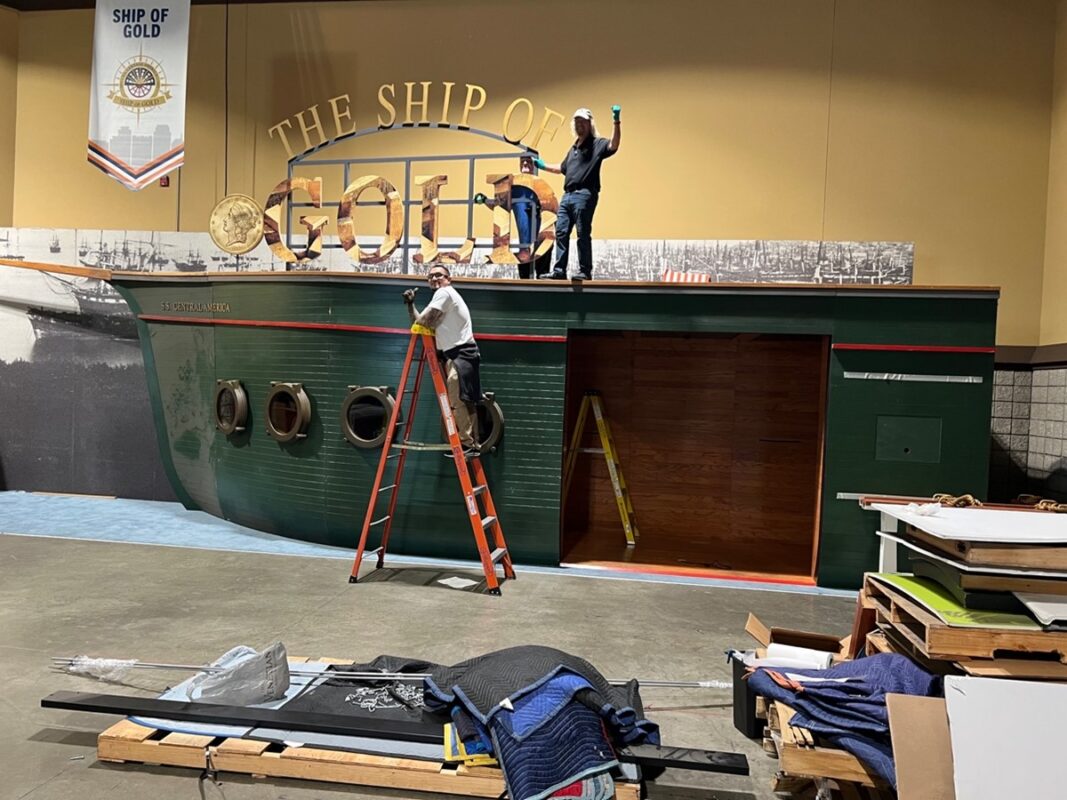
It looked like a set made for the Broadway stage, the bow end of a ship, with portholes in the side serving as display cases.
In a small alcove room to the right, we displayed the largest ingot we found, (recovered during the 1991 season, after the Tonight Show) the amazing “Eureka Bar,” named for the California State Motto: 933.94 ounces.
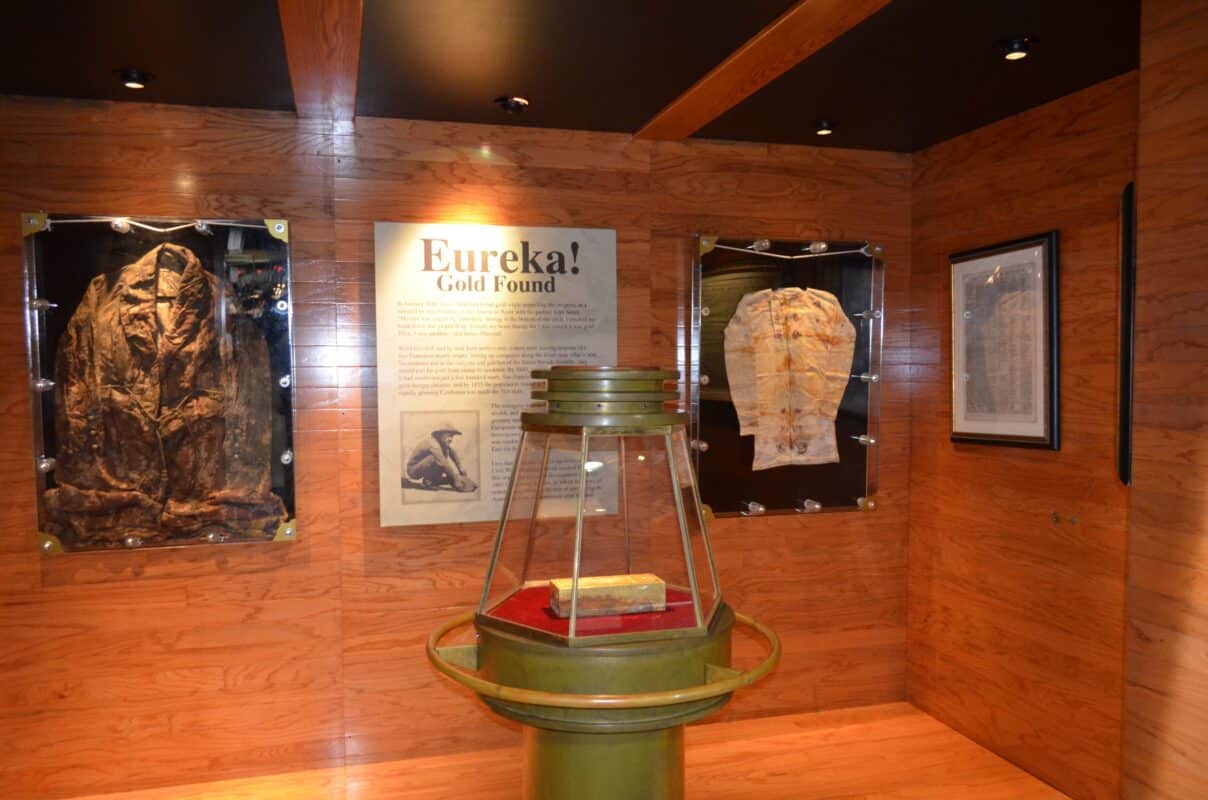
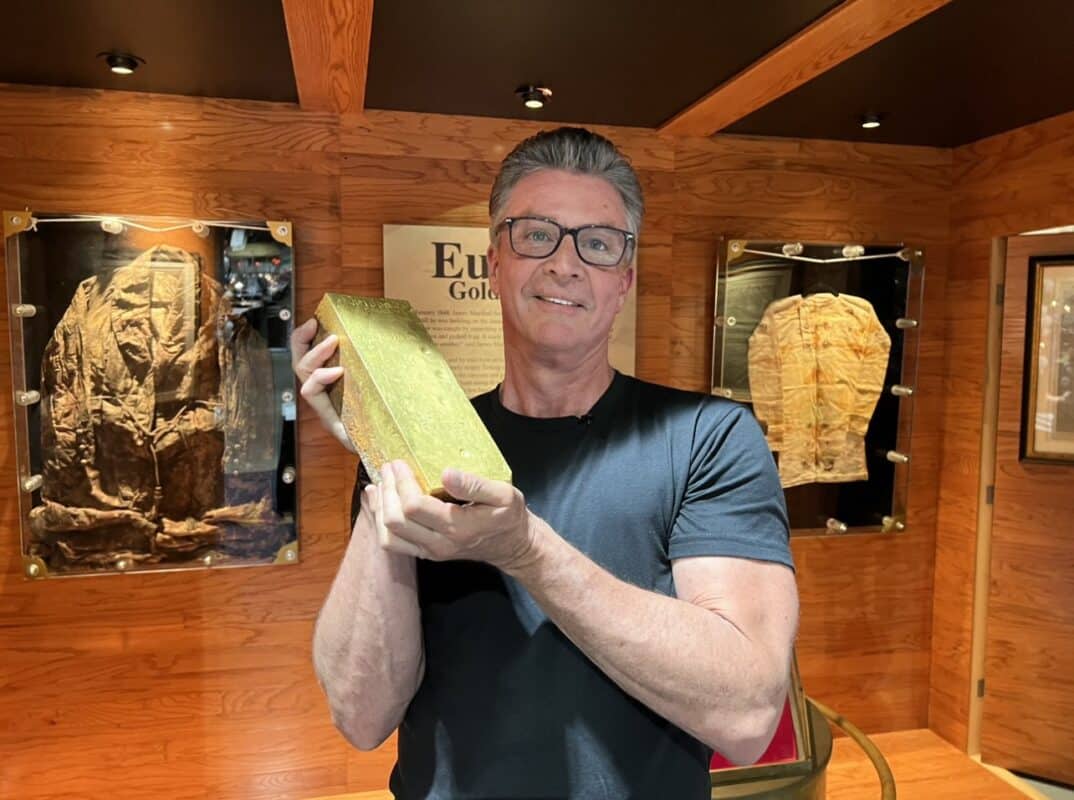
For the first couple of appearances of this exhibit, we also had a glass-fronted, ten by ten foot “Assay Office,” depicting the Kellogg & Humbert 1857 business on Montgomery Street in San Francisco that manufactured gold monetary ingots. In that small building and in the main ship exhibit we showed hundreds of pounds of gold treasure to thousands of people.
Eureka bar returns to market
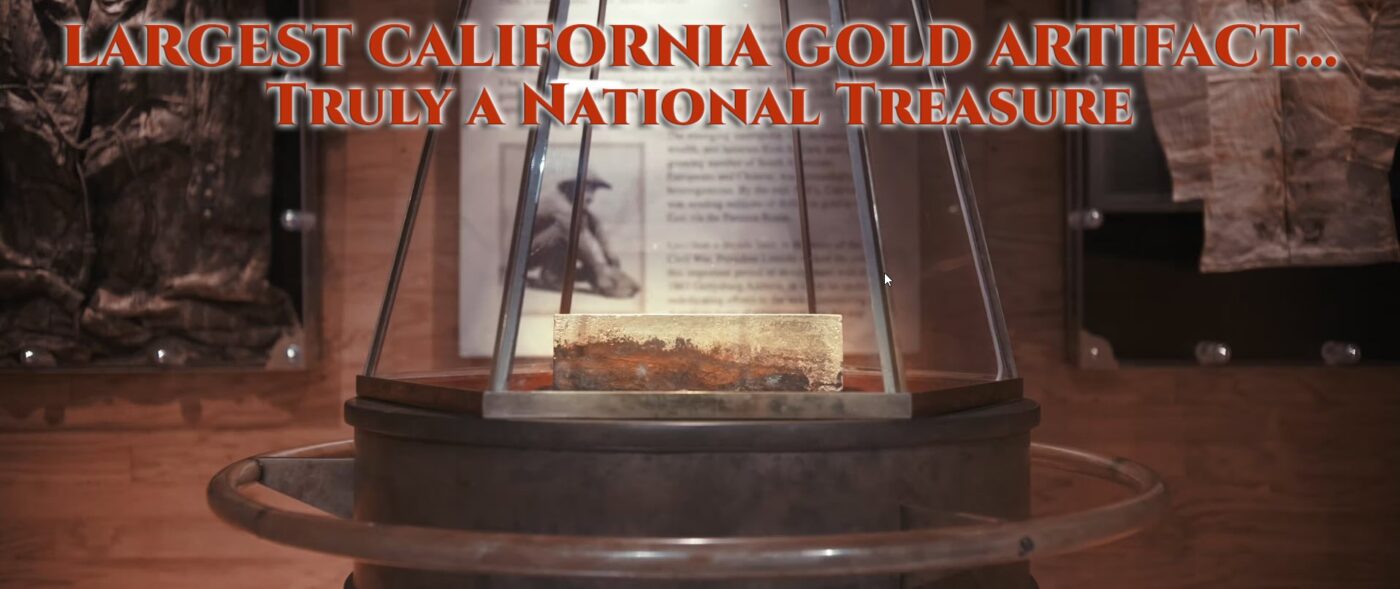
An eager public, folks who normally don’t go to coin shows, swarmed to see this attraction at the numismatic conventions, wherever it appeared: Long Beach, Philadelphia, Salt Lake City, Atlanta. It traveled to museums as well, San Francisco and Omaha.
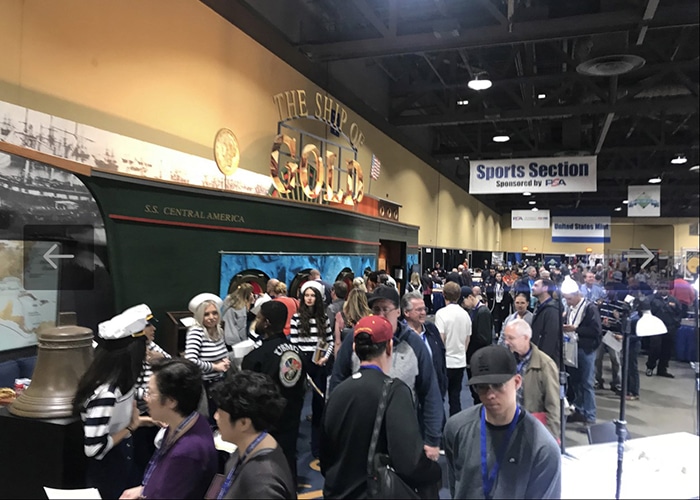
It was a feature at the California State Fair. We presented it in the heart of New York City, at Christie’s, in support of the December 2000 auction offering selected highlights from the treasure. (The Rockefeller Center Christmas tree was lit up just outside.)
I sometimes think back to my youth and the roots of my interest in discovery. All my life I have enjoyed going out and finding interesting stuff, and then bringing it back to show to people. When I was a boy, these discoveries might be fossils collected from the limestone of local gravel driveways and parking lots, or maybe a small animal skull found in a local woodlot. My fossil collecting became a more serious pursuit in my teens, and fossils I had collected became the subjects of my science fair projects. I also served as a Student Volunteer at the Center of Science and Industry, a museum in downtown Columbus that featured many push-button exhibits (push the button and listen to the narration about the display). It was there that I really learned to talk about science with the public, an interaction I truly enjoyed, and still do. Also, I have no doubt that my ease with the public developed as a musician, taking piano lessons throughout my school years, and performing at recitals.
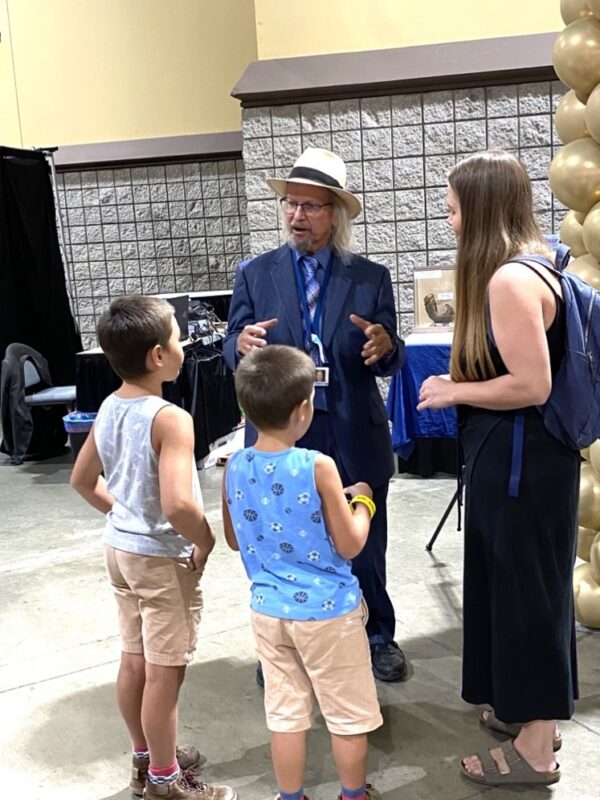
So, I like giving presentations, and I’m comfortable with performance, at an exhibit, in a classroom, in a convention hall, on camera. I love sharing my interests with others. For me, the Ship Of Gold Exhibit was like the ultimate Science Fair project. I was the co-discoverer of the treasure, and the curator who had studied it and conserved it. So, who better to talk about it? I settled into the role as treasure spokesman. With the setting of the ship-like exhibit and many hundreds of pounds of gold on display, it was a grand stage for engaging the public in the stories, both the rich history and the modern tale of discovery and exploration.
In 2014, almost a quarter century after the initial discovery, there was no shortage of additional experiences and adventures.
My collaborators/colleagues and I had undertaken detailed numismatic studies of the coins and ingots found, and I wrote or co-wrote some articles that were well received. Q. David Bowers wrote a definitive numismatic work, a monumental 11-pound book that is like a museum of the treasure in literary form. Tommy Thompson sank in a legal morass, refused to appear in Federal Court, and ran away, leaving the company leaderless. Under a court-appointed Receiver, the project re-constituted, and I joined a return expedition to the shipwreck site in 2014, 23 years after I last left it. That expedition, equipped with technology many generations beyond that available to us in 1991, recovered thousands of gold pieces, and a huge wealth of information as well. We could see the signs of 1857 San Francisco opulence, revealed in the gold coins and jewelry of passengers, now strewn across the seabed around the main shipwreck. Additional studies always seem to uncover new information, and the Central America continues to unveil its mysteries decades after our initial discovery.
I am immensely fortunate in being connected with the S.S. Central America treasure for the past 41 years. As a scientist, the subject is wonderful and multi-disciplinary: geology, oceanography, biology, metallurgy, along with the roots of math, physics, and chemistry. The historical story is rich and varied as well, and the artifacts we found relate part of the story not previously told in print. The 1850s were pivotal for the United States. The California Gold Rush, the explosive growth of American economic power, and the idea of the steamship route connecting in Panama, brought enormous prosperity, as people from different backgrounds and different localities converged in the California melting pot. With an almost endless storehouse of information and experiences, I look forward to continuing to share my perspectives with others, in this blog and elsewhere. I hope you enjoy reading about it, as I have enjoyed living it.
Best of fortune!
Bob Evans