News
A Truly Landmark Event – The EID MAR Denarius

Apr
COIN MARKET INSIDER • VOLUME 33 • ISSUE 3
A Truly Landmark Event – The EID MAR Denarius
History is about to be made in a numismatic auction, the likes of which have seldom been seen.
Not only is the auction event historically significant, but the featured coin to be auctioned is among the most historically significant in all of numismatics.
Finest Known is in the Middle of the Action, Preparing to Tender the Winning Bid.
The numismatic masterpiece is a Roman Imperatorial Brutus (d. 42 B.C.) Silver Denarius EID MAR. Minted around 44-42 B.C.
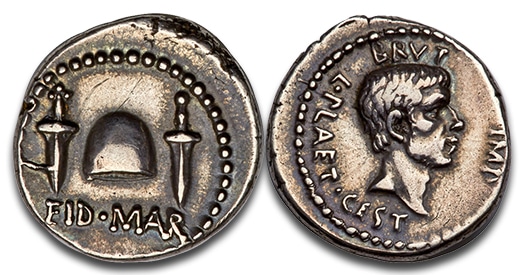
This coin is perhaps the most important ancient coin in the world.
It has appeared in important auctions since as long ago as 1930 and most recently in 2011:
• Ex Freeman & Sear, private sale with old dealer tags; Rubicon Collection (Heritage Auctions, Auction 3015 Long Beach, 7 September 2011), lot 23268;
• Numismatica Ars Classica, Auction 29 (11 May 2005), lot 415;
• Peter Weller Collection (Antiqua, Fixed Price List VIII, Summer 2000);
• Harlan Berk, Buy or Bid Sale 114 (23 May 2000), lot 301;
• Nelson Bunker Hunt Collection Part I (Sotheby’s, 19 June 1990), lot 119, acquired by private treaty from the Sy Weintraub Collection;
• Frank Sternberg, Auction 1 (30 November 1973), lot 10;
• Hall Park McCullough Collection (Stack’s, 22 November 1967), lot 1032; W. H. Woodward Collection (Ars Classica, Auction XV, 2 July 1930), lot 1315.
On May 11, 2005, it fetched $170,000 at auction with Numismatica Ars Classica. Subsequent to that it fetched $475,000 on September 7, 2011, at the Heritage Long Beach Signature Sale.
Right now, it is the top rarity in the CSNS World Coins Signature Auction to be held May 3-5, 2023. It is estimated to attract a winning bid of between $450,000 to $550,000 which, given its extreme rarity and historical significance, seems bound to be regarded as a bargain in the future.
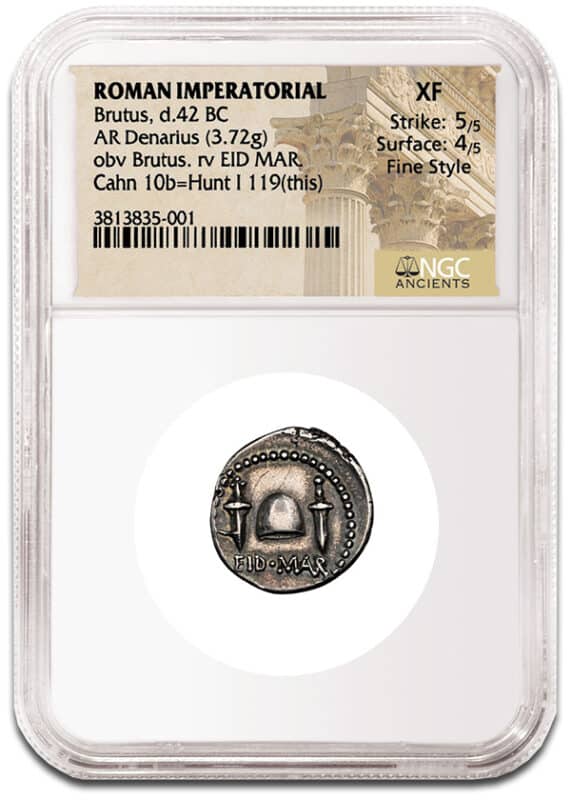
Struck by the warlord Brutus, the EID MAR is at the forefront of 800 ancient coins offered at the upcoming auction.
It has been graded and certified by Numismatic Guaranty Corporation (NGC) Ancients XF, 5/5 Strike, and 4/5 Surface with Fine Style, an amazing level of preservation considering that the coin is well over 2,000 years old.
The coin’s iconic design, depicting Brutus in a liberty cap flanked by daggers, celebrates the murder of Julius Caesar on the Ides of March (March 15), 44 B.C., a deed that shaped the history of the Western world.
As NGC Describes:
“Caesar’s murder brought a tragic end to a political career that had eclipsed all those of his contemporaries, many of whom feared the tyranny that might ensnare Rome if Caesar continued to rule. Though Caesar had countless enemies, his most formidable turned out to be Brutus and Cassius, young senators who led the conspiracy against him. Though both men afterward struck coins of their own, only Brutus portrayed himself and created a design that celebrates the murder.”
“The EID MAR denarius is perhaps the most important coin type of the ancient world,” said NGC Ancients Director David Vagi. “It celebrates one of the great events in Roman history and was familiar enough to have been described more than 250 years later by the ancient historian Dio Cassius.”
Cataloger describes this specimen as “Struck in exceptionally sound metal and beautifully toned. Superb portrait of the famed tyrannicide and among the finest specimens known. The sole certified example to receive a Fine Style designation from NGC.”
NGC goes on to provide an important and detailed historical perspective behind the events that led to the minting of the EID MAR denarius. After reading it, we are sure every investor and collector will appreciate the incredible significance of this museum-quality artifact.
“The EID MAR denarius, undoubtedly the most historically important of all ancient coins, and one of the very few specific coins mentioned by classical authors. In his account of the Roman civil wars of 49-31 BC, the Roman historian Dio Cassius writes: “Brutus stamped upon the coins which were being minted his own likeness and a cap and two daggers, indicating by this and by the inscription that he and Cassius had liberated the fatherland.” The EID MAR type is justifiably famous and was selected in a 2008 vote by top numismatists as Number 1 of the “100 Greatest Ancient Coins.” Numerous books, articles, and TV productions have illustrated this type, including the most widely used handbook of Roman coins, David R. Sear’s “Roman Coins and Their Values Vol. I.”
The event so celebrated, of course, is the assassination of Julius Caesar on the Ides of March (15 March), 44 BC.
The man depicted on the obverse, Marcus Junius Brutus, was one of the ringleaders of the assassination plot, despite being the son of Caesar’s longtime mistress, Servilia. In the centuries since, he has been both hailed as a champion of liberty and vilified as the most treasonous of traitors. Brutus was born in about 85 BC, the product of two of Rome’s most distinguished families: the Junii, represented by his father M. Junius Brutus the Elder, and the Servili, exemplified by his mother Servilia. The themes of Republican liberty and the defeat of tyrants ran strong in Brutus’ bloodlines. One of his distant ancestors, L. Junius Brutus, expelled the last Tarquin king of Rome and went on to become the Republic’s first chief magistrate, or Consul; another ancestor, Servius Ahala, murdered the tyrant Spurius Maelius, who had threatened to overthrow the Republic and install himself as king. His father had resisted the tyranny of the Dictator Sulla and was murdered on the orders of his henchman, Pompey the Great, during the bloody Proscriptions of 78-77 BC.
After entering public life in 58 BC, Brutus became a protégé of the Republican firebrand Cato the Younger and later married his daughter, Porcia. Although viewed by many as a paragon of the Roman virtues, Brutus was anything but kind to non-Romans. As a finance officer (Quaestor) in the provinces, Brutus made his fortune by loaning money at the extortionate interest rate of 48 percent to provincial cities, then using Roman armies to squeeze his debtors dry. When Julius Caesar crossed the Rubicon and plunged the Republic into Civil War on 10 January 49 BC, Brutus was faced with a dilemma: Should he support his friend (and his mother’s paramour) Caesar, or back the Republican cause embodied by his benefactor Cato, but led by his father’s murderer, Pompey? Despite his hatred for Pompey, Brutus chose to side with him and the Republicans, joining them in exile in Greece in mid-49 BC.
After Pompey’s defeat at Pharsalus the following year, Brutus sought and obtained Caesar’s pardon. During the dictatorship, he stood in high favor and won many plum positions in the regime, prompting rumors that Brutus was Caesar’s illegitimate son. As Caesar grew ever more megalomaniacal, Brutus began to have misgivings about the fate of his beloved Republic. |
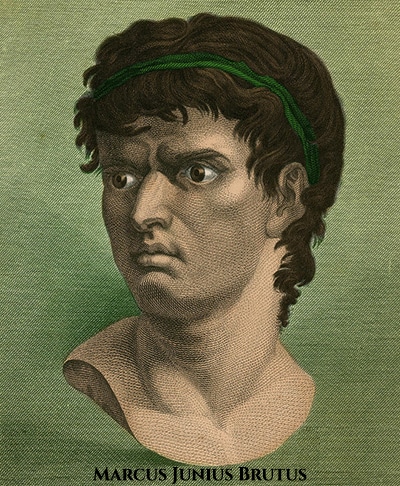
When his friend C. Cassius Longinus asked him to join a conspiracy against the great dictator, Brutus eagerly accepted and became one of its ringleaders. On the Ides of March 44 BC, a cabal of senators led by Brutus and Cassius surrounded Caesar during a monumental session of the Senate, where Caesar was about to announce his plans for the invasion of Parthia.

In a bloody, frenzied scene reenacted countless times since, they stabbed him to death. Caesar’s poignant last words were delivered in Greek as Brutus delivered the fatal thrust.
The conspirators expected to be hailed as liberators, but the Roman populace was horrified by Caesar’s murder and wanted the assassins punished. Brutus left Rome in April barely ahead of a lynch mob. He joined Cassius in assembling a pro-Republican power base in Macedonia, where they could wage war against Caesar’s successors, Marc Antony and Octavian. A successful campaign against the Bessi, a Celtic tribe in Thrace, won him acclamation as Imperator, after which he began to strike coins to pay his growing army.
His early coinage follows traditional themes, but his final type, the EID MAR issue of mid-42 BC, breaks the old Republican taboo by placing his own portrait on the obverse, coupled with the pileus or cap of liberty (traditionally given to slaves who had received their freedom) between the daggers that executed Caesar.
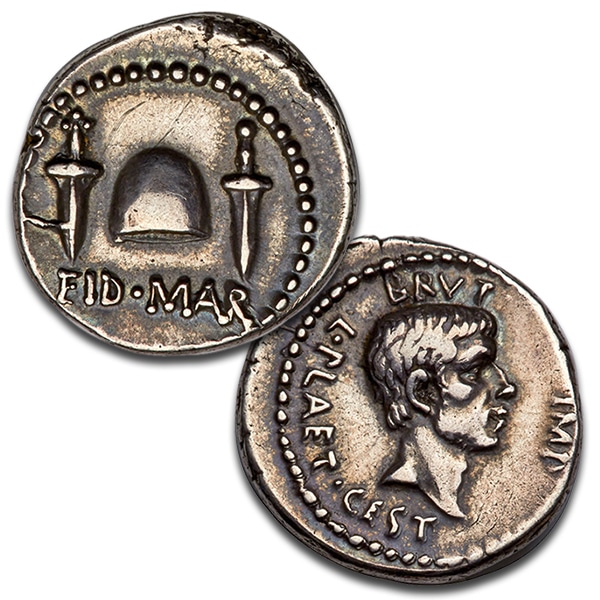
The irony is palpable: One of the acts that got Caesar killed was putting his own portrait on coins, prompting fears that he aimed to make himself King of Rome. Now Brutus was following suit, while celebrating his betrayal of Caesar on the iconic reverse. The choice of types could be seen as a final, brazen act of defiance as the armies of the warring factions closed for an ultimate clash in northern Greece. In a final twist of fate, Brutus used the same dagger he had plunged into Caesar to take his own life following the final defeat of the assassins, at the second battle of Philippi on 23 October 42 BC.
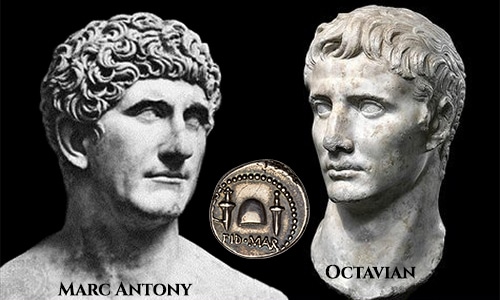
The relative rarity of Eid Mar Denarii today is doubtless because the type was deliberately recalled and melted down by the victors, Marc Antony and Octavian.
-
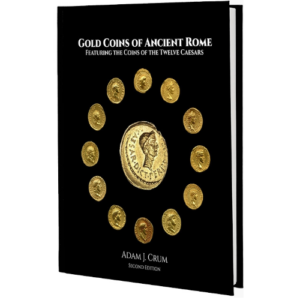
 2026 Book: Gold Coins of Ancient Rome – 2nd Edition$49.00
 -
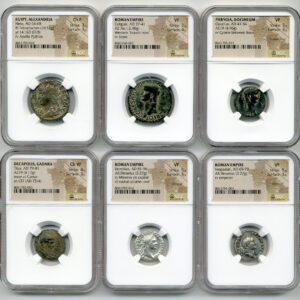
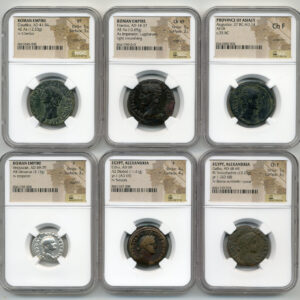
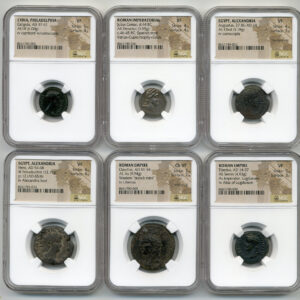
Rome Roman Empire 48 BC – AD 96 DENARI – BRONZE SET NGC Mixed$7,995.00
-
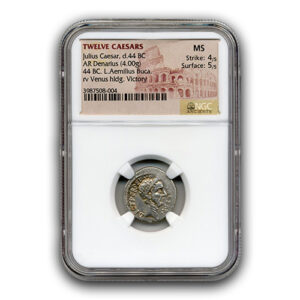
Twelve Caesars 44 BC Julius Caesar Denarius (PORTRAIT) NGC MS 4 5$35,000.00
-
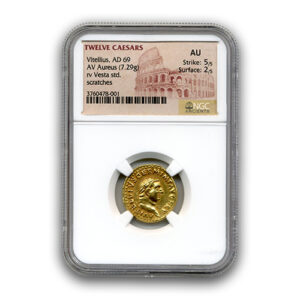
Rome Roman Empire AD 69 VITELLIUS AUREUS NGC AU 5 2$85,000.00
-
Attica Athen c. 440-404 BC Tetradrachm NGC MS 4 4$2,750.00
-
Rome Roman Empire AD 32 – 69 6 COIN – 12-CAESARS LEGACY STARTER SET NGC Mixed$4,030.00
-
Rome Roman Empire AD 14 – 96 6 COIN – 12-CAESARS LEGACY STARTER SET NGC Mixed$4,095.00
-
Rome Roman Empire 27 BC – AD 69 6 COIN – 12-CAESARS LEGACY STARTER SET NGC Mixed$4,256.00
-
Rome Roman Empire 27 BC – AD 69 6 COIN – 12-CAESARS LEGACY STARTER SET NGC Mixed$4,290.00
-
ROMAN Roman Empire 46 BC – AD 96 12 CAESARS LEGACY SET NGC Mixed$8,908.00
-
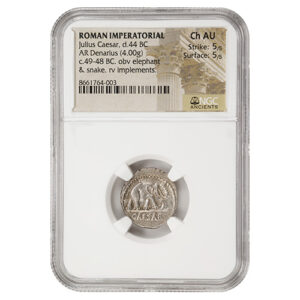
Rome Roman Empire d.44 BC Julius Caesar – AR Denarius NGC Ch AU 5 5$8,645.00
-
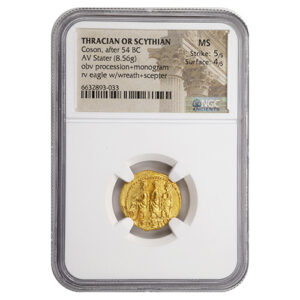
Ancient THRACIAN OR SCYTHIAN Coson, after 54 BC AV Stater – THREE KINGS NGC MS 5 4$3,325.00
-
Ancient THRACIAN OR SCYTHIAN Coson, after 54 BC AV Stater – THREE KINGS NGC MS 5 4$3,325.00
-
Ancient THRACIAN OR SCYTHIAN Coson, after 54 BC AV Stater – THREE KINGS NGC MS 5 4$3,325.00
-
Achaemenid Empire c.5th Century BC NGC AU$4,375.00
-
GREEK Philip I Seleucid 95-75BC Tetradrachm – Comments NGC CH AU 3 3$595.00