Treasure Talk with Bob Evans, News, Rare Coin Articles
Treasure Talk 14 Part 2: The Inhabitants that move
May
Treasure Talk 14 Part 2: The Inhabitants that move
The water is very cold at the SSCA site, just a few degrees above freezing. It stands to reason that animals living in such a place conserve their energy whenever possible. So far, I have discussed organisms that barely move, filter feeders, and the clams that slowly burrow through the wood. But there are other animals that crawl and swim through this neighborhood. There is a complicated Food Web (a network more complicated than a simple Food Chain) that has developed around the SSCA shipwreck, as a host of species have found a way to make a living and raise future generations using this giant wooden resource resting in nutritious waters. Let’s look at a few important highlights among those who “get around” the shipwreck.
Galatheid Crabs: (common name: Squat Lobsters)
When we first saw the paddlewheels and the extraordinary congress of starfish that had gathered there, we noticed another conspicuous inhabitant.
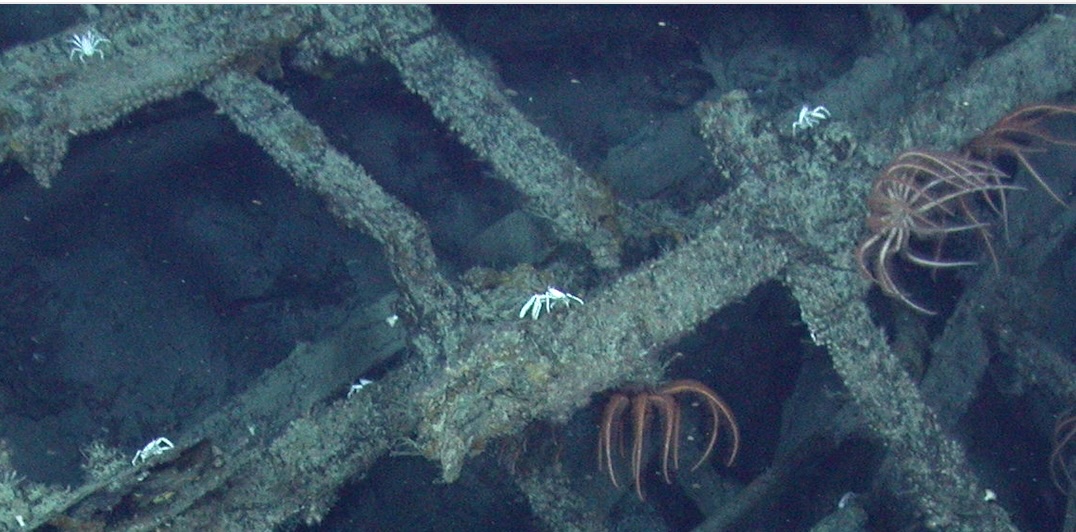
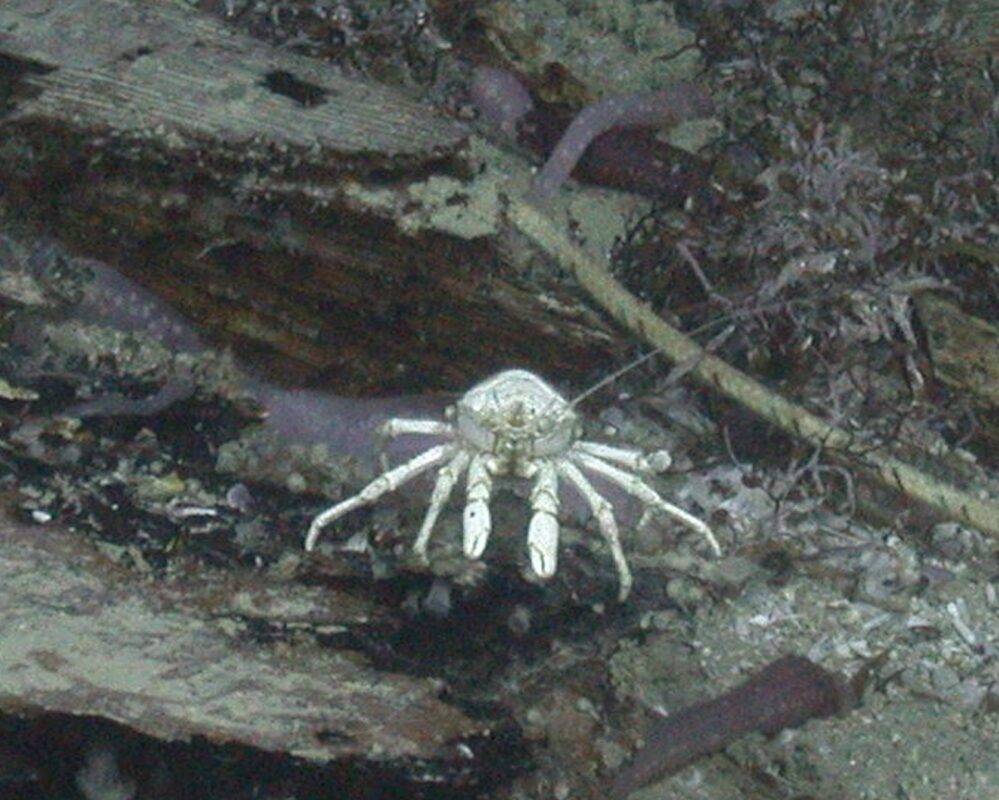
The little crustaceans shining bright white in our lights are galatheid crabs, also known a Squat Lobsters. They are about the size of the crayfish (vernacular “crawdad”) that used to steal my worms while I fished in Big Walnut Creek as a boy. We would encounter them all over the shipwreck, a couple of these white varieties as well as some other pinkish or brownish types. Some of them would show real attitude, a 4-inch crab facing down a 6-ton robot.
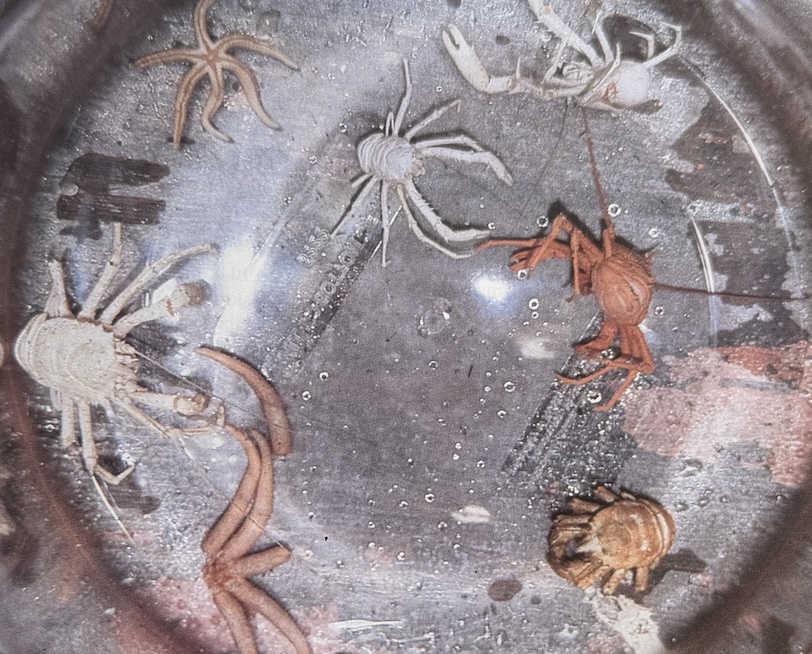
We baited two minnow traps and deployed them in a designated “Science Station 3,” to see what we might catch. One was baited with lobster tail, the other with prime rib. (Project management and Chef Mickey King saw to it that we ate very well on the research vessel.) We set the traps down and picked them up on a subsequent dive, once we had observed that crabs had entered the wire mesh traps.
We had trapped 5 crabs of 3 different species (interesting diversity for a small experiment in a limited area,) as well as a couple of starfish who had crawled in. There were 4 crabs in the trap baited with prime rib and only one with the lobster. This caused me to quip that they obviously do not get beef very often.
Here’s our collection from the traps, gathered in a clear bucket. You can see the diversity.
Octopus:
It seems that every shipwreck of significant size has an octopus, which means there must be at least two, or else they get around. If it’s not resting in a hostile environment, a shipwreck provides plenty of nooks and crannies for dens or emergency escape from predators for these soft-bodied, intelligent animals. Even a collapsed or partially buried shipwreck usually has voids suitable for octopod occupancy.
Our operations ran 24 hours a day for as long as the equipment operated properly, or the two 300-frame cassettes of Ektachrome 400 film ran out. I had to sleep sometime, but I would leave instructions to wake me if anything important was happening.
I had a private cabin, which was nice but not spacious, 7 ½ x 9 feet, with a small chest of drawers, a very small sink, a small “closet” (the size of two school lockers) and a 30-inch x 6-foot wooden box with a mattress inside it, just inside the door. I never had trouble with the bunk size, but taller men did. I slept with my feet just inside the door, and had instructed that this was my practice, and to awaken me someone could just reach inside the door and jostle one of my feet. No noise. Others might be sleeping in nearby cabins on the berth deck.
So, one day or night, it doesn’t matter 7,200 feet down, I felt a hand grab my foot. It may have been Chris Baker, the co-pilot for that shift, but I forget.
“Bob. Mike (Milosh, the pilot) wants you to know that there is an octopus making love to Nemo.” (Our robot.)
I startled awake at this news and quickly gathered myself to go up one deck to the control room. Sure enough, a truly beautiful beast was checking us out. Biologists reviewed the tape afterwards and told us this was a female.
One of the things we noticed while exploring and excavating the shipwreck was that our operations must really smell. While we probed around, looking for concealed treasure under exposed treasure, we were chumming the waters for the local residents. There is no light, although some animals might be bioluminescent. No good reason to rely on sight alone for getting around. I think we generated a perceptible electrical field, and some may have been curious about that. But there is no doubt in my mind that scent and sound (or vibration detection) were of paramount importance to the free-swimming or crawling members of the community.
For more than half an hour she clambered around and swam. She climbed on Nemo’s arms, and examined the area in front of the ROV.
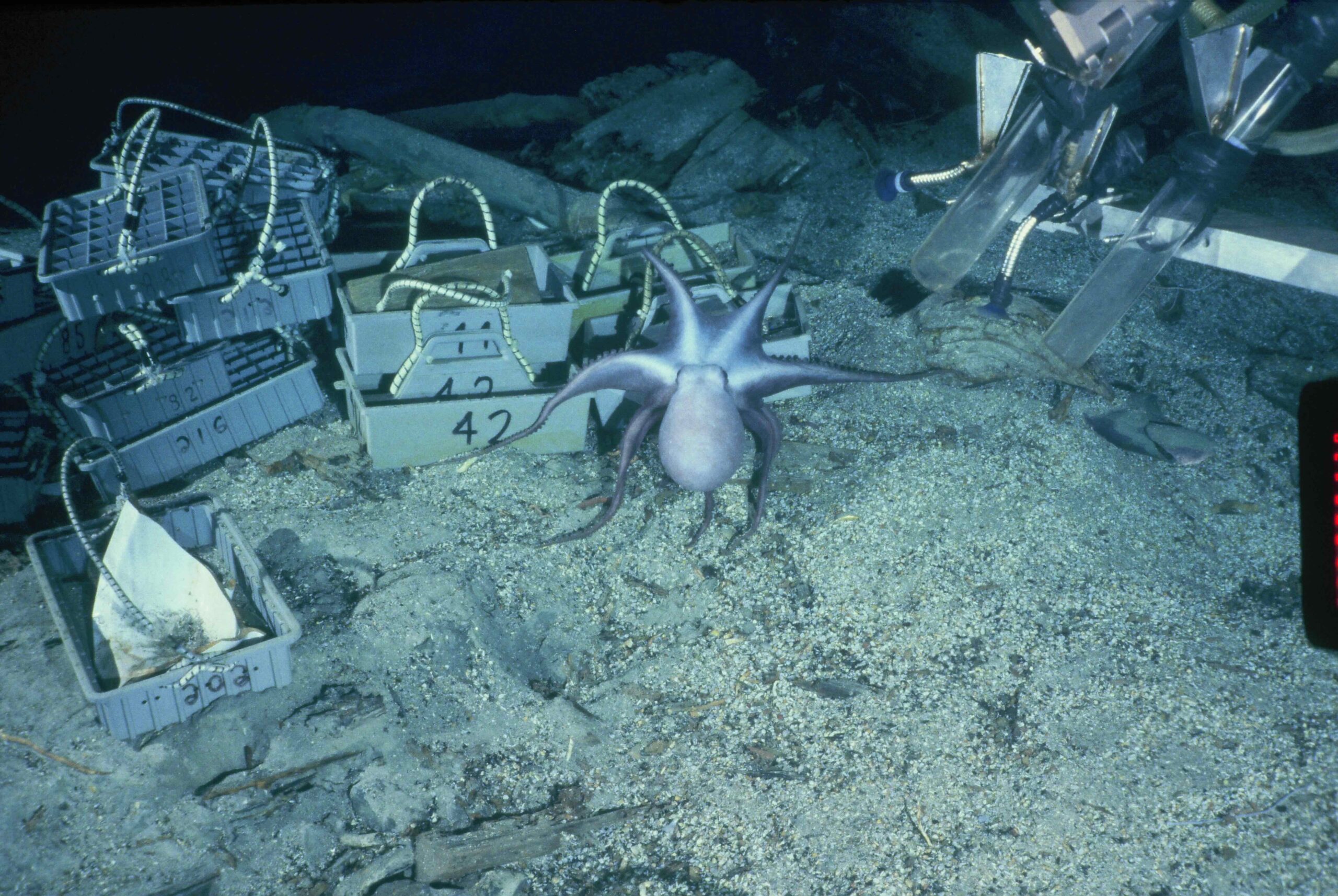
Here is the octopus swimming past an array of our recovery tools, acting like a docent, pointing out features of our operations. On the left you can see the modified plastic tool caddies and storage boxes we would fill with gold bars, coins or other artifacts. A broken washbasin sits in Box #202.
On the right we see Nemo’s tool-rack arrayed with important instruments designed to be grabbed by the manipulator.
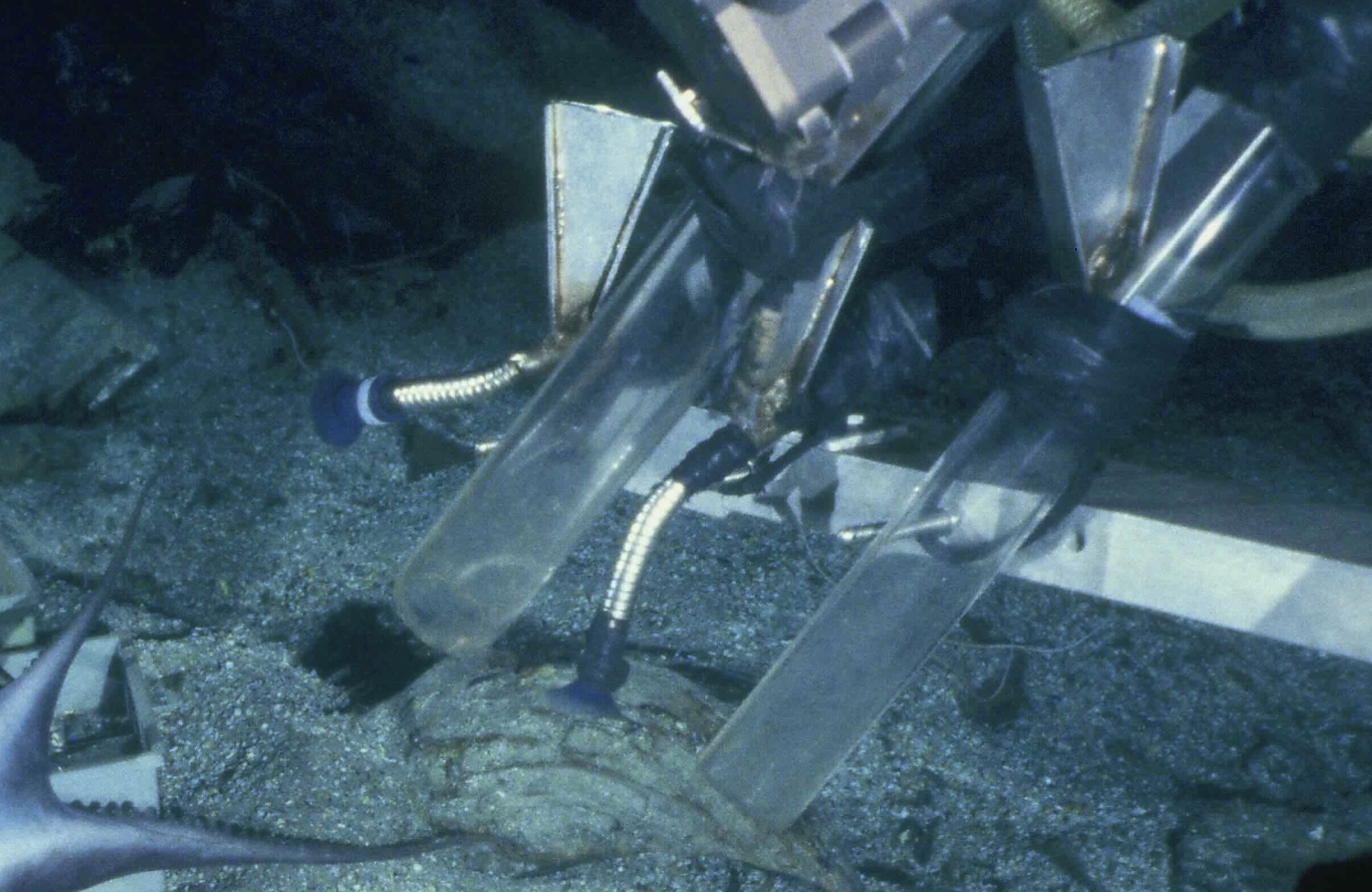
There are two clear plastic dredge nozzles, employed to vacuum up sediment and expose treasure. There are also two stainless flexible lines leading to blue rubber dart-like tips. These have an open line and an orifice in the middle, and can be used to blow away sediment with pinpoint accuracy, or they can serve as “suction pickers” for gently plucking up coins or small ingots.
After examining our equipment, the octopus wandered over to a wooden prominence with a galatheid crab on top, and draped herself over it, her body flexing and changing color. When she left that spot the crab was gone, so we learned what an octopus on the SSCA eats.
Fish:
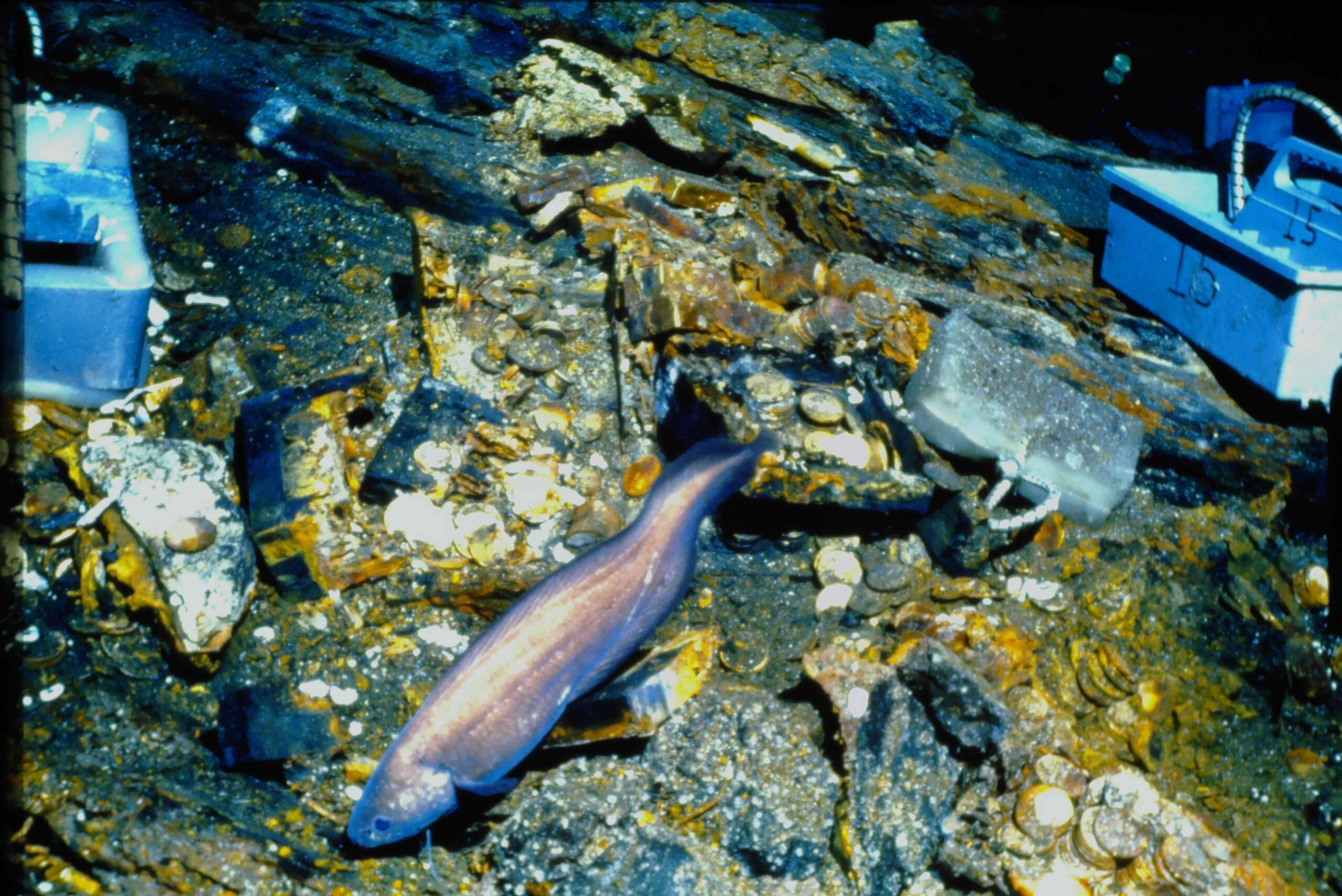
Other swimmers we attracted by our activities, as I indicated, the smell. This is a brotulid fish. They slowly graze around the shipwreck rubble and sediment, sifting through it for small edible invertebrates beyond the scope of this article. Sometimes they would graze through areas we were actively excavating, in strange, slowly undulating movements. It was fascinating to watch this fish feel its way slowly through the treasure, surrounded by hundreds of thousands of dollars in gold, smelling for something yucky to eat. (Well, yucky for us.) It would wolf in a mouthful of assorted bottom detritus, then spit it out moments later, obviously gleaning what it wanted from this activity, since it hung around for an hour or more in the vicinity. I never saw it pick up a coin while grazing, but it might have been able to handle a quarter eagle, only to obviously reject it, an amusing thought. Never happened, though…
As with the crabtraps, we decided to do another bait experiment. While we were in port, Eddie got a hundred pounds of waste fish from the local processor. There were grouper heads and fileting discards, which he tied into a bundle, and talked Chef Mickey into letting him freeze it into a block in the ship’s deep-freezer, one that would then fit into Nemo’s cargo drawer for the trip down for deployment at our Science Station #3.
We loaded the frozen block of fish into the drawer in the afternoon, ready for a dive just after dinnertime. Then then were equipment issues with the ROV, and the team scrambled to fix things late into evening. The fish-block began to thaw, and then to smell. Finally, it was decided to get everything right, and we would launch at dawn; always better to handle that in the daylight.
By morning, fish oil was oozing onto the workdeck deck around Nemo. It occurred to me that this ship had not smelled like that since its days as a Canadian Fisheries Research Vessel, trawling for cod off the Maritimes. Once the vehicle was launched and descending, the deckhands began to hose down and scrub the deck, muttering about whether science was worth it.
When Nemo arrived at the bottom, we landed at the experiment station, took the bundle out the drawer, and stacked it next to some of our wooden posts (see above.) Then we just waited and watched, planning to note and record the times of arrival and other behaviors. We did not have to wait very long.
It took a half hour or so to consolidate and arrange the stack, a rather unwieldy collection of grouper and mackerel parts tied with nylon line. The mass floated irregularly as the pilot tried to corral it into a coherent stack. There were some weights tied to the bundle, to make sure it didn’t float away entirely. We were admiring the result when the first customers showed up, only a couple minutes later. Three blunt-nosed eels were the first to inspect the bait. There were a multitude of eel relatives and eel-like fishes that snaked through these deep waters, and we had just dropped a big piece of chum.
After four hours and 16 minutes, a Grenadier arrived, a familiar form of fish we had seen before. Additional species arrived, a cutthroat eel after around 6 hours, followed by a deep cod 20 minutes later. Additional blunt nosed eels began to arrive, feeding by chomping down on the bait and twisting around to tear off pieces.
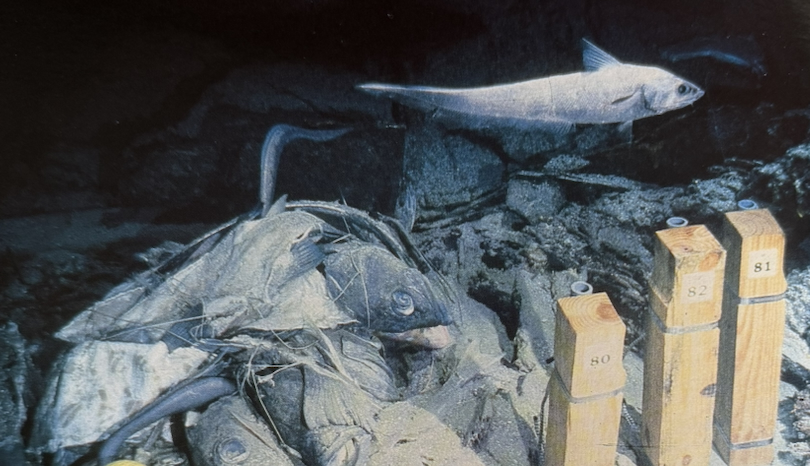
A Grenadier fish swims over the bait pile, while blunt-nosed eels begin feeding.
We discovered the shipwreck’s ultimate climax predator 7 hours and 5 minutes into the bait deployment. We had Nemo sitting by the experiment for a few hours watching this important science unfold, but it was time to shift back to treasure recovery and broader survey. The treasure was nearby, and we planned monitor further activity at the bait with one of the cameras. Mike Milosh the pilot lifted Nemo up off the bottom, and I lifted myself from my seat, to stretch and visit the head.
I had just exited the control room when I heard shouting back inside. “HOLY SHIT! Get the guys! Get Bob!”
In the passageway outside, I weighed my options. I really needed to go. But something important was obviously happening. Something exciting. I stumbled back into the darkened control room to see a huge shadowy form cruising under our down-looking black & white video camera mounted under the vehicle.
“Oh, that’s just Spike.” I said, using the nickname we had for the deep cod with the long dorsal spine.
“No, it isn’t! No, it isn’t!” Mike blurted. “This thing is HUGE.”
My perspective shifted to accept the reality. I watch an enormous fish pass through the scene again, and I joined in, “Well, Holy Shit!”
It was a Greenland Shark, (Somniosus microcephalus) and it was 6 meters long, somewhere between 19 and 20 feet. Nemo had left a footprint by the experiment station, and this gave us a yardstick to measure this remarkable giant.
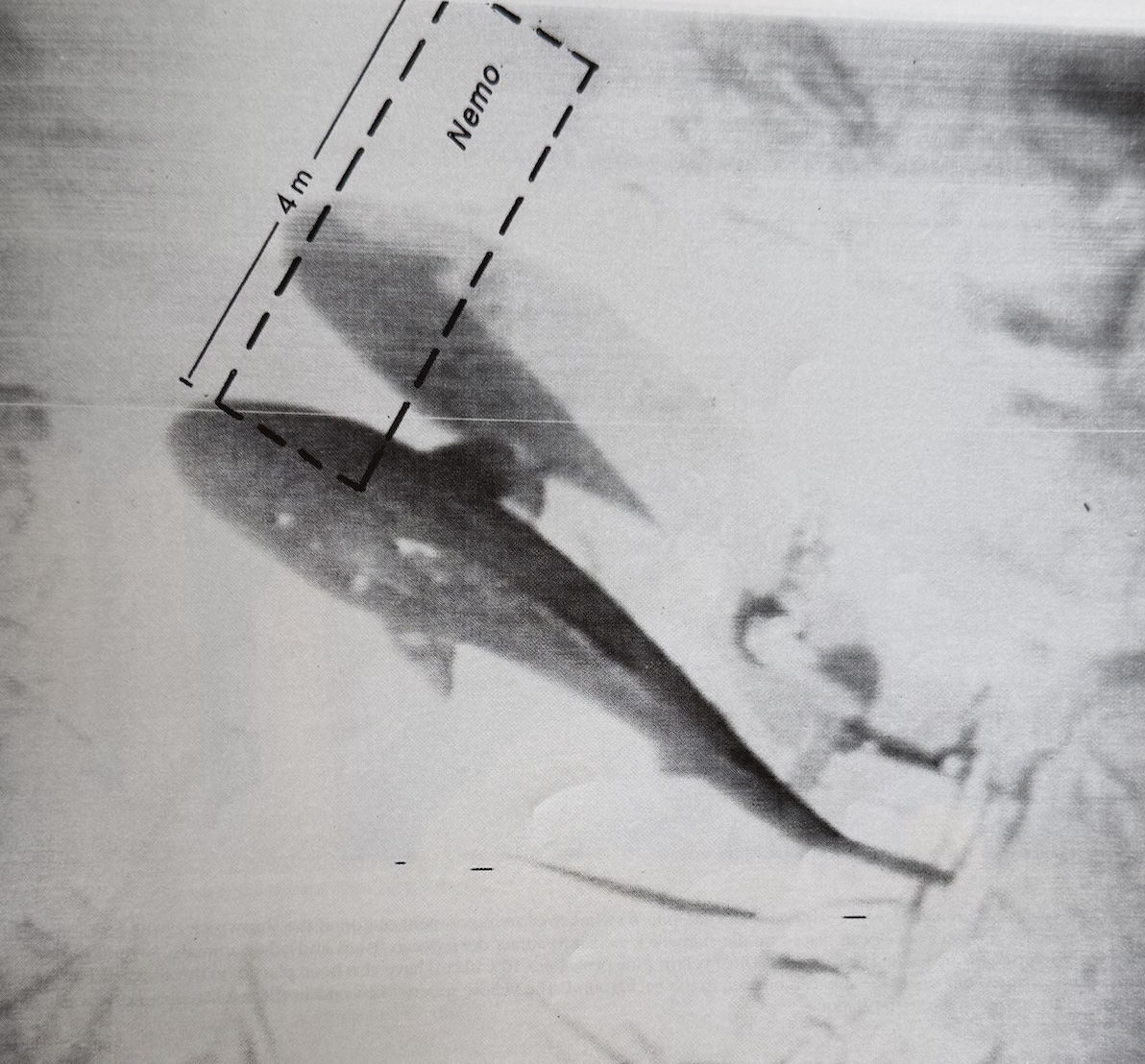
A Greenland Shark swims over the experiment station and Nemo’s footprint.
At the time this happened, our footage comprised the deepest images ever taken of a living shark. Observing “the habits of the deep-sea dwellers, and see(ing) them in their natural attitudes, fulfilling the hopes Alexander Agassiz’s expressed in 1888.
Sharks had been caught on lines set deeper, and cameras have since captured footage of sharks swimming at greater depth. But this was a surprise, and it taught the world of science something more about a truly unusual animal.
Greenland Sharks are not necessarily a deep-water fish. They swim near the surface near the island that has given them their name, and where they are a part of the native fishery. They are remarkably long-lived, reported living for hundreds of years. And, as our experience proved, they are a cold-water climax predator. They are well-known in the cold nutritious water of the northern latitudes, but they also live in the hidden depths much farther south, cruising the lightless depths of the Western Boundary Undercurrent, looking for food and opportunity. In this case it was a bunch of fish heads dropped by humans on a shipwreck, just to find out what kind of inhabitants were around.
We found a well-developed, diverse and populous community of organisms inhabiting the Ship of Gold, a small number of which I have told you about here.
More next time…